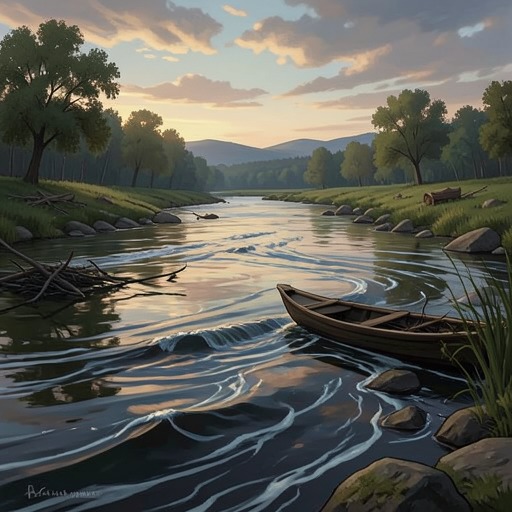
Water never waits
Memoirs of a Geisha“Water never waits” names a principle of adaptation that Mameha uses to read Chiyo’s character and that the narrative later enlarges into a view of human agency. Water does not defeat every obstacle by force or choose its destination freely; it changes shape, finds a passage, and follows the terrain. The image links Chiyo’s instinct to escape with a more difficult lesson about circumstance, timing, and the currents that shape a life.
Mameha’s Reading of Chiyo
Mameha introduces the image when she challenges Chiyo’s patience. Chiyo has spent more than two years waiting for an opportunity after her mistakes left her in the life of a maid. Mameha says that waiting does not suit her: she sees in Chiyo a great deal of water, an element that cannot remain still while a route remains possible. Her description makes adaptability more than a temperament. Water can wash away earth, put out fire, wear down metal, and sustain even its natural complement, wood. Its strength lies in changing its relation to whatever blocks or depends on it.
The metaphor is also a form of diagnosis. Mameha does not tell Chiyo simply to try harder; she says Chiyo has failed to draw on qualities she already possesses. The five-element language turns an apparent weakness—being unable to wait passively—into a capacity for invention. Water is versatile precisely because it is not fixed in one shape or method, and Mameha’s counsel asks Chiyo to recognize that capacity in her own life.
The Roof, the Dam, and the Reversal
Chiyo answers that the thought of flowing water had, in fact, given her the idea of escaping over a roof. The reply makes the metaphor concrete: she has tried to turn the image into a physical route out. Mameha judges the attempt a poor use of the insight, however. Those with water in their personalities cannot simply pick where they will flow; they must move where the landscape of their lives carries them. Resourcefulness is real, but it does not amount to unrestricted control over the destination.
Chiyo then names the obstacle in her own terms: she is a river that has reached a dam, and the dam is Hatsumomo. Mameha accepts the comparison, but alters its implication. A dam appears to make movement impossible; a river, given time, may wash it away. Her answer preserves the force of Chiyo’s sense of obstruction while refusing to treat it as final. The exchange shifts the image from escape as a sudden leap to change as an ongoing pressure capable of wearing down resistance.
From Personal Adaptation to the Larger Current
The water image reaches beyond Chiyo’s immediate conflict when the narrative reflects on how events redirect a life. People proceed in one direction until they meet something that forces them to find a new course; Mr. Tanaka’s intervention sends Chiyo into the world and changes her horizons. The image therefore holds two ideas together: a person can respond creatively to a changed landscape, yet may not choose the force or circumstance that first changes it.
A later reflection makes that limit explicit. Chiyo begins to understand that she had been unaware of how closely things are connected, and that human beings belong to something larger than themselves. A person’s small action can alter the path of another creature—a foot may crush a beetle, or a change in the air may send a fly somewhere it would not otherwise have gone. Reversing the comparison, the individual becomes the insect, subject to forces whose scale and direction cannot be controlled.
The resulting counsel is neither surrender nor a promise of mastery. People must use whatever methods they can to understand the movement of the universe around them, then time their actions so they are not fighting the currents but moving with them. The expression thus joins Mameha’s close reading of Chiyo to a broader account of agency: adaptability matters, but it works through attention to circumstances, connections, and timing. Water never waits, yet the route it takes is shaped by the terrain.