Ayooba Baloch
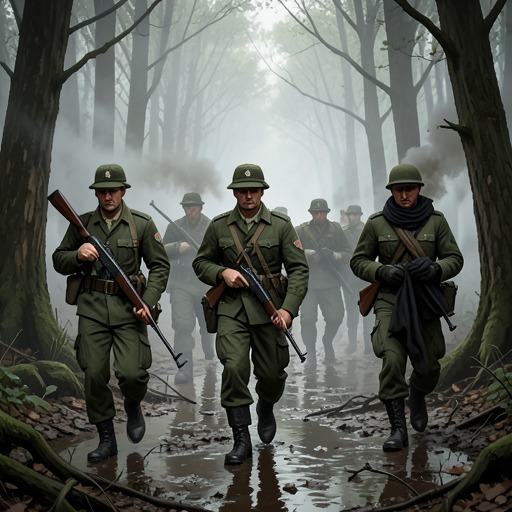
Midnight's ChildrenAyooba Baloch is a young Pakistani soldier whose swaggering faith in military conquest is gradually overtaken by the bewildering realities of war. Assigned to the covert Canine Unit for Tracking and Intelligence Activities (CUTIA), he initially treats its work as an opportunity to fight India; during the unit’s mission in East Pakistan, however, he is lost for months in the Sundarbans with Farooq Rashid, Shaheed Dar, and Saleem, the tracker called the buddha. Ayooba’s final act is to comfort Saleem in an abandoned village, where a sniper’s bullet kills him instead of the man he has just tried to console.
Identity and Assignment
Ayooba enters the story among CUTIA’s newest recruits, alongside Farooq Rashid and Shaheed Dar. Brigadier Iskandar orders the three to shape up and announces their new unit; the brigadier’s batman, Lala Moin, identifies the tracker they must accompany as the man-dog. The camp itself is concealed in the hills, with a camouflaged perimeter and an unmarked gate, reflecting the secrecy surrounding the force.
In the barracks, Ayooba interprets tracking and intelligence as glamorous espionage and imagines fighting Indian troops. His talk turns quickly to conquest: he reasons that promises of land to peasants imply a need to seize more territory. The bravado establishes how firmly he begins within the soldiers’ martial assumptions. Farooq, by contrast, wonders whether war will come and worries about Sikh troops; Ayooba answers uncertainty with confidence and boasts of what the coming conflict will bring.
Jealousy and the Electric Prank
Ayooba’s anger later narrows from politics to a personal grievance. He becomes infatuated with a young latrine cleaner, follows her, and discovers that she visits the buddha. Her preference for the tracker, and her account of his attention to her, provoke Ayooba’s jealousy. He insults her and turns that resentment into a practical joke aimed at the buddha.
Ayooba connects the latrine’s metal footplates to a jeep battery with jump-leads, expecting the current to shock the tracker. On February 10, Farooq and Shaheed wait nearby as the buddha enters the latrine. When no cry comes, Ayooba reveals that he has switched on the current several minutes earlier. Shaheed rushes in and finds the tracker apparently unaffected, with a blue crackle around his nose. The buddha leaves calmly, carrying his silver spittoon; the soldiers understand that the electric shock has not made him react. For a week afterward, he gives off shocks when touched, and the latrine cleaner can no longer visit him there.
The prank reverses Ayooba’s attitude. He stops resenting the buddha and begins treating him with respect. The bizarre failure of his attempt to humiliate the tracker binds the dog unit together: what began as an assignment endured by three recruits becomes a team prepared to go into action. Ayooba’s change is not a conversion to a new political outlook; the episode instead disrupts his contempt for the man whose apparent numbness had made him a target.
From Secret Mission to the Sundarbans
On March 15, 1971, CUTIA assembles as Yahya Khan offers Sheikh Mujib-ur-Rahman immediate talks with himself and Zulfikar Ali Bhutto. After negotiations break down, and Mujib proclaims Bangladesh on March 25, military units leave their barracks. At midnight, Ayooba, Farooq, Shaheed, and the buddha accompany Brigadier Iskandar on the operation to find Mujib. The tracker identifies Mujib by scent from an old shirt, and Saleem later tells Padma that he was the one who tracked Mujib down.
The quartet’s subsequent pursuit carries them into the Sundarbans, where the forest defeats their confidence in the tracker. Rowing through labyrinthine waterways, they repeatedly rely on the buddha’s directions before Farooq realizes that he may not know the way. Once they believe the jungle has swallowed them, Ayooba breaks down and weeps. Farooq lashes out at the tracker, while Shaheed restrains him to keep the boat safe. The scene reverses Ayooba’s earlier role as the boastful, physically imposing recruit: in the forest he is frightened and helpless, and his distress contributes to the group’s loss of control.
The soldiers abandon the purpose of their mission and try to survive. Under Shaheed’s direction, they make a shelter from oilskins and palm fronds and live on fruit. They endure illness and learn practical skills, including how to catch food and defend themselves. The jungle also becomes a setting for apparitions and punishment. After Ayooba sees a ghostly peasant, his right arm becomes immovable; the others encounter their own frightening visions, and even the buddha wakes with a sense of the forest closing in. Ayooba’s disability and the group’s shared fear help turn their disappearance into a prolonged ordeal rather than a straightforward military adventure.
Return, Compassion, and Death
After seven months missing from the war, the three soldiers and their tracker emerge from the Sundarbans in October, as the Mukti Bahini attacks Pakistani military outposts. They are deafened by the forest’s poisonous mud and disoriented in an abandoned village. Their uniforms are in tatters, their hair has grown long, and Ayooba still has trouble moving his arm. Farooq blames the buddha for leading them astray, while Ayooba voices a quieter recognition that the conflict has become something far worse and stranger than the fight against the Indian troops he had imagined.
In the village, Saleem’s memories remain inaccessible: amid the men’s fear, he cannot summon his name and can produce only remembered nicknames. He cries that his situation is unfair. Ayooba leaves his corner, sits in front of him, and puts his one good arm around his neck. The gesture recalls his own collapse in the Sundarbans, but now he is the one offering comfort. A sniper’s bullet strikes Ayooba in the neck as he sits beside Saleem. The narrator states that, without Ayooba’s presence, the bullet would have passed through Saleem’s head.
The surviving men remain in the hut for a night and a day, until Ayooba’s body requires them to act. Before leaving, they find pickaxes and bury him. When the Indian Army later arrives, Ayooba is not there to resume the bravado of his first days in CUTIA. His arc ends instead in a concrete act of protection: the soldier who once imagined conquest dies shielding the companion he had learned to respect.