Bangladesh Liberation War (1971)
Midnight's ChildrenThe Bangladesh Liberation War (1971) enters the narrative as both a political crisis and a journey imposed on Saleem and the soldiers around him. The account links the breakdown of negotiations, the West Wing’s military action in Dacca, the displacement of millions, and the soldiers’ movement south through river country; Saleem’s recollections also make the war a test of what can be seen, believed, and later told.
Political Rupture and Military Deployment
In a rapid, film-like transition from the political upheavals of Pakistan to the approaching war, the narrator’s calendar comes to rest in late 1970, before the election that would divide the country. The scene places the crisis between opposing political forces: the West Wing and East Wing, the Pakistan People’s Party and the Awami League, Zulfikar Ali Bhutto and Sheikh Mujib-ur-Rahman. Rather than linger on the public stage, the narration shifts to three young soldiers arriving at a mysterious camp in the Murree Hills.
On March 15, twenty members of the Canine Unit for Tracking and Intelligence Activities, including Shaheed Dar, Farooq Rashid, and Ayooba Baloch, were flown to Dacca by way of Ceylon. They traveled alongside sixty thousand West Wing troops, also in civilian clothes. The account identifies Tikka Khan as the General Officer Commanding and Tiger Niazi as the officer assigned to Dacca and its eventual surrender. The conspicuous contrast between their clothing and military roles establishes the distance between an apparently ordinary journey and the operation it conceals.
The March 25 Crackdown
On March 25, Yahya Khan and Zulfikar Ali Bhutto broke off their talks with Sheikh Mujib-ur-Rahman and returned to the West Wing. That night, Brigadier Iskandar entered the CUTIA barracks with Sergeant-Major Najmuddin and Lala Moin, who carried uniforms and dog-collars. The young men, until then passengers under orders about their dress, were told to put on uniforms and take up arms. Brigadier Iskandar disclosed that their mission concerned Sheikh Mujib-ur-Rahman and that they were to make him jump.
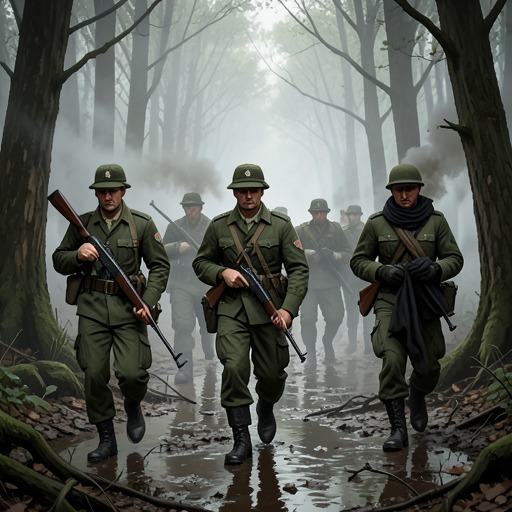
At midnight, troops moved past the university, which was being shelled, toward Sheikh Mujib-ur-Rahman’s residence. Students and lecturers emerged from their hostels and were met by gunfire. Sheikh Mujib-ur-Rahman was not killed: Ayooba Baloch took him in handcuffs to a waiting van. The operation thus joined a military assault on Dacca with the arrest of the political leader whose negotiations had just collapsed.
During the drive through the city, Shaheed saw soldiers enter women’s hostels and take women into the street; he also saw newspaper offices burning and trade-union offices destroyed. The narrative presents these sights through his perception, not as a detached report. Later, Saleem recalls that he and Shaheed saw educated civilians being killed and the city’s intellectual community targeted. Saleem repeatedly frames what they saw as impossible or untrue, invoking the belief that their own soldiers could not have behaved in that way. This denial sits uneasily beside the scenes he recounts and beside the official picture of the military leadership.
Displacement and the Southward Pursuit
The account measures the war’s human consequence in ten million refugees crossing from East Pakistan—Bangladesh into India during 1971. Saleem remarks on the failure of such a number to become intelligible merely through comparisons with other migrations. Across the border, Indian soldiers trained the guerrillas known as the Mukti Bahini; in Dacca, Tiger Niazi held command. These brief statements widen the narrative beyond the soldiers’ immediate mission, showing the conflict as a mass displacement and an expanding military struggle.
The CUTIA unit’s own route turns away from the city and toward the sea. Following an unseen trail, its members are drawn south toward the mouths of the Ganges. They commandeer a boat because their leader has indicated that the trail follows the river. Hungry and exhausted, they row through abandoned rice fields, with the war receding from their immediate awareness even as the pursuit continues. The river is called the Padma, but the narration treats that name as a local designation for the larger sacred waterway associated with the Ganges. Its movement toward the sea makes the soldiers’ journey at once a military pursuit and a passage through a landscape shaped by mythic associations.
Memory, Official Accounts, and Historical Time
The war is narrated retrospectively by Saleem, whose account moves between political events, military orders, and personal recollection. His description of the March 25 events depends in part on what Shaheed saw, while later reflections return to the city and qualify those memories as impossible. The result is not a simple correction of one version by another: Saleem sets remembered experience against the story authorities and military figures would have the public accept, and lets the conflict between them remain visible.
That uncertainty is sharpened by the narrator’s description of what counts as truth in Pakistan: what he recalls may be as likely as anything, except what people were officially told. The distinction makes the war an episode in a wider struggle over public memory, not only a sequence of battlefield actions. The narrative does not resolve every contradiction; instead, it shows how denial and official claims accompany Saleem’s account of what he and Shaheed witnessed.
The war also becomes one of the journeys that organize Saleem’s life. Earlier journeys by train and later travel between Bombay and Karachi establish a recurring pattern in which transit brings changes of identity, belonging, and historical circumstance. In the war narrative, movement by plane to Dacca and boat down the river places the soldiers inside a national crisis, while Saleem’s later return westward follows his loss of connection to history. From Benares station he boards a departing mail train with only a platform ticket, and again finds himself outside a compartment asking to be let in. The repeated image of the train door turns the end of this passage into a return to an earlier motif of exclusion, now colored by the exhaustion of war and exile.