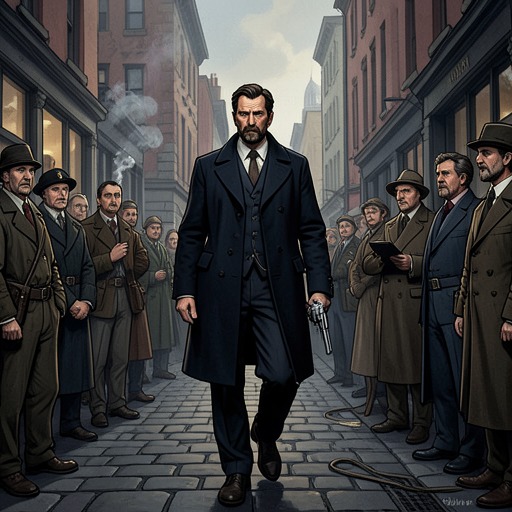
Commander Sabarmati’s revolver
Midnight's ChildrenCommander Sabarmati’s revolver is both the instrument of the Colaba shootings and the object through which a private betrayal becomes a public spectacle. Signed out from a naval arsenal after the Commander receives a detective’s report, it is carried to the apartment where he confronts his wife and her lover. After the shootings, he surrenders the weapon in words but not at once in practice: a frightened traffic policeman flees, and the Commander uses the revolver as a baton to direct traffic until police seize him. At trial, the weapon also becomes evidence around which competing accounts of intention and premeditation are built.
From arsenal to apartment
The revolver enters the sequence on a Sunday morning, while six children watch a film at the Metro Cub Club. Their presence supplies Saleem with an alibi: he says he is nowhere near the crime scene and describes himself as acting at a distance. Meanwhile, Commander Sabarmati visits the naval arsenal and signs out a long-nosed revolver and ammunition. He carries a detective’s written address in one hand and the unholstered weapon in the other, then takes a taxi to Colaba Causeway and walks to the specified apartment.
At the apartment, the gun changes the encounter from discovery to irreversible violence. Commander Sabarmati shoots his wife, Lila, and Homi Catrack, whom he finds there. The revolver is not silenced. The account marks the contrast between its gunfire and the enormous silence that follows, making the weapon’s noise the hinge between a concealed affair and the aftermath of the killings.
The weapon in public
Commander Sabarmati leaves the apartment with the smoking revolver still in his hand. On Colaba Causeway, he approaches a traffic policeman and says that he has just killed his wife and her lover and is surrendering. Yet the policeman, frightened by the gun being waved near him, drops his traffic baton and runs. The expected handover does not happen: left on the traffic podium amid the resulting confusion, the Commander begins directing cars with the revolver instead.
For ten minutes, the weapon performs the ordinary work of a traffic baton, though its function is inseparable from the killings that preceded it. Twelve policemen arrive, seize the Commander, and remove the unusual substitute with which he has been directing traffic. The revolver thus passes through sharply different roles in a single episode: naval property, murder weapon, would-be instrument of surrender, and improvised public authority.
Evidence, explanation, and responsibility
At trial, the prosecution presents the weapon’s sign-out from the arsenal as part of its case for premeditated murder. The gun is considered alongside motive, opportunity, the Commander’s confession, the detective’s report, and the children’s trip to the cinema. In this account, its acquisition helps connect prior preparation to the shootings, rather than leaving the weapon as a detail of the crime scene alone.
The defense offers a different explanation for why Commander Sabarmati took the revolver. Ismail Ibrahim argues that the Commander signed it out intending to kill himself if the detective’s report proved true; according to this account, he went to the Colaba address in despair, not with a prior plan to kill the couple. The defense distinguishes the alleged purpose for obtaining the gun from what happened after the Commander found his wife with Catrack, using that distinction to contest the charge of first-degree murder. The jury finds him not guilty.
An instrument in Saleem’s account
Saleem presents himself as the distant cause of the affair’s public consequences. He says that he sent the anonymous note that prompted the Commander to hire the detective, and he recalls a campaign of secret messages and other provocations before the events. He describes his aim as a scandal, a warning, or a lesson, but insists that he did not intend the killings. The revolver is not in Saleem’s hands; its significance lies in the gap between his indirect intervention and the Commander’s use of it.
That gap complicates the question of agency. Saleem calls himself the puppet-master and the Commander a puppet, yet acknowledges that the outcome exceeded what he meant to cause. The revolver makes that excess concrete: an object obtained through naval procedure carries the Commander from suspicion to violence, then from violence into an awkward performance of public order. Its changing uses give the episode a material thread through which the story joins private betrayal, criminal responsibility, public reaction, and the narrator’s belated recognition of his own part in events.