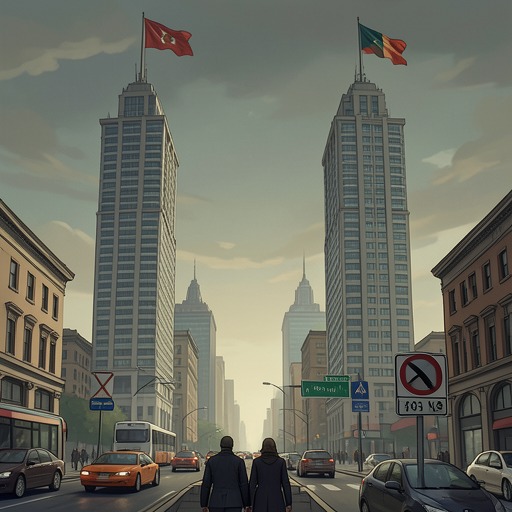
Karachi
Midnight's ChildrenKarachi is the principal setting of Saleem Sinai’s exile in Pakistan, a city he never accepts as a replacement for Bombay. It is at once a place of family resettlement and political upheaval, and a landscape Saleem reads through smell, memory, and suspicion: his new sensory gift helps him recognize concealed feeling, but offers no command over what follows. The city’s story is shaped by arrivals and departures, by the household’s effort to take root, and by the narrator’s uncertain attempts to distinguish what he knows from what he imagines.
Arrival and estrangement
Saleem’s family reaches Karachi after leaving Bombay. The move belongs to a larger pattern of journeys in the novel: trains and boats carry people across changing borders, while their passengers discover that physical arrival does not necessarily make a place feel like home. Saleem’s first passage to Pakistan is aboard the SS Sabarmati, whose name recalls Commander Sabarmati. Its sister ship, the Sarasvati, passes before Karachi harbor. The paired names turn the crossing into another recurrence in Saleem’s life, a reminder that even exile seems caught in repeating patterns.
The family travels onward to Rawalpindi, but Karachi remains central to Saleem’s account of life in Pakistan. He admits that he never forgives it for not being Bombay. In his description, the city lies between desert and saline creeks, and its population has quadrupled since 1947. This rapid growth makes it seem to him misshapen and unfamiliar. The contrast with Bombay is not merely a judgment about urban appearance: Karachi is also the place where Saleem must live without the Midnight Children whose existence had given him a special connection to the world around him.
The household on Clayton Road
At the center of Saleem’s Karachi is Alia Aziz’s large old house on Clayton Road. Its yellowed paint and shadows form the setting for his family’s renewed dependence on the aunt whose hospitality has brought them in. Saleem sees the house as a place of waiting: Alia’s resentment, he believes, inhabits it as persistently as a ghost. The minaret of a nearby mosque casts a long shadow across the building each afternoon. That recurring image later shapes Saleem’s response to other mosque shadows, including the one beneath which he lives in the magicians’ ghetto. For him, the shade in Karachi carries the memory of Alia’s accusation and the vengeance he believes she is preparing.
Alia’s welcome at the docks appears affectionate to Saleem’s parents and sister. He, however, claims that his newly acquired sense of smell detects revenge beneath her embrace and offers of hospitality. He connects that resentment to his father’s earlier choice of Alia’s sister, and to the bitterness he believes had already surrounded him in infancy. The family is driven from the harbor to Alia’s home before Saleem can challenge her or alter the situation. His perception grants him an intimate interpretation of the welcome, but no authority over the household into which they have been received.
The family’s effort to settle in Karachi includes a striking reversal in the parents’ fortunes as Saleem understands them. He recalls that Amina’s guilt had lifted and that Ahmed’s condition had improved; their renewed affection made them seem newly alive to him. Ahmed buys a towel factory and names its product Amina Brand, confidently imagining that it will outshine the established wealthy families. The factory and its towels give the family a material project in their new home, while the brand name turns Ahmed’s business ambition into a declaration of love. Saleem, however, detects the lingering influence of what he calls the optimism virus in his father’s grand promise.
Karachi also becomes the setting for Saleem’s sister Jamila’s rise as a singer. After the family arrives, she acquires public acclaim under names including Pakistan’s Angel and Bulbul-of-the-Faith. Her patriotic performances offer a public identity that differs from Saleem’s alienated view of the country. He describes their gifts as complementary: she can sing what his nose can distinguish, yet the two siblings are moving apart as her performances turn toward patriotism and his attention remains fixed on resentment and closed-mindedness.
A city read through the senses
After losing his telepathic connection, Saleem discovers that his sense of smell is extraordinarily acute. In Karachi he uses it to distinguish emotional and moral atmospheres, especially love and hatred. He can detect what he takes to be Alia’s concealed vengeance beneath polite words, and he follows the city’s trails of dispossession and fanaticism. But the gift does not make him an agent capable of changing events. Saleem himself draws the distinction: the nose supplies knowledge, not power over what is happening.
On his sixteenth birthday, Saleem receives a Lambretta scooter and rides through the city. He says that he smells both the fatalistic hopelessness of slum dwellers and the defensiveness of the rich. The scooter extends his passage through Karachi beyond the family home, carrying him along trails that lead toward Tai Bibi. The episode connects mobility with perception: Saleem can move through social spaces and register their tensions, but the city remains too large and divided for his sensory knowledge to become mastery.
In Saleem’s telling, Karachi is also a city of mirages. The desert has not lost its power simply because streets and buildings occupy its ground; Saleem imagines oases appearing on Elphinstone Street and caravanserais shimmering among hovels near Kala Pul. He associates these illusions with Karachiites’ uncertain grasp of reality and their willingness to look to leaders for guidance about what is real. This landscape of apparitions gives physical form to a wider political unease: the city’s unstable appearances echo Saleem’s account of a country in which public claims and lived realities do not reliably coincide.
Bread, belonging, and departure
The Santa Ignacia nunnery gives Karachi a more intimate place in Saleem’s memories. Jamila loves leavened bread, and Saleem brings her fresh loaves from the nuns’ hatch each Thursday, riding his Lambretta and joining the long queues. His repeated errand joins the siblings through an ordinary act of care. It also links Jamila’s earlier association with Christianity to her later public identity as a celebrated patriotic singer, even as Saleem keeps that tension to himself.
The siblings’ connection becomes more painful when Saleem recognizes, retrospectively, that he was already in love with Jamila. The weekly bread deliveries are among the concrete signs through which he reconstructs that feeling: he attends to her preference and brings her the loaves without criticism. His account presents the memory as a discovery made after the fact, not as a conscious declaration at the time. Karachi is thus both the setting of his adolescent attachment and a city in which that attachment remains private and unspoken.
Later, during the turmoil of war in Bangladesh, Saleem hears that Jamila has disappeared after speaking publicly against Pakistan’s new rulers. He fears that she has fallen into state custody, but then narrates a dream in which she escapes the capital by air, arrives in Karachi, and seeks sanctuary at Santa Ignacia. In the dream she enters the nunnery through the hatch where she once received bread, exchanging one form of invisibility for another. Saleem insists that she is safe there, alive and singing with the nuns, while acknowledging that what he has heard from his uncle consists only of bare facts. The episode makes Karachi a refuge in Saleem’s imagined account, but it leaves Jamila’s fate unconfirmed by independent knowledge.
War and the limits of knowing
During the air raids of September 22, 1965, Karachi is among the Pakistani cities targeted by Indian aircraft. Saleem’s account says that most bombs fall harmlessly into the sea, but that three bombs are enough to destroy Major Alauddin Latif and his seven Puffias. Their deaths release Saleem from a promise he had made. The city’s role in the war therefore enters his personal history not just as a site under attack, but as the place where an obligation is ended by events beyond his control.
The discrepancy between public reports, actual events, and Saleem’s own uncertain narrative recurs in his descriptions of the war. He allows that aircraft and bombs may be actual or imagined, and presents some accounts as fact or as a figment of a diseased imagination. Karachi is part of this unstable field of knowledge: its wartime experience is narrated through a voice that insists on memory while exposing the limits of what can be verified. That uncertainty does not erase consequence. The deaths Saleem recounts alter his personal obligations, even as his account resists a clean separation between history and imagination.
Karachi’s place in the novel is ultimately defined by this tension between refuge and estrangement. Saleem’s family tries to build a life there through work, hospitality, and Jamila’s public success; he experiences the city through resentment, sensory alertness, and remembered care. The nunnery offers him an image of shelter, while the family home holds the shadow of unresolved grievance. In later recollection, Karachi becomes a city whose streets and institutions preserve the traces of attachment and loss without granting Saleem certainty about either the people he loves or the history that has carried them away.