Kujirat
Midnight's ChildrenGujarat is a linguistic and political identity whose claim to territory collides with Maharashtra’s in the novel’s account of Bombay’s reorganization. Its significance lies in the way language moves from a regional marker to a mass slogan: Saleem’s accidental recitation of a Gujarati rhyme is taken up by demonstrators and becomes part of the violence that divides Bombay State.
Language and Territorial Claims
After India’s States Reorganization Committee report was implemented, the country was divided into fourteen states and six centrally administered territories, with language shaping many of the new boundaries. Bombay State remained unresolved. The Samyukta Maharashtra Samiti called for a Marathi-speaking state of Maharashtra, while the Maha Gujarat Parishad envisioned a Gujarati-speaking state north of Bombay City, extending to the Kathiawar peninsula and the Rann of Kutch. These competing claims turned language into a proposed map: membership in a speech community could imply a claim to territory.
The March and Saleem’s Rhyme
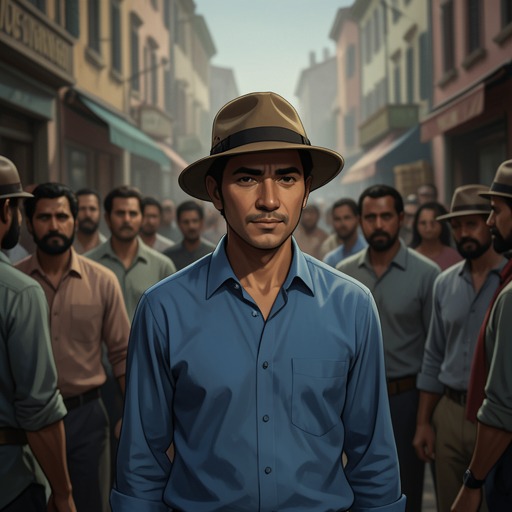
In February 1957, after Saleem and his family returned from Agra, a demonstration for Maharashtra filled Warden Road outside Methwold’s Estate. It lasted two days. Shopkeepers observing a hartal and striking textile workers were among the marchers, while the children on the hill watched from a distance. Saleem was forbidden to go down, but he and the other children crept partway toward the road. A disturbance at Evie Burns’s home sent Saleem downhill on a bicycle and into the procession. When the marchers challenged him to speak Gujarati, he could offer only a rhyme he had learned at school. Its words were a taunt rather than a considered political statement; Saleem recalls that he was dazed into telling the truth and repeated what he knew. The demonstrators laughed, then repeated the rhyme, carrying it forward through the procession until it became a song of war.
Riot and Aftermath
That afternoon, the head of the Samyukta Maharashtra Samiti procession met a Maha Gujarat Parishad demonstration at Kemp’s Corner. The Maharashtra marchers took up the rhyme, and the Gujarati demonstrators responded; the two groups fought beneath posters for Air-India and the Kolynos Kid. The first language riot left fifteen people dead and more than three hundred wounded. Saleem describes himself as directly responsible for triggering the violence that ended in Bombay State’s partition. The city became the capital of Maharashtra, so the political outcome favored the side whose march had adopted his chant. Gujarat’s claim is therefore present not as a settled resolution but as one side of a conflict in which a locally learned phrase acquired public force.
Language as Political Force
The episode connects the competing territorial projects to the novel’s wider concern with how speech and history shape one another. Saleem’s rhyme begins as a schoolyard taunt, is detached from its original use, and gains a new meaning through repetition among rival crowds. The shift shows how language can mark allegiance and mobilize people even when the speaker’s intent is slight or absent. The narrator’s account also places the episode within a history he reconstructs retrospectively: an apparently trivial utterance becomes, in his telling, part of the chain leading to the reorganization of Bombay State.