Lifafa Das
Midnight's ChildrenLifafa Das is a street entertainer whose peepshow turns a black box on wheels into a miniature, continually expanding world. His encounter with a hostile crowd in Old Delhi makes him the target of communal suspicion; Amina Sinai’s decision to shelter him saves his life, and his gratitude leads her to the fortune-teller whose prophecy will shadow her child’s story.
Identity and the peepshow
Lifafa Das is a young Hindu showman who travels with a wheeled peepshow and a dugdugee drum. He is almost invisible until he smiles or rattles the drum, which draws children to him. In a city where everyday traffic already fills the narrow lanes around Chandni Chowk, his performance offers a portable attraction and a promise of access to somewhere larger than the neighborhood.
He calls to passersby to see everything. That claim begins as a showman’s invitation but gradually becomes an ambition he cannot satisfy: he keeps adding picture postcards in an effort to put the whole world inside his box. Its contents range from celebrated landmarks—the Taj Mahal, Meenakshi Temple, and the Ganges—to contemporary scenes, including Stafford Cripps leaving Nehru’s residence, untouchables being touched, people sleeping on railway lines, and a newspaper photograph of an industrial fire. The show does not confine itself to picturesque or reassuring views; its crowded mixture of famous sights and difficult realities gives the peepshow a miniature version of the novel’s urge to encompass an entire age.
The mob and Amina’s intervention
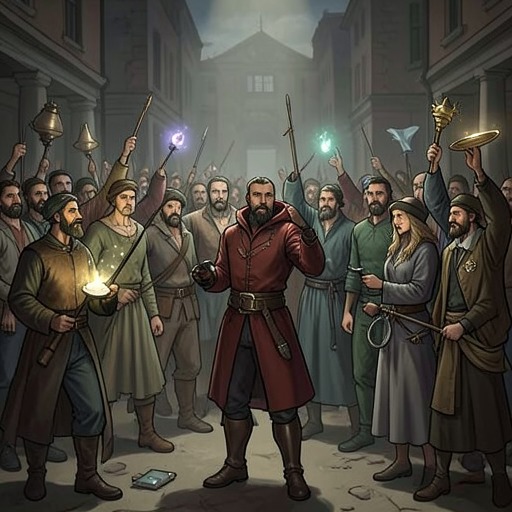
In January 1947, Lifafa Das brings his peepshow into the Muslim neighborhood where Amina lives. The district is already marked by communal tensions: slogans appear on walls, Muslim businesses face threats, and old resentments divide neighbors who share a religion while setting them against a Hindu resident. Against this background, a girl identifies Lifafa Das as Hindu, and the gathering crowd turns that fact into suspicion and accusation. Rumors of assaults on Muslim children feed the disorder, although the crowd has no established evidence against him.
The children begin chanting, adults join in, and the accusation escalates as more people press toward him. Lifafa Das tries to withdraw with his wheeled box, but he is surrounded and driven against a doorway. When the door opens behind him, he falls into a corridor beside Amina. She has spent the morning preoccupied with private family news and with the strain of the neighborhood’s changing mood; now she places herself between the crowd and its target. Her intervention punctures the mob’s self-image by addressing its members as if their numbers and bravado made them the spectacle. The crowd disperses, and Lifafa Das survives.
Gratitude and the prophecy
After the crowd leaves, Musa retrieves the peepshow from the street. Amina gives Lifafa Das fresh lime water, which he sweetens heavily with raw sugar. Having recovered, he thanks her and offers to bless her house and unborn child. He also proposes that she meet his cousin Ramram Seth, a seer who, he says, can reveal the future of her son.
Amina accepts the invitation despite Zohra’s warnings and her own inherited skepticism about fortune-tellers. Her decision arises from the new certainty of impending motherhood: the offer of knowledge reaches a part of her that is willing to believe. Lifafa Das arranges to meet her at the gate to the Red Fort and take her to his cousin. His gratitude thus links the rescue in the neighborhood to the prophecy that follows, turning an act of protection into a narrative threshold.
Narrative significance
Ramram Seth’s prophecy announces a son who will remain bound to the age of his motherland, describes him through the recurring image of a nose and knees, and forecasts both his two mothers and the violence, trials, and transformations ahead. Lifafa Das is not the prophet, but he is the necessary intermediary: without his arrival in the neighborhood, Amina’s intervention, and his invitation, she would not have come to hear the prediction. The showman who tries to fit the whole world into a box becomes the guide to a prophecy that compresses a life and a national history into a sequence of images.
Years later, Amina remembers the man she saved and the prophecy he led her to. She regrets that she did not understand its references to blood, knees, and nose, and wonders whether she might have had a different son. Her recollection gives Lifafa Das’s brief appearance an afterlife: he remains attached both to the life Amina saved and to the forewarning whose meaning only becomes legible in retrospect.