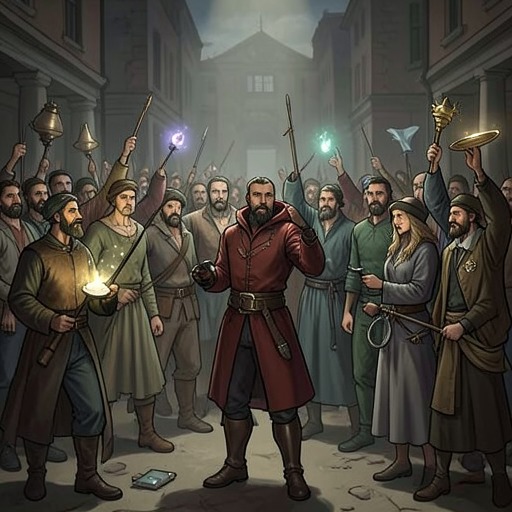
Magic and illusion
Midnight's ChildrenMagic and illusion are not separate realms in the novel so much as competing ways of handling reality. Public conjuring is practiced art, Parvati-the-witch possesses powers that the story treats as real, and Saleem’s passage through her basket leaves him both present and absent. Yet the magicians’ strongest claim is not that anything can happen: they can bend reality in performance without forgetting what it is. This distinction makes their art a way to explore belief, identity, and the limits of explanation.
Performance and public spectacle
When the Indian advance enters Dacca, military triumph travels with a company of entertainers. A special Indian Air Force transport brings 101 performers and conjurers from the Delhi magicians’ ghetto; many wear the uniforms of the Indian army, encouraging Daccans to see sorcery as part of the victors’ power. Acrobats form human pyramids on moving carts, contortionists display their practiced feats, and jugglers keep toy grenades aloft in numbers that turn the crowd’s wonder into a spectacle of abundance.
Other performers make the victory feel celebratory rather than merely martial. Card-tricksters produce a queen from women’s ears, the dancer Anarkali leaps and turns on a donkey-cart, and Master Vikram’s sitar intensifies the audience’s mood. In this setting, illusion does public work: it gives the crowd a shared language for delight and makes the advance seem to arrive with an entire imaginative world in its train. The performances do not prove that the military outcome was predetermined; they show how spectacle can make victory feel inevitable after the fact.
Picture Singh’s presence joins spectacle to danger and mastery. A seven-foot snake-charmer, he moves through the crowds entwined with venomous snakes whose poison sacs remain intact. His title, the Most Charming Man In The World, names a skill earned through performance, not a supernatural claim. The novel places this formidable but practiced art beside Parvati-the-witch, whose actual powers remain hidden beneath the conventions of public entertainment.
Parvati’s powers and their limits
In Dacca, Parvati uses a large wicker basket with a lid for an illusionist’s act. Volunteers enter and disappear until she chooses to bring them back; onlookers ask how she does it, treating the marvel as a trick to be explained. The scene presents her magic through the familiar form of stage performance, but her midnight-given sorcery is not merely sleight of hand. The basket can conceal a difference between what spectators think they have witnessed and what has occurred.
Parvati’s powers have been secret because the magicians’ community has consistently denied that such possibilities exist. She reveals them to Saleem away from public view, on the blind side of the Friday Mosque, where the performers are out of sight. The contrast is pointed: the ghetto can celebrate illusion as a trade, but genuine sorcery would unsettle the shared assumptions on which that trade depends. Her secrecy is therefore not just personal concealment; it protects a form of power that her community might refuse to recognize.
The magic she shows Saleem is specifically healing and protective. She can cure disease, counter poison, treat sores, and consecrate talismans. To demonstrate her resistance to venom, she allows snakes to bite her and performs a ritual invoking the snake-god Takshasa, drinking water infused with the Krimuka tree and old boiled garments, and reciting a spell that compares poison to an arrow whose force has been turned aside. She also knows the sraktya charm and the Rite of the Tree. These practices give her abilities a recognizable pattern, but not a complete explanatory system: the narration presents their effects as real without reducing them to a fully specified set of rules.
That pattern also marks a limit. The powers Parvati performs for Saleem belong to what the narrative calls white magic; the evidence does not show her using them to conjure wealth, transform objects, or raise the dead. Her magic is impressive, but it is not boundless. The distinction between power and limitation helps keep her apart from a generalized fantasy of omnipotence and grounds her sorcery in the acts she actually performs.
The basket, invisibility, and return
Parvati’s basket becomes more than an apparatus for a disappearing act when she carries Saleem back to India. He is inside it, but also not inside it: Picture Singh can lift and toss the basket into an army truck without feeling Saleem’s weight, and Saleem feels no impact. The journey takes Parvati, Picture Singh, and the other performers toward an aircraft at the military airfield; the account counts 101 artists on arrival and 102 persons on the return, though Saleem is present in a peculiar, weightless way. Without passport or permit, he returns unseen to the land where he was born.
Saleem describes the experience as ghostlike. In the basket he is actual but insubstantial, able to perceive the world only dimly, with the wickerwork appearing at the edge of an absence. The episode links invisibility to death and forgetting: the dead fade from the memories of the living, but ghosts, too, begin to lose their memories of those they have left behind. Parvati’s magic thus enables his return while making that return resemble a suspension between life and death.
The narrative does not settle the episode into an ordinary trick. Saleem insists that he was both transported and not transported, and argues that Parvati made possible what an earlier fabulous story had imagined in Baghdad. His insistence leaves the reader between explanations: a concealed passenger, an illusion, or a genuine supernatural passage. The novel sustains that uncertainty as part of the event’s force rather than supplying a natural account that would close it.
The ghetto’s reality and its divisions
Saleem’s first stay in the magicians’ ghetto lasts only days, but his arrival changes how its people interpret their circumstances. Resham Bibi fears that he brings bad luck, recalling his unusual birth and predicting misfortune. Picture Singh rejects that verdict and protects Saleem as an honored guest. Soon the performers’ fortunes appear to turn: jugglers keep 1,001 balls in the air, an apprentice crosses hot coals, the rope trick is said to have succeeded, police omit their customary monthly raid, and wealthy visitors request performers for gala evenings. Saleem is dubbed Saleem Kismeti, Lucky Saleem, and Resham Bibi is brought to apologize.
The episode gives luck and magic a social dimension without establishing that Saleem caused each improvement. The community’s first response makes him an omen of disaster; its later response makes him a source of good fortune. Picture Singh’s confidence helps protect him through both interpretations. The reversal reveals how readily belief attaches a collective change in circumstance to the person who happens to arrive before it.
At the same time, the performers’ disputes echo divisions in Indian communist politics. Conjurers align with the official Moscow-line Communist Party, contortionists lean toward the Chinese-oriented left, fire-eaters and sword-swallowers support Naxalite tactics, and other performers take different political positions. Picture Singh, described as above the factions, uses the shade of his umbrella to shelter arguments that are growing bitter. The ghetto’s variety of acts does not dissolve disagreement; the community’s shared craft becomes a miniature arena for wider ideological conflict.
The performers’ relation to reality is clearest in Picture Singh’s demonstration with Nagaraj, a cobra. His music appears to hold the snake upright in the air, but he also demonstrates the difference between his own skill and another person’s inability to reproduce it. Saleem learns that the magicians grip reality firmly enough to bend it for their arts without forgetting what it is. Their achievement is not confusion between trick and truth; it is command of the unstable line between them.
Secrecy, disclosure, and narrative uncertainty
Parvati’s hidden powers expose the cost of the ghetto’s insistence that the supernatural is impossible. The performers can make audiences wonder, but their professional identity depends on treating wonders as acts. Her ability to heal and counter poison threatens that boundary because it cannot be placed comfortably within the acknowledged craft. The story therefore distinguishes public illusion from private sorcery while allowing the same person to occupy both roles.
The narration’s changing registers keep that distinction unsettled. Dacca’s crowds see tricks and ask for explanations; Saleem’s account of the basket insists on a passage that ordinary explanations cannot resolve; the community reads changes in its luck as evidence about his presence. Each account interprets the same broad territory—what can be seen, what can be believed, and what has actually happened—from a different position. Magic and illusion become a means of examining how reality is made legible, and how quickly certainty gives way when a performance seems to exceed its frame.