Muslim League
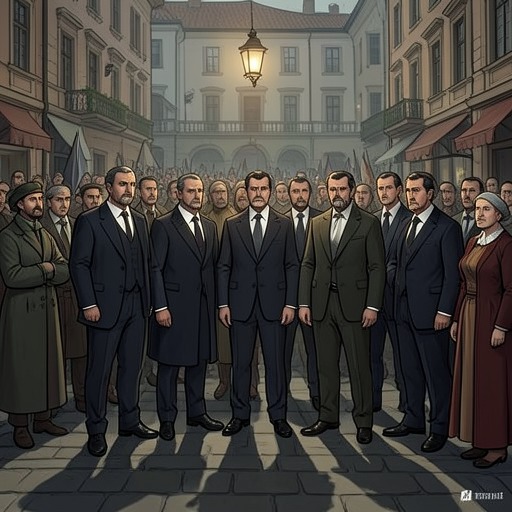
Midnight's ChildrenThe Muslim League is a central political force in the novel’s account of the movement toward partition and of Pakistan’s later political life. Its demand to divide India is opposed by the Free Islam Convocation, which argues that the League speaks for its own interests rather than for Muslims as a whole. The League’s ascent is marked first by the assassination of its opponent, Mian Abdullah, and later by a reported electoral victory in Pakistan that exposes how political power can prescribe what counts as truth.
Political position and opposition
Aadam Aziz, the Rani of Cooch Naheen, and Mian Abdullah all loathe the Muslim League. The Rani condemns its leaders as landowners protecting vested interests, willing to cooperate with the British after the Congress refuses to form governments for them. In her view, their claim to act for Muslims is contradicted by their self-interest, and their advocacy of partition is evidence of political madness. Her denunciation places the League within a contest not simply over national borders, but over who has the authority to speak in the name of a religious community.
Mian Abdullah, known as the Hummingbird, makes that challenge organizational. He creates the Free Islam Convocation almost single-handedly, inviting leaders of dozens of Muslim splinter groups to form a loose federation as an alternative to the League’s dogmatism and vested interests. The first Convocation meets in Lahore; a second is planned for Agra. Its prospective gathering is to include agrarian movements, urban labor syndicates, religious divines, and regional groups. The breadth of that intended coalition gives material force to its claim that the League does not represent Muslims collectively.
The Convocation’s posters make the dispute explicit: the League has turned its back on the people and then claims they stand behind it. Mian Abdullah opposes partition, while the League demands it. The opposition thus exposes a gap between the League’s political claim to represent Muslims and the diversity of Muslim organizations and interests the Convocation seeks to bring together.
The assassination of Mian Abdullah
The planned Agra meeting takes place against a dangerous political background. Agra is a Muslim League stronghold, but the Rani of Cooch Naheen, the Hummingbird’s patron, pays the event’s entire expenses without complaint or interference. Her support for his political work brings her enemies in the town. She does not, in the narrator’s telling, behave like other princes: rather than devote herself to hunts and scandals, she endows scholarships and turns her attention to politics. Rumors about her circulate, while Aadam Aziz enjoys her circle of friends and Naseem Aziz stays away, partly believing the stories.
The optimism surrounding the Convocation leaves its supporters unprepared for what follows. After Mian Abdullah is murdered, a sweeper-woman finds him dead in the Free Islam Convention’s offices. The assassins are never identified, and their paymasters are never named. Major Zulfikar summons Aadam Aziz to the campus to write his friend’s death certificate, then promises to visit him to tie up loose ends. Aadam blows his nose and leaves. At the maidan, the Convocation’s tents come down; the gathering will never be held again.
The novel does not establish that the Muslim League ordered the assassination. It does, however, connect the League’s political position to the consequences of its opponent’s removal: the League secretly rejoices at the fall of the man who had organized a rival Muslim coalition. The distinction between what is known and what remains concealed is central. The assassins and their paymasters remain unnamed, while the political outcome is plain: Mian Abdullah’s alternative is silenced and the Convocation disappears.
Electoral power in Pakistan
The League appears again in the narrator’s account of Pakistan’s 1965 presidential election. After two members of the Combined Opposition Party are kept under guard until the polls close, they accuse the authorities of electoral manipulation. The Nawab of Kif answers by pointing to his family’s political ties: his daughter is betrothed to Zafar Zulfikar, and he hopes his other daughter will marry the President’s son. He presents his refusal to provide votes as a matter of family honor, making patronage and kinship part of the machinery surrounding the contest.
When the Basic Democrats have completed their duty, the newspapers announce a crushing victory for the President’s Muslim League over the Combined Opposition Party of the Mader-i-Millat. The narrator treats the result as proof not of the unambiguous transparency of the election, but of how readily facts can be arranged and announced as political reality. In a country where truth is what it is instructed to be, he says, reality ceases to exist in any dependable sense. This episode extends the League’s significance beyond its demand for partition: it is also the governing political force whose declared electoral success becomes entangled with allegations of confinement, influence, and electoral jiggery-pokery.
Nationalism and religious legitimacy
The novel places the League’s politics within a wider struggle to make national identity appear unified. India is described as a collective dream, shared by people of different regions and communities, and one that periodically demands renewal through bloodshed. The League’s partition project belongs to this unstable making of nations: it promises political definition while sharpening the divide between communities. Mian Abdullah’s Convocation offers a counterclaim to that logic by bringing together Muslim constituencies that the League’s demand cannot be assumed to represent.
Later, in Pakistan, Jamila Singer performs through a gold-and-white veil with a small embroidered opening. Her voice is presented to the nation as a weapon for purity, and she declares that the President’s will is the voice of her heart. The scene does not identify her as a representative or agent of the Muslim League; rather, it shows how political authority can acquire a sacred register, joining patriotism, religious language, and obedience. The novel’s account of religious plurality and political performance complicates any claim that national unity speaks with one voice.
A similar tension appears in the narrator’s reflection on Pakistan’s two wings. Religion, he says, is the glue imagined to hold them together, just as consciousness binds past and present into a self. That account links national cohesion to the costs of suppressing division: a country may invoke a shared faith as its foundation while remaining vulnerable to political and historical fracture. Against this background, the League’s claims to represent Muslims are repeatedly tested—by the Convocation’s coalition, by the narrator’s account of electoral unreality, and by the later disintegration of the national unity that political rhetoric seeks to secure.
Narrative significance
The Muslim League is not presented through a single institutional portrait or a full account of its organization. Instead, it enters the narrative at moments when political representation, violence, and official truth are in dispute. Its contrast with the Free Islam Convocation establishes an alternative Muslim politics; the unexplained assassination of Mian Abdullah leaves that alternative without its organizer; the League’s reported election victory in Pakistan brings the problem of representation into the realm of public results and official announcements.
The narrator’s method makes those events part of a broader inquiry into how history is made and believed. A political movement claims to speak for a people; a rival coalition challenges that claim; violence removes the rival, while newspapers later announce an electoral triumph. The book does not resolve every hidden cause, especially the identity and sponsors of Mian Abdullah’s assassins. Instead, it draws attention to the space between political claims and what can be established, and to the power that accrues to those able to declare a version of events authoritative.