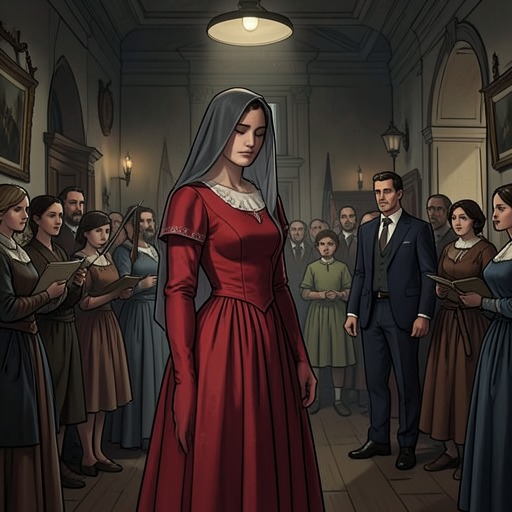
Saleem Sinai—Parvati-the-witch
Midnight's ChildrenSaleem Sinai and Parvati-the-witch are fellow Midnight’s Children whose intimacy develops from shared magical identity and companionship into a marriage that neither resolves Saleem’s emotional conflicts nor rests on the biological assumptions he makes about parenthood. Parvati repeatedly offers him care and loyalty, but he cannot return the love she wants. Their eventual wedding, prompted by her pregnancy and the need to protect her social standing, binds them together while preserving the relationship’s central distance: Saleem cannot consummate the marriage because he sees Jamila Singer’s face whenever he tries to be intimate with Parvati.
A bond among the Midnight’s Children
When Saleem reopens the Midnight Children’s Conference during the 1962 war, Parvati is initially among his firmest supporters. The children gather again after Saleem has kept Mary Pereira’s secret from them, but their reunion soon turns into a confrontation. The group accuses him of secrecy and arrogance, and Parvati, too, tells him that he has changed. As the other children gradually withdraw from the nightly meetings, she remains his sole magical interlocutor when the Conference has drained away. Their connection therefore outlasts the collective project, though it cannot prevent its collapse.
Parvati later encounters Saleem amid the celebratory crowds in Delhi, performing with the basket that makes volunteers disappear. Recognizing him by his distinctive nose, she restores his name to him when he has lost it. Their recognition is more than a reunion between old acquaintances: both are midnight-born, and Parvati reminds Saleem of their shared inheritance. In the basket’s darkness, she tells him that they are both children of midnight, and he is carried back in memory to the purposes and uncertainties of their childhood. Her magic then makes him vanish, giving him a route out of public view.
Care, desire, and withdrawal
After returning to the magicians’ community, Saleem becomes dependent on Parvati’s care. She uses her magic and remedies to help him: his hair returns, the marks on his face fade, and even the appearance of his legs seems to improve. She can offer healing and companionship, but she wants a romantic relationship rather than the role of an audience to whom she displays her abilities. The difference between what she gives and what Saleem can give back becomes a persistent source of sadness between them.
Saleem’s inability to respond is bound to his unresolved attachment to Jamila, his sister. In moments of intimacy with Parvati, he imagines Jamila’s face in her place, and the association makes physical closeness impossible for him. Parvati tries charms and other means of attracting his love, but Saleem remains caught in what he describes as an older enchantment. The narrative presents his refusal neither as proof that Parvati lacks agency nor as a simple choice between two women: Parvati expresses her desire, while Saleem’s private fixation determines what he can accept.
When Parvati raises the possibility of marriage, Saleem admits that he cannot marry anyone or have children. He tells Picture Singh that this is not merely a matter of an existing wife or family, but claims he is unable to father children. Picture Singh recognizes the distress of a life without children and proposes marriage as a way to preserve Parvati’s honor and address the predicament created by Saleem’s claim. Saleem’s silence and consent expose how the relationship is shaped by social responsibility as well as by affection: he does not believe he can offer Parvati the marriage she wants, but he also cannot dismiss the consequences of her situation.
Marriage, legitimacy, and parenthood
The marriage takes place on February 23, 1975, the second anniversary of Saleem’s return to the magicians’ ghetto. Its immediate social context is Parvati’s pregnancy by Shiva. On Republic Day, after someone hangs a rope of old shoes above her door, she breaks down under the insult. Picture Singh proposes that marrying Saleem will restore her honor while accommodating Saleem’s asserted sterility. Parvati accepts, and Saleem agrees despite his fear that Jamila’s face will again prevent intimacy.
The wedding gives the couple a public family even as its circumstances unsettle ordinary ideas of kinship. Parvati formally converts to Islam and takes the name Laylah, chosen by Saleem. At the henna ceremony, the magicians divide themselves between the two sides and perform the functions of family; during the marriage ceremony, the couple sit on a dais made from boxes salvaged from Resham Bibi’s demolished shelter. The gathered community supplies a kinship structure that Saleem lacks, turning the wedding into a collective act of recognition as well as a private arrangement.
The pregnancy also makes the family line more complicated than the ceremony suggests. Saleem anticipates the birth of a child whose father is not Saleem, yet whose biological connection makes him the true grandchild of Saleem’s own parents. That tangled genealogy recalls the earlier substitution that shaped Saleem’s identity and the concealed history of his birth. His marriage to Parvati thus repeats, rather than repairs, the novel’s pattern of children entering families through relationships that do not match the apparent or legally recognized ones.
An unconsummated union and its narrative role
The marriage does not overcome Saleem’s emotional barrier. During the wedding night he keeps his eyes shut and turns his body away from Parvati, fearing that Jamila’s face will return. At the consummation ceremony, there are no bloodstained sheets to display: the public rites and the community’s celebration stand in contrast to the couple’s lack of sexual intimacy. The relationship is therefore a marriage in name and social function, but not a union that resolves Saleem’s inability to love Parvati as she wishes.
The couple’s story is shaped by a succession of concealed truths and mistaken expectations. Saleem hides Mary Pereira’s secret from the Conference; Parvati privately carries the history of her relationship with Shiva; and Saleem misreads his own prospects for fatherhood. His confession of sterility becomes part of the reasoning behind the marriage, while the pregnancy reveals that the child will arrive through a different biological father. The result is not simply a private irony: it links the couple’s domestic arrangements to the larger work’s repeated questions about who counts as a parent, how names and families are made, and whether personal lives can escape the history that has shaped them.
After the celebrations, Saleem hears the approaching future as a countdown toward the birth of Parvati’s child and a corresponding birth of the child’s father. Their relationship thus becomes a hinge between Saleem’s old life among the midnight-born and the family history about to begin. The marriage creates a place for Parvati and her child within Saleem’s life, but its unresolved intimacy and uncertain parentage preserve the fractures that brought them there.