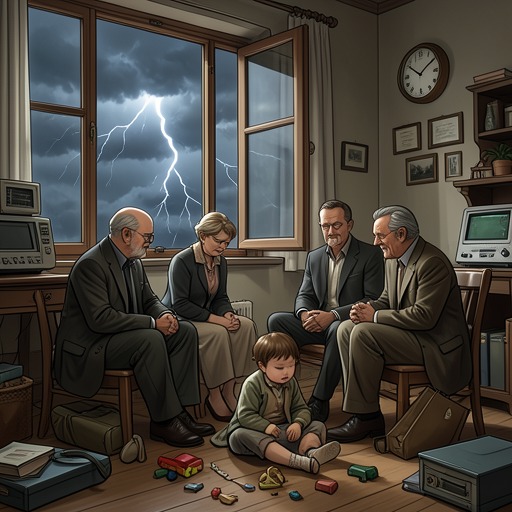
Saleem's “drained” state
Midnight's ChildrenSaleem Sinai’s “drained” state is the bodily and psychic aftermath of a sinus operation that cures his inflamed passages by destroying the telepathic connection he associates with his first catastrophic sniff in a washing-chest. He emerges with a clear nose, no voices, and no access to the Midnight Children; what is presented as a medical clearing-out becomes an expulsion from a community and a defining change in how he perceives the world.
Origin in the washing-chest
The state has its origin in a moment of bodily intrusion and unintended knowledge. Hidden in a washing-chest, Saleem overhears his mother, Amina Sinai, repeat the name of Nadir Khan. Through the laundry’s narrow gaps, the boy sees and hears an intimacy that unsettles his understanding of family life. His fear, the pajama cord in his nostril, and his involuntary sniff converge: nasal fluid is pulled upward into his sinuses, pressure builds, and something bursts inside his head. The narrative links this shock to the opening of new channels and to the electrical connection that will allow voices to reach him.
That beginning matters because the later operation reverses it. What first seemed an accident of mucus, pain, and a cord lodged in a nostril had made Saleem a receiver; the medical intervention that restores ordinary breathing removes that extraordinary capacity. His body is not simply repaired and then left unchanged. The same passages that once served as a route into a wider world are cleared of the condition through which that world could speak to him.
The operation and its deception
The operation is arranged through a telephone call that books the date, time, and place of what Saleem calls his undoing. His parents lie to him about the purpose of the outing. Ahmed Sinai invites his son along as if they are going on a picnic, then brings him instead to an unfamiliar, crumbling building on Carnac Road, where a brass plate identifies an Ear Nose Throat Clinic. Saleem understands the deception only when his father, nurses, and doctors begin steering him inside.
The treatment is described as a complete clearing of his sinuses. Saleem remembers the earlier nasal accident and recognizes, in terror, that the passages being operated on were where the voices first gained access to him. He kicks and yells as the staff hold him down. A doctor promises that he will feel nothing and tells him to count to ten; Saleem hears the numbers advance before released gas silences the sequence. The clinic’s language of fixing and clearing gives the procedure an ordinary medical rationale, but the effect in his account is much larger: it removes the means of connection that had made him more than an isolated listener.
Silence and the end of telepathy
After the operation, silence comes from both sides. Outside Saleem there is a dark room, blinds down, and nothing visible; inside him, the connection is broken, and there is nothing to hear. He describes the silence as desert-like and the newly clear air in his nasal passages as an invasion of private places. The physical result promised by the operation has been achieved, but in the same act the voices disappear, never to return.
Saleem names the condition as being drained. The image of a grounded parahamsa gives the loss a second register: a power that had seemed to carry him beyond ordinary limits has been brought down, for good. The operation’s ostensible purpose is the treatment of inflamed sinuses and the permanent clearing of the nasal passages; its consequence, as Saleem understands it, is the breaking of the connection made in the washing-chest, the loss of nose-given telepathy, and his exclusion from the possibility of the Midnight Children. The cure thus functions as severance. A clear passage is not an open channel: physical freedom from blockage coincides with psychic and social isolation.
Changed perception and continuing consequences
The loss does not leave Saleem without a new capacity. After the family arrives in Karachi, he observes that, although no voices speak in his head and never will again, he has gained the astonishing delight of possessing a sense of smell for the first time in his life. That sense is acute enough to distinguish hypocrisy in the welcoming smile of his aunt Alia. The contrast is sharp: telepathy had carried other people’s thoughts into Saleem, while smell now makes him attentive to what their outward gestures may conceal. The operation ends one mode of knowing and inaugurates another, narrower but newly powerful one.
The state also remains entangled with Saleem’s body and biography. During his later wartime recollections, he lists among his accumulated injuries and humiliations his cucumber nose, stained face, bandy legs, horn temples, monk’s tonsure, lost finger, and one bad ear. The list gives the drained state a place among changes that cannot be undone or neatly separated from the self. Its effects are not merely a past episode: the absence of voices becomes part of the continuing account of who Saleem is and what he has lost.
Narrative meaning
Saleem’s telling refuses to let the operation appear as a neutral medical episode. He interrupts the narrative to explain its consequence, spelling out how a procedure aimed at his sinuses also ended his telepathy and removed him from the Midnight Children. This direct explanation makes the causal reversal explicit while preserving the shock of the bodily scene: the boy who had been terrified of a nasal passage becoming a route to somewhere it should not reach is later subjected, under deception, to a procedure that closes that route.
The episode also belongs to the novel’s recurring concern with the instability of bodily wholeness. Saleem has already imagined the body as a one-piece suit and treated the loss of his finger as a breach with consequences for both private life and public history. In the operation, that concern turns from opening to closure: his body is cleared, yet the clearance changes his relations to others and to history. The drained state names not an empty body but a transformed one—silent where it once received voices, newly perceptive through smell, and permanently separated from a collective connection that had shaped his sense of purpose.