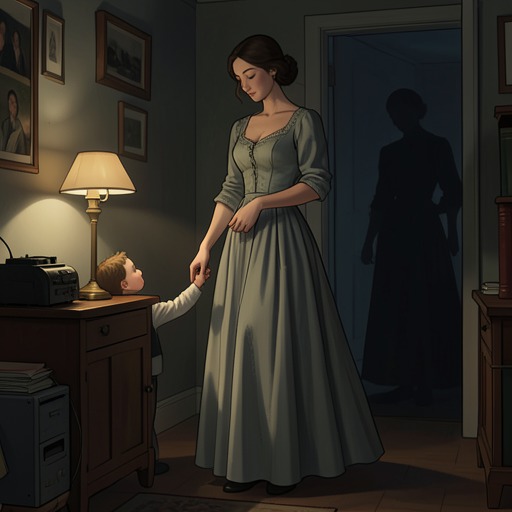
Saleem's reunion with Mary Pereira
Midnight's ChildrenSaleem’s reunion with Mary Pereira turns a taste of green chutney into a route back to the person who raised him—and to the secret that shaped his identity. At Braganza Pickles (Private) Ltd., the former ayah appears not as a distant figure from the past but as the factory’s manager, Mrs. Braganza, who sees Saleem and cries out to her son. The meeting gives physical form to a novel in which memory returns through the senses, while the truth of a life must be assembled from surviving fragments.
The taste that opens the past
After returning to the city of his birth, Saleem eats chutney served in a back room after Picture Singh recovers from a faint. Its green color and taste bring back a particular earlier chutney: the one he was given after emerging from hospital nine-fingered and going into exile at Hanif Aziz’s home. The taste does more than resemble the old one; it seems to be the very same, restoring the past with an immediacy that nearly makes Saleem faint.
The recognition makes the chutney a practical clue. Saleem asks the blind waitress who made it, restraining an outburst as he presses for its source. She identifies it as Braganza Pickle, and he has her bring him the jar. Its label names Braganza Pickles (Private) Ltd. and gives the factory’s address. Printed words on an ordinary jar become an “open-sesame”: they turn memory into a destination and prompt Saleem to set off in search of the maker.
The journey to the factory
Saleem goes north with Aadam in his arms. The journey leads from the blind waitresses’ back room to the busy pickle works, among bubbling vats, flies and lizards, workers, overseers, and the clanking jars of the bottling plant. The factory is not an abstract destination supplied by memory: Saleem arrives in a crowded, working place where the chutney is made and where his past has acquired a new public identity.
At the end of the road, Padma stands in his way. She is the factory’s manager and initially refuses to let him through, insisting that he make an appointment and return later. Saleem says he would have stayed and pressed past her, even by force, but a shout from the catwalk interrupts the standoff. The reunion begins not with an orderly introduction but with a voice calling down from above.
Mary’s recognition and changed identity
The woman on the catwalk hurries down the metal steps, exclaiming, “O my God, O my God, O Jesus sweet Jesus, baba, my son, look who’s come here, arré baba, don’t you see me, look how thin you got, come, come, let me kiss you, let me give you cake!” Her welcome is immediate and intimate: she calls Saleem her son, notices his thinness, and offers kisses and cake. The cry makes recognition explicit before the narrator supplies her name.
She is Mary Pereira, Saleem’s former ayah and the woman who switched his and Shiva’s name tags at birth. At the factory she is known as Mrs. Braganza and holds the position of manager. The reunion thus brings together two identities that had seemed separate: the domestic caregiver Saleem remembers and the businesswoman who now runs the place whose chutney led him to her. The narration identifies her as the only mother Saleem has left in the world, giving the encounter the force of a return to family as well as a disclosure of the person behind the factory’s product.
Memory, clues, and the unfinished ending
The scene’s chain of recognition runs from taste to label, address, journey, and voice. No single clue carries the whole past: the chutney first revives a hospital and an exile, while the jar supplies a route and Mary’s cry completes the identification. A manufactured food becomes an archive of personal history, and the label that points to its maker opens what Saleem calls the last door of his life.
That recovery belongs to a deliberately broken mode of telling. Saleem says the climax reaches him as scraps of memory rather than as the designed peak he expected; he must fill gaps from a few remaining clues. The reunion is therefore both an arrival and an act of reconstruction. Its warmth—Mary’s embrace, her concern, her offer of cake—does not erase the history of the switched birth, but it allows Saleem to encounter the woman who raised him again, now under a changed name and in a changed role. The story ends its central search with recognition, while leaving the larger account of Picture Singh’s life unresolved.