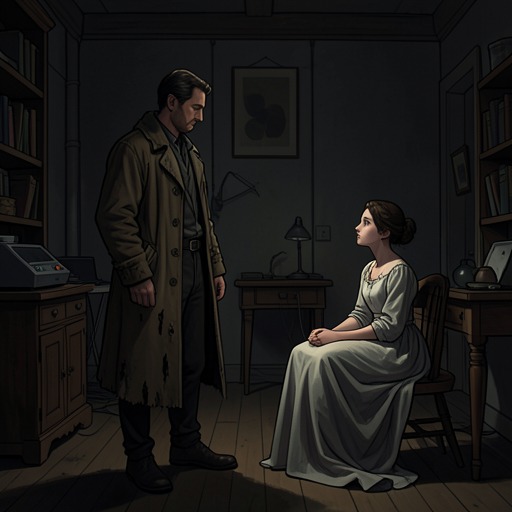
Aadam Sinai’s birth
Midnight's ChildrenAadam Sinai’s birth is synchronized with India’s entry into the Emergency: at midnight on June 25, 1975, Parvati gives birth in the Old Delhi magicians’ ghetto as the government suspends civil rights and begins arrests. The child is Parvati and Shiva’s biological son, but Saleem raises him as his own. His enormous ears and lifelong silence make him a figure of history’s burdens, a child who appears to hear a nation’s violence without being able to answer it.
Background and the Birth’s Political Clock
The birth is presented not as an isolated family event but as the culmination of a parallel between Parvati’s labor and the political crisis surrounding Indira Gandhi. At two in the afternoon on June 12, 1975, the Allahabad High Court finds Gandhi guilty of two counts of campaign malpractice; at precisely the same time, Parvati, now known as Laylah Sinai, becomes certain that labor has begun. The shared hour establishes the novel’s pattern of making private bodily time echo public history.
The labor continues for thirteen days. Saleem and Picture Singh are kept outside the hut by three contortionists acting as midwives, so Saleem must wait and listen rather than intervene. On the first day, Parvati’s contractions are severe but her labor does not progress. Saleem, who has never consummated their marriage, refuses food until the child is born or the crisis resolves. Picture Singh tries to reassure him that the baby will be a large, healthy child, but Saleem’s fear persists.
As the labor stretches on, political developments provide a second, public clock. On the second day, Janata Morcha candidates win in Gujarat. By the ninth day, the ghetto is wrapped in an extraordinary silence: Saleem cannot hear even the mosque’s call to prayer or the demonstrations outside Rashtrapati Bhavan. The silence blocks out news of Morarji Desai’s appeal to the President to dismiss Gandhi, while Saleem hears only Parvati’s suffering and the imagined ticktock of a countdown. The midwives pour water over her to replace what her body is losing and try to keep her from injuring herself as the ordeal worsens.
Midnight: Birth and Emergency
On the twelfth day, the Supreme Court rules that Gandhi need not resign while her appeal is pending, although she cannot vote in the Lok Sabha or draw a salary. On the evening of the thirteenth day, Parvati begins to push. At the same time, opposition leaders press the police and Army to disobey the Prime Minister’s orders, and the political confrontation approaches its own crisis. The novel intercuts these events so that labor and political struggle seem to push toward the same midnight.
As the night darkens, the midwives announce that the baby is coming. Elsewhere, the authorities arrest opposition leaders and a broad range of public figures, including teachers, lawyers, poets, journalists, and trade unionists. At the instant the child is born, the word Emergency is heard for the first time, accompanied by the suspension of civil rights, press censorship, and the arrest of people classed as subversive. The child’s birth thus coincides with the onset of a prolonged political midnight that will last two years.
The labor’s prolonged anguish gives way at the last moment to an unexpectedly easy delivery. Parvati gives a final cry, and the baby emerges. The contrast between thirteen days of apparent crisis and the suddenness of the birth is part of the event’s reversal: after enduring hunger and terror beside the hut, Saleem receives a son just as the country enters a new and frightening state of emergency.
Parentage, Appearance, and Silence
When the midwives bring the washed and wrapped infant out for Saleem to see, he laughs helplessly. The baby is well formed except for ears of startling size, which the midwives say briefly made them think he was a tiny elephant. Picture Singh urges Saleem not to be upset by the child’s ears. Saleem’s laughter initially reads as shock at the strange appearance, but the narrator connects it to his recognition that fate has delivered another grotesque joke.
Aadam is born in Old Delhi on June 25, 1975, precisely at midnight. Saleem describes the timing as an occult bond between the child and the country: Aadam is “handcuffed to history,” though he has had no choice in the matter. Unlike Saleem, whose birth brought a letter from Jawaharlal Nehru, Aadam arrives without a prime minister’s notice or public celebration. The difference marks the end of Saleem’s own special connection to national time and the beginning of his son’s.
The narration clarifies that Saleem is not Aadam’s biological father: the child is the son of Shiva and Parvati. At the same time, Saleem calls himself Aadam’s father and takes him into his care. The child is also described as the true great-grandson of Saleem’s great-grandfather, while his elephantine ears associate him with Ganesh. These overlapping claims make Aadam’s identity a knot of biological descent, adoptive kinship, inherited family history, and mythic resemblance rather than a single uncomplicated lineage.
The ears are associated with Aadam’s permanent silence. Saleem imagines that they have heard shootings in Bihar and the cries of workers beaten by police in Bombay. Aadam never speaks between his birth and Saleem’s later account of him; the narrator presents his silence as the consequence of hearing too much. His ears therefore operate as more than a physical feature: they turn the child into a receptacle for public suffering, while withholding from him the ability to speak it back.
Saleem’s Fatherhood and the Birth’s Afterlife
Aadam’s quiet, good-natured refusal to cry or whimper wins over Saleem, who stops laughing at the child’s ears and gently rocks him. That change is crucial to the event’s family consequences. Saleem has just witnessed the uncanny timing of the birth and recognized a fate-laden child, yet the infant’s calm elicits ordinary tenderness. The scene places care beside prophecy rather than allowing the symbolic meaning of the birth to erase the intimate act of parenting.
The birth also changes the direction of the novel’s historical metaphor. Saleem had understood his own life as a mirror of India’s, and now he sees his period of connection nearing its end as Aadam’s begins. But Aadam receives no agency in this inheritance: he is a newborn who cannot even wipe his nose, much less choose the historical circumstances into which he has been born. The language of being chained to history stresses the asymmetry between the national forces that shape him and the child who must live with their effects.
The event’s meaning remains mediated by Saleem’s retrospective storytelling. He sets down the exact date and hour, then folds the birth into a deliberately constructed correspondence with political events. Elsewhere, he describes the final climax of his story as fragments that must be fitted together from incomplete memory. That narrative self-awareness does not undo the birth’s stated particulars; it shows how the novel makes their significance through juxtaposition, repetition, and the narrator’s effort to connect private experience with public history.
Aadam’s arrival thus closes one historical connection while opening another. The infant is Saleem’s son by adoption and Shiva and Parvati’s son by birth; he is at once a particular child in a Delhi slum and a figure bound to the Emergency’s beginning. His immense ears and silence give physical form to the burden of a history that can be heard but not controlled, while Saleem’s decision to rock and raise him offers a personal answer to the political darkness surrounding his birth.