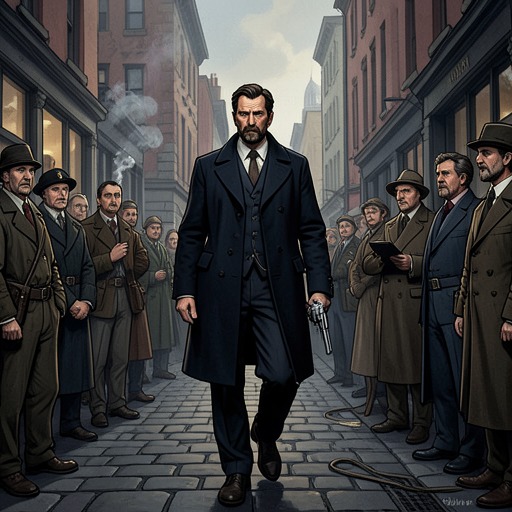
Commander Sabarmati
Midnight's ChildrenCommander Sabarmati is a high-ranking naval officer who lives at Methwold’s Estate with his wife, Lila, and their two infant sons. Seen first through the neighborhood Saleem recalls from childhood, the family appears to have secured a home at an unusually favorable price. Yet the household’s polished domestic surface conceals a history of infidelity, childhood violence, and later narrative invention. Commander Sabarmati matters not only as a member of Saleem’s Bombay neighborhood but as a figure whose remembered story reveals how observation, revenge, and unreliable recollection become interwoven in Saleem’s autobiography.
Identity and household
At the time the families move into Methwold’s Estate, Commander Sabarmati is described as one of the Navy’s highest flyers. He and Lila have two sons, then eighteen months and four months old. Saleem retrospectively names the boys Eyeslice and Hairoil, nicknames that mark them as children whose futures he already seems to know. The family’s place in the Estate is part of the wider circle of residents selected by William Methwold, who leaves the Englishman’s peculiar customs in place as part of the terms of the sale.
The favorable purchase price helps explain why residents tolerate those customs, but the move also places the Sabarmatis amid an unusually observant community. Saleem describes the households as the center of his childhood world. His account presents the Estate not merely as a row of homes but as a shared setting in which private lives overlap, secrets become visible to a child, and domestic events later acquire consequences beyond their original scale.
Lila, Homi Catrack, and Saleem’s observation
As a baby, Saleem is circulated among the Estate’s households in a pram, after the residents become interested in him as the first birth believed to make their new homes real. He says he became a voyeur in the homes of Lila and Homi Catrack, observing Lila’s repeated infidelities and eventually witnessing the beginnings of her liaison with the film magnate and racehorse owner. Saleem adds that this knowledge would later serve him when he planned an act of revenge. The affair is therefore not just a private episode in the Sabarmatis’ marriage: in his telling, it becomes information stored in childhood and put to use much later.
The account gives Lila’s actions a consequential role but does not present her through an independent account of her motives. Her private life reaches the reader through Saleem’s retrospective gaze, which connects what he saw as a baby to the revenge he would later contemplate. The gap between the child who observes without understanding and the adult narrator who selects and interprets those observations is central to how Commander Sabarmati’s household enters the larger story.
The sons and the childhood conflict
The two boys are initially introduced as very young children whose future character Saleem anticipates: they will grow up slow and boisterous. The elder son later becomes the target of Shiva’s anger. When the Sabarmatis’ elder boy is eight, he teases Shiva about his surliness, his clothes, and his knees. Shiva responds by throwing a sharp, flat stone, blinding the boy in his right eye.
The injury changes the family’s connection to the Estate. After the accident, Wee Willie Winkie comes there alone; his son is left to enter what the narrator calls dark labyrinths, from which only war would save him. The episode links the Sabarmati family’s domestic history to Shiva’s own childhood and to the violence that follows him into adulthood. It also shows how a brief encounter among children can become a durable part of Saleem’s account of the neighborhood’s overlapping lives.
Later recollection and the limits of truth
During the first day of the thirty-seven-day period Saleem calls the false peace, Ahmed Sinai suffers a stroke that leaves him paralyzed on his left side. In the same passage, Saleem recalls a visit from Commander Sabarmati, who comes to see Amina carrying a curious baton. The brief appearance brings the former Bombay neighbor into the account of the Sinai family’s decline in Pakistan, where memory and history are presented as tangled together rather than neatly separated.
Near the end of his autobiography, Saleem explicitly admits that he lied about Shiva’s death. He explains that he does not know what happened to his rival after the Widows’ Hostel and that fear of Shiva’s possible return shaped the invented version. In describing how he made that fiction, Saleem invokes the ghost of Commander Sabarmati as looking over his shoulder while he places a weapon in Roshanara Shetty’s hand and invents her access to Shiva’s cell. He identifies the fabricated episode as the product of a memory of one of his earliest crimes, transformed into circumstances for what he presented as his last. Commander Sabarmati thus appears both as a person in the remembered world and as part of the machinery of Saleem’s confessed invention: a spectral witness to the narrator’s attempt to make fear seem like fact.