Farooq Rashid
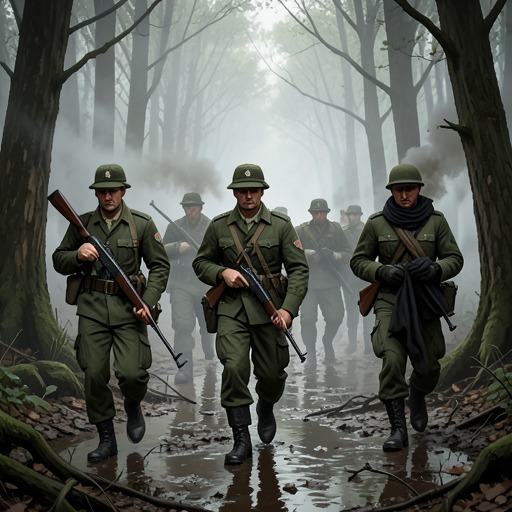
Midnight's ChildrenFarooq Rashid is a young soldier in the secret CUTIA unit, one of three recruits sent with the amnesiac Saleem into the military campaign in East Pakistan. His trajectory moves from eagerness for war to fear, disorientation, and a chastened awareness of what the campaign has done; the account ends with his death in the fighting near Dacca.## Recruitment and expectations Farooq is introduced alongside Ayooba Baloch and Shaheed Dar as a new recruit to the Canine Unit for Tracking and Intelligence Activities. Brigadier Iskandar’s command makes the trio a military unit, while the Brigadier’s batman, Lala Moin, mocks their assignment by calling attention to the man-dog they will accompany. Farooq’s early place in the group is thus both subordinate and uneasy: he has joined a secret tracking force, but its work is bound to Saleem’s unusual abilities rather than to conventional soldiering.
That night, Farooq asks whether there will be a war. Ayooba treats one as inevitable and links it to political promises and the prospect of territorial conquest. Farooq’s question shows that he is still looking toward the future of the unit and trying to understand what its mission will become. The young men’s expectations are framed by Ayooba’s boastful confidence, especially his contemptuous belief that vegetarian Indians would be weak opponents. Farooq is present at the start of a campaign imagined as adventure and victory, an expectation that later experience steadily dismantles.
The unit and the arrest of Mujib
Farooq accompanies Ayooba, Shaheed, Saleem, and Brigadier Iskandar on the night Sheikh Mujib-ur-Rahman is arrested. Saleem recounts that the unit was selected for the operation and that he tracked Mujib by scent from an old shirt. During the operation, Saleem leads troops to Mujib’s hiding place; Mujib is taken alive and escorted to an aircraft for captivity in West Pakistan. Farooq is part of the small unit carrying out this task, which places him at the beginning of a wider military assault rather than in an isolated tracking operation.
The account of the night expands beyond the arrest. As the unit travels through Dacca, its members see the consequences of the army’s violence: civilians flee, buildings and offices are attacked, and the city’s residents are subjected to military force. The soldiers are directed to pursue people identified as enemies of national unity, while Farooq and the others are also physically affected by the destruction around them. The contrast between their assigned task and the scale of the campaign becomes increasingly difficult to ignore.## Ordeal in the Sundarbans Farooq’s passage through the Sundarbans begins after the unit becomes lost in the forest. The men have been pursuing their objectives as soldiers, but there they lose their bearings and their confidence in Saleem as an infallible tracker. When Saleem can no longer direct them reliably, Farooq turns on him and strikes him; Shaheed intervenes to keep the confrontation from endangering the boat. The episode exposes the fragility beneath Farooq’s earlier certainty: away from military direction and familiar terrain, he is frightened and quick to blame the person on whom the group depends.
The jungle’s punishments and visions draw the three soldiers back toward their pasts. Farooq sees his brother running through the forest and becomes convinced that his father has died. The vision recalls a story his father once told: a landlord who charged ruinous interest had agreed to buy the father’s soul, and the brother would have to flee with the father’s spirit inside him. In the forest, this recovered memory gives Farooq strength to abandon the childish behavior he had fallen into; he stops crying when hungry and asking why. His change is not a simple return to military discipline. The jungle reconnects him with a family history and with a sense of responsibility that the demand merely to follow orders had weakened.
Saleem’s recovery of memory alters the small group again. After a snake bites him and Shaheed intervenes, Saleem’s past returns in a rush of stories, from his birth at midnight onward. Farooq listens with Shaheed to an account that makes the apparently blank man legible as a person with layered histories. Farooq recognizes that there had been much inside Saleem that the latter had not disclosed. The moment shifts the unit’s relation to the man they had treated as a tracking instrument: his silence is revealed to conceal a life, not an absence of one.
Return to the war
After leaving the jungle, the three soldiers find themselves in a deserted village, in poor condition and fearful of what their commanders will make of their disappearance. They have lost their hearing, their uniforms are in tatters, and their memories of the jungle’s lessons are already giving way to anxiety about punishment and the possibility of being treated as deserters. Farooq accuses Saleem of leading them astray and fears that the men in authority will not believe what they have experienced. The episode places the soldiers between two worlds: the uncanny forest they have left and the military system they expect to rejoin.
As they move north through abandoned settlements and fields, Farooq’s earlier enthusiasm gives way to dismay. He says he had come to fight the Indians but has encountered something far worse than the conflict he had imagined. His judgment registers a moral and emotional reversal without making him a detached observer: he remains frightened, angry, and concerned about the consequences for himself and his companions. Yet his words mark the distance traveled from the recruit who anticipated conquest after the election.
Death near Dacca
In December, Farooq, Shaheed, and Saleem arrive on stolen bicycles at a field outside Dacca. They find a peasant scavenging among the dead, collecting objects from the bodies of fallen West Pakistani soldiers. The peasant reports that Indian forces have arrived and that Jessore has fallen; he also describes a powerful Indian soldier whose unusual fighting method is associated with his knees. Farooq moves to the edge of the field while Shaheed is overcome by what they see. The scene’s news of military defeat reaches them amid evidence of its human cost.
A shot is heard, and Farooq does not answer when Shaheed calls his name. Saleem later recalls crossing the field toward his fallen companion and discovering a grotesque heap of intertwined bodies. The narrative identifies one of its heads by details associated with Shiva, making the discovery more than the death of a fellow soldier: Farooq’s final scene intersects with Saleem’s buried personal history and the story of the war. Farooq, who had once spoken confidently of combat, is not present to meet the arriving Indian Army or to repeat his early boasts.
Narrative role
Farooq’s arc is shaped by the gap between expectation and experience. His early question about war and his confidence in Ayooba’s vision of conquest give way to the confusion of the military operation, the disorienting trials of the forest, and the sight of a defeated army’s dead. The change is conveyed through discrete reversals: fear replaces bravado, remembered family history interrupts the soldier’s present, and the claim that the unit can simply follow orders is unsettled by what the men encounter.
His place in Saleem’s account also complicates the boundary between personal recollection and national history. Farooq first appears as one member of a military unit, but the jungle makes him a listener to Saleem’s restored life, and the field outside Dacca connects his fate to the novel’s wider pattern of concealed identities and histories returning at moments of crisis. His story does not conclude with a homecoming or a clear reckoning; it ends with his absence, registered when Shaheed calls and receives no reply.