Rani of Cooch Naheen
Midnight's ChildrenRani of Cooch Naheen is a princess whose political commitments distinguish her from the conventional image of an Indian ruler. She funds the Free Islam Convocation, opposes the Muslim League’s partition plan, and supports Mian Abdullah and Aadam Aziz; after Abdullah is assassinated, she withdraws from public life and remains ill for years. Her story links political hope to the precariousness of the people and institutions that sustain it.
Identity and political outlook
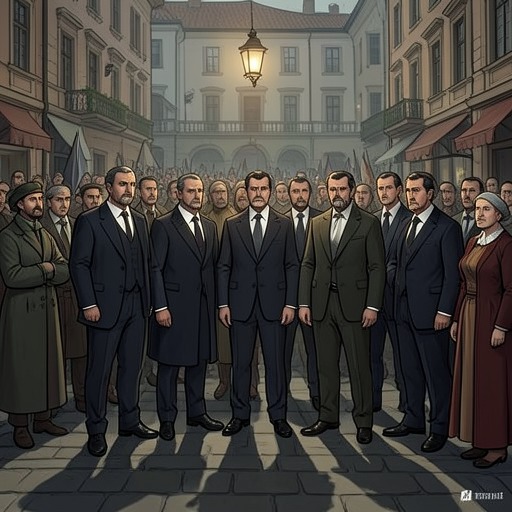
A photograph recalled by Saleem places Rani of Cooch Naheen beside Aadam Aziz and Mian Abdullah, known as the Hummingbird. The scene presents her as part of Abdullah’s circle of optimists, whose ambitions reach beyond personal advancement. In the photograph’s imagined conversation, she describes her blotchy skin as an outward expression of her internationalist spirit. The narrative connects that personal condition to a wider historical pattern: her illness seems to anticipate, on an enormous scale, a later eruption in public life.
Rani of Cooch Naheen shares Aadam Aziz’s and Nadir Khan’s opposition to the Muslim League. She regards its leaders as landowners protecting their interests rather than representatives of Muslims, and objects to their willingness to govern for the British after the Congress refuses to do so. In the year of the Quit India resolution, she condemns the League’s demand to partition India as evidence of political folly. This places her among opponents of partition whose disagreement is not simply over who should rule, but over whether the League can claim to speak for the Muslim communities it invokes.
Patronage and political work
Mian Abdullah creates the Free Islam Convocation as a loosely federated alternative to the League, inviting leaders of Muslim groups with different regional, religious, labor, and agrarian commitments. After a first assembly in Lahore, a second is planned for Agra. Its organizers intend the gathering to demonstrate that the League speaks for its own interests, not for Muslims as a whole. Abdullah’s project depends on Rani of Cooch Naheen’s financial support: she bears the event’s entire expense and does not interfere with its conduct.
Her patronage is presented as an expression of a larger political character. Rather than pursuing the hunts and scandals associated with princely life, she endows scholarships and devotes herself to politics. Her decision to support an assembly in Agra, a Muslim League stronghold, exposes her to local hostility. Rumors portray her scholarships as a cover for sexual access to scholars and recast her damaged appearance as a tool of seduction. These are presented as town gossip, not established fact; their narrative function is to show how her public independence is answered with efforts to discredit her.
Rani of Cooch Naheen also gives her political circle a setting for exchange across cultural and artistic boundaries. The imagined photographic conversation brings together Abdullah’s argument that art should recall a shared literary inheritance and Nadir Khan’s insistence that poetry and the game of hit-the-spittoon stand on equal ground. She responds with a joke about setting aside a room for both paan-eating and spittoon practice, proposing that the resulting stains would at least be honest. The episode associates her with a cosmopolitan circle that treats political solidarity and cultural mixture as compatible.
Alliance with Aadam Aziz and Mian Abdullah
Aadam Aziz enjoys the Rani’s circle and does not believe the stories that she is a witch. Naseem Aziz, by contrast, half-believes the rumors and refuses to accompany him to the princess’s house. That difference marks a divide between Aadam’s participation in the Rani’s multilingual, politically engaged world and Naseem’s suspicion of it. The Rani’s friendships are at ease in Persian and German, while the rumors around her turn precisely that cosmopolitan life into grounds for distrust.
Her alliance with Abdullah is both political and personal. She supports his opposition to partition and pays for the Agra Convocation, while accepting that the choice will make enemies. The narrative describes the Hummingbird’s circle as absorbed in an epidemic of optimism: its members play hit-the-spittoon and ignore signs of danger. Rani of Cooch Naheen’s confidence in Abdullah’s project is therefore not merely background patronage; it helps make the planned assembly possible, even as the circle’s hopeful concentration leaves it unprepared for the violence that follows.
A silver spittoon inlaid with lapis lazuli carries her support into the private life of Nadir Khan and Mumtaz Aziz. When they live secretly together in a vault beneath the Aziz house, Rani of Cooch Naheen sends the spittoon as a wedding gift. The couple make the old men’s game their own, with Nadir’s paan and Mumtaz’s lemon drink producing contrasting streams. The gift connects the political circle’s shared game and aesthetic life to the couple’s hidden marriage, making an object associated with Abdullah’s gatherings part of their domestic world.
Assassination and withdrawal
The murder of Mian Abdullah ends the optimism surrounding the Convocation. A sweeper discovers him dead in the Free Islam Convention offices; the assassins are never identified, and neither are their paymasters. Aadam Aziz is called to the campus by Major Zulfikar to write the death certificate. Tents for the Agra gathering are taken down, and the Convocation is never held again. The evidence does not establish who arranged the killing, and Rani of Cooch Naheen’s political role should not be mistaken for knowledge of its perpetrators.
After Abdullah’s death, Rani of Cooch Naheen takes to her bed. Having long made light of her illnesses, she now allows them to overtake her and lies still for years, watching herself turn the color of her bedsheets. Her withdrawal follows the collapse of the political project she had helped finance: the public gathering disappears, its leader is silenced, and its patron retreats from public life. Her arc thus turns on the contrast between active, generous support before the assassination and prolonged passivity afterward.
Narrative significance
Rani of Cooch Naheen embodies a form of political resistance that relies on alliances, money, education, and convening rather than official authority. The Convocation’s breadth—bringing together agrarian movements, labor syndicates, religious figures, and regional groups—stands against the League’s claim to represent Muslims through its demand for partition. Her sponsorship gives that alternative a material base, but the assassination shows how readily an organized countervoice can be extinguished while its killers remain unknown.
Her story also links bodily change, public image, and historical interpretation. In the remembered photograph, she speaks of her blotched skin as a sign of internationalism; the narrator frames the disease as a personal condition that seems to leak into history and recur at a much larger scale. That connection is presented through Saleem’s retrospective, associative narration rather than as a literal political cause. The photograph, the rumors, and the narrator’s historical hindsight offer competing ways of making her legible: as a patron, a scandalous figure in local gossip, and a symbol whose private illness appears to foreshadow public upheaval. The narrative keeps those forms of interpretation in tension, while the end of her political activity remains concrete: after Abdullah’s death, the Convocation disappears and she stays in bed for years.