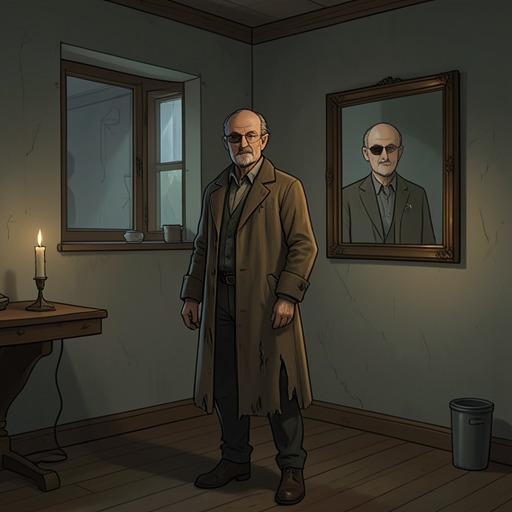
Saleem's sinus operation
Midnight's ChildrenSaleem's sinus operation ends the telepathic connection he traces to an accident in the washing-chest, and marks a decisive break in his relationship to the Midnight’s Children. His parents arrange the operation as a surprise during a supposed family outing; afterward, Saleem awakens to silence both outside and within himself. The procedure is presented as treatment for inflamed sinuses, but its consequence, in Saleem’s account, is the permanent loss of his nose-given telepathy.
Background: the nose and the connection
The operation acquires its full significance from an earlier incident Saleem remembers in the washing-chest. Hidden there, he sees Amina Sinai crying and hears her repeat the name Nadir Khan, an old attachment she has not spoken of since becoming Amina Sinai. The discovery unsettles him, and the events of the scene culminate in an involuntary sniff. Saleem narrates that the inhalation sends nasal fluid into channels it should not reach, creates pressure in his sinuses, and causes something inside his head to burst. Later, he identifies this accident as the moment when the connection that enabled his voices began.
The power is not simply a private faculty. Through it, Saleem can hear the voices of the Midnight’s Children, and it becomes the basis of his participation in their imagined community. The later operation therefore threatens more than a physical condition: it places the source of his unusual access to other lives under medical treatment. Saleem’s account links the nasal passages, the voices, and his place among the children in a chain of cause and consequence.
The picnic and the deception
By November 1, Saleem’s nasal passages are in acute crisis. Amina Sinai gives him daily treatments with Vick’s inhaler and steam, but his sinuses do not respond. On that same day, Ahmed Sinai reaches out to him, invites him close, and expresses his love. Saleem accepts the embrace happily; afterward, nasal fluid has stained Ahmed’s shirt. Saleem later recalls that Amina makes a telephone call while pretending to speak to a friend, and sees this deception as part of the plan that brings him to the operation.
On November 21, the family prepares for a picnic. They make sandwiches and parathas, load ice and drinks into the car, and set out with Ahmed and Amina in front and the children behind. Saleem expects a destination such as Juhu, Elephanta, or Marvé. When the car turns the wrong way, his parents reassure him that they will make one stop before continuing. The reassurances conceal the real destination: a building in Carnac Road whose brass plate identifies it as an ear, nose, and throat clinic.
Ahmed invites Saleem to accompany him inside, presenting the visit as part of his father’s business. Saleem follows willingly until he recognizes the clinic and asks why they have come. His father tightens his hold on Saleem’s shoulder as clinic staff take over. A doctor greets them, and a nurse directs Saleem toward preparation for the procedure. Saleem’s account stresses the contrast between the family’s promised celebration and the medical appointment concealed within it: the telephone has fixed the date, time, and place of his undoing, while his parents have lied about the outing.
The operation and its immediate effect
Saleem understands the operation through the history of the accident in the washing-chest. Remembering that his nasal passages had started everything, he resists being taken to the operating room. Staff hold him down while a doctor describes the procedure as a way to fix his sinuses and clear them out. Saleem hears the assurance that he will feel nothing and is asked to count as the anesthetic takes effect. The episode turns the earlier accident into a pointed reversal: what began in a washing-chest ends on an operating table.
When Saleem wakes, the effects are described as silence. Outside him, the room is dark and still; inside him, the connection is broken, and there is nothing to hear. He also registers a newly clear nose, with air moving freely through the passages that had been blocked. But the physical relief has come at the cost of the voices. Saleem states that the operation’s stated purpose was to drain his inflamed sinuses and clear his nasal passages, while its actual effect was to break the connection made in the washing-chest and deprive him of telepathy. He describes that loss as banishing him from the possibility of the Midnight’s Children.
Consequences and narrative significance
The operation makes bodily intervention a hinge between Saleem’s private life and the novel’s larger history. Earlier, the loss of a finger had led him to imagine that opening or altering the body could allow unexpected changes to spill into the world, affecting whether parents remain parents and whether love turns to hate. His sinus operation gives that reflection a more direct consequence: a medical procedure changes not only his body but also his access to the children whose voices had helped define his role.
Saleem’s narration does not present the episode as a simple medical report. He addresses Padma, emphasizes the deception behind the picnic, and connects the operation’s ending back to the washing-chest where his telepathy began. That circular structure makes the procedure both a literal intervention and a narrative threshold: the source of the voices is treated, and the voices fall silent. The loss also intensifies the novel’s recurring uncertainty about how bodily experience, memory, and historical meaning fit together. Saleem can state what the operation did to his connection, even as his wider narrative acknowledges that remembered events and their sequence may not be fully reliable.