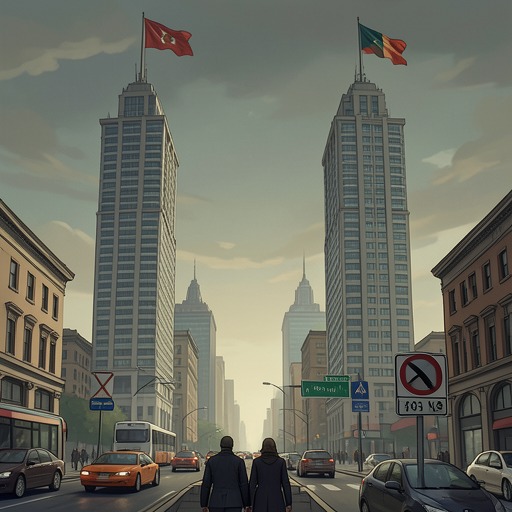
The truth is what it is instructed to be
Midnight's Children“The truth is what it is instructed to be” is a political and narrative principle in Midnight’s Children: authority can prescribe what counts as truth, but the resulting official account does not erase contradictions—it makes them more visible. Across national myth, election results, patriotic performance, and wartime reporting, the novel shows how declarations acquire the force of reality while competing experience is pushed aside.
Official Truth and Pakistan
The expression’s sharpest formulation follows the Pakistani presidential election. Two opposition politicians are kept from leaving their rooms until the polls close; the Nawab, whose daughter is betrothed to Zafar Zulfikar and whose other daughter may marry the President’s son, refuses to give them the votes they demand. The newspapers then announce a crushing victory for the President’s Muslim League over the Combined Opposition Party. Saleem treats the result as proof that, in a country where truth is instructed, reality can cease to exist: the public account is not simply a description of events but a version imposed upon them.
Saleem contrasts this political atmosphere with his Indian childhood. He describes that earlier world as containing innumerable alternative realities, while his Pakistani adolescence leaves him amid falseness, unreality, and lies. The contrast is his retrospective interpretation, not a claim that untruth belongs exclusively to Pakistan. He accepts a whispered correction that no country has a monopoly on it, and later recognizes that Jamila, too, can believe an authorized version over what she knows to be true.
National Stories and Sacred Authority
The idea reaches beyond elections. On the eve of independence, Saleem describes India as a collective dream: a new nation made possible by shared belief and requiring repeated ritual renewal. This national myth is neither presented as a simple factual account nor dismissed as meaningless. Its reality depends on collective will, and the novel places it beside the other powerful human fictions Saleem names: money and God.
In Pakistan, Jamila Singer’s performance for President Ayub shows political authority borrowing the language of purification and faith. She sings behind a perforated sheet; the President calls her voice a weapon for cleansing souls, and Jamila dedicates herself to patriotism. The ceremony turns song into a public affirmation of the leader’s values. Saleem’s account sets that sanctioned voice against his own increasingly divergent perception: while Jamila sings patriotic songs, his attention is drawn to the bitterness and closed-mindedness around him.
The same entanglement of political and religious language appears during the war. Jamila is summoned to sing for Pakistani troops, while religious assurances promise that those killed in battle will enter a blessed afterlife. Such claims give sacrifice a sacred meaning even as the two states broadcast incompatible accounts of military destruction. The novel’s concern is not only whether a statement is true, but who has the power to make a statement sound unquestionable.
Contradictory Reports and Fragmented History
Wartime radio makes the struggle over truth especially stark. Voice of Pakistan and All-India Radio issue wildly conflicting accounts of losses, each describing the other side’s destruction in absolute terms. Reports about the fighting around Lahore likewise diverge: the broadcasts tell different stories about the city’s danger, the movements of troops, and the course of the battle. Saleem presents these claims amid his uncertainty about who attacked and who defended, so that the reader encounters war through competing announcements rather than a settled account.
The uncertainty is part of the novel’s form. Saleem narrates retrospectively and openly interprets events, yet his acknowledgment of uncertainty does not give him a neutral position outside history. His account links public falsehood to private misrecognition and insists that personal memory, political authority, and national story can all shape what is believed. The expression therefore describes both propaganda and the narrator’s problem: reality is mediated, and a confident narrative is not automatically a reliable one.
The Widow and the Fear of Rival Gods
The principle reaches its most concentrated political and religious form in Saleem’s explanation of the Widow’s persecution of the Midnight’s Children. She is at once Prime Minister and, in his interpretation, an aspiring goddess. The children number 420, an apparently negligible fraction of India’s population, but their distinct magical capacities make them potential rivals to her claim to singular authority. Saleem concludes that those who would be gods fear other potential deities.
Here, official truth becomes a contest over who may embody the sacred and define the nation. The Widow’s explanation that the people worship her as a manifestation of the one divine principle attempts to absorb plurality into a single authorized image. Saleem’s answer invokes the religious multiplicity he encountered in Bombay. His account connects that conflict to the children’s destruction: in his interpretation, their difference is threatening because it cannot be fully contained within the Widow’s prescribed version of national and divine power.