Zafar Zulfikar
Midnight's ChildrenZafar Zulfikar, Saleem Sinai’s cousin and General Zulfikar’s son, is defined by the collision between private vulnerability and public demands for masculine discipline. His persistent enuresis makes him a target of his father’s anger and military society’s ridicule; during the 1965 conflict in the Rann of Kutch, the humiliation becomes entangled with a discovery about his father’s smuggling, and Zafar kills him. His arc turns a family shame into a political crime, while the official account obscures the corruption behind both.
Identity and Family Background
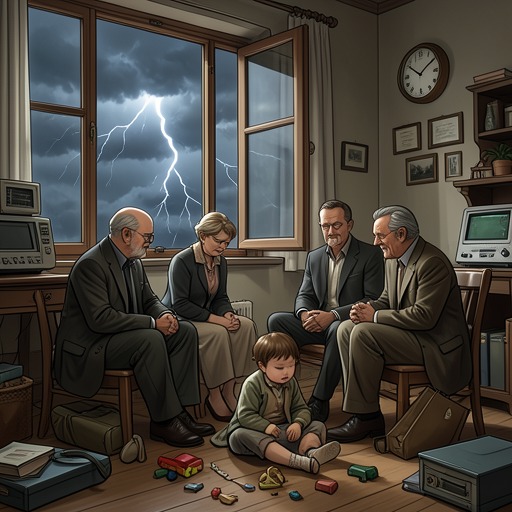
Zafar grows up in General Zulfikar’s household in Pakistan and attends school alongside Saleem. The General’s expectations are sternly gendered: after Zafar wets the bed during a childhood stay at the family’s mountain cottage in Nathia Gali, his father berates and punishes him, insisting that he become organized and prove himself. The recurring bed-wetting does not stop; the episode establishes a pattern in which a bodily vulnerability is treated not as a private difficulty but as evidence of unfitness for manhood.
The family’s response makes Zafar’s condition a public measure of his worth. Later, after he wets himself during the gathering at which Ayub Khan declares martial law, the General ejects him from the room and hurls gendered insults after him. At the same moment, the General looks to Saleem to help preserve the family’s honor. Saleem accepts the unspoken appeal and assists the coup through symbolic movements of pepperpots and tableware as the General describes troop deployments. Zafar’s humiliation thus helps create a temporary father-son bond between Saleem and the General, even as it further distances Zafar from his father.
From Childhood Shame to Military Service
The adults’ conflict over Zafar’s enuresis continues after the family’s early years in Pakistan. During the four-year interval that Saleem recounts, the General has not forgiven his son for the incident at the martial-law dinner. He tells Zafar that he will join the Army when old enough, framing military service as a test of whether he can prove himself a man. The assignment is not presented as an expression of Zafar’s own ambitions; it follows directly from his father’s contempt and the family’s effort to impose discipline on him.
By 1965, Zafar is a lieutenant, but his condition has not ceased to mark him. At the Abbottabad base he becomes a subject of ridicule, with enlisted men mimicking the supposed sound of a rubber undergarment. The narrator later links that public shame to the statement Zafar makes after his arrest for murder. In April, Zafar is sent to maneuvers in the Pakistan-controlled Rann of Kutch, a disputed region where Pakistani border posts stand along the unofficial frontier. The movement from military mockery to an exposed border outpost places him in a setting where the uniform and its claims to order offer little protection.
The Rann of Kutch and the Discovery
In the narrator’s account, the Rann conflict lasts eighty-two days, from the Indian Army’s occupation of several posts on April 9 until the fighting ends on July 1. The official descriptions of the conflict are uncertain and self-serving, and the narrator says that Zafar’s account is substantially the basis of what follows. The episode is therefore presented through a retrospective narrative that distinguishes reported fact from the unstable stories surrounding the conflict.
Zafar spends seven nights at one of the posts with five other soldiers. The men hear frightening sounds in the darkness and become so fearful that the others, too, lose control of their bladders. On the final night, what they take for a supernatural force approaches the outpost. The apparent ghosts prove to be smugglers arriving in boats. The revelation turns the soldiers’ fear into shame, but it also exposes the operation’s real power: the smugglers ask whether the guards have already been paid off.
The smugglers’ connection leads Zafar to recognize that the operation is conducted in his father’s name. General Zulfikar’s wealth, the narrator says, had first been built on the suffering of Hindu families fleeing in 1947 and was now being augmented by convoys passing through the unguarded Rann into Pakistani cities. Zafar returns on leave to his father’s house in Rawalpindi carrying this knowledge alongside the accumulated memory of childhood blows and military humiliation. The discovery does not simply reveal corruption to him; it identifies his father as responsible for the circumstances that left him and the other soldiers frightened and exposed at the border.
Patricide and Its Aftermath
In July, Zafar finds General Zulfikar in the bath beside his bed and kills him with a curved knife associated with the smugglers. The narrator places the act after a lifetime of humiliations and the immediate knowledge of the General’s role in the Rann. The account connects those causes without reducing the murder to a single grievance: Zafar carries both the intimate history of his father’s treatment and the revelation of his father’s criminal activity.
The public version of the killing diverges sharply from the family history Saleem recounts. Newspaper headlines describe an Indian invasion repelled by Pakistani soldiers and present the border guards as innocent victims of an Indian massacre. They do not disclose General Zulfikar’s smuggling, and the narrator observes that powerful men across the country possessed goods and comforts obtained through similar illegality. General Zulfikar dies, and Zafar is imprisoned; the criminal network and the official story remain difficult to separate.
The narrator calls the Rann incidents a kind of tinder for the larger war that begins in August, linking Zafar’s family tragedy to the broader military crisis without making him its sole cause. His fate is also presented as a pointed inversion of the marriage plans once associated with him: in prison, he is spared marriage to a Kifi princess who refuses to enter puberty precisely to avoid marrying him. Neither outcome offers a conventional repair. The violence at home ends the father’s authority, but it does not undo the years of humiliation or the corruption the discovery uncovered.
Narrative Role and Significance
Zafar’s bed-wetting recurs as more than a private characteristic. The General and the Army culture surrounding him treat bodily control as proof of masculine fitness, so that an involuntary condition becomes the basis for insults, disciplinary threats, and public ridicule. The pattern is cruelly unstable: at the empty border post, the other soldiers become so frightened that they, too, wet themselves, temporarily erasing the distinction on which their mockery of Zafar depends. The episode exposes the weakness beneath the military performance of composure.
Saleem’s narration also connects Zafar’s personal life to the political history he witnesses. During the 1958 coup, Saleem’s help to General Zulfikar emerges from Zafar’s humiliation; years later, Zafar’s military posting brings him to the border where he learns of the General’s smuggling. Family authority, state power, and public performance therefore meet in a chain of consequences rather than in separate stories. The later account of Zafar’s crime remains framed by unreliable and contradictory public reports, making his private knowledge of his father’s guilt difficult to recover from official history. Through Zafar, the novel places bodily shame beside political deception: both are made visible to those who endure them and concealed or manipulated by those who control the public account.