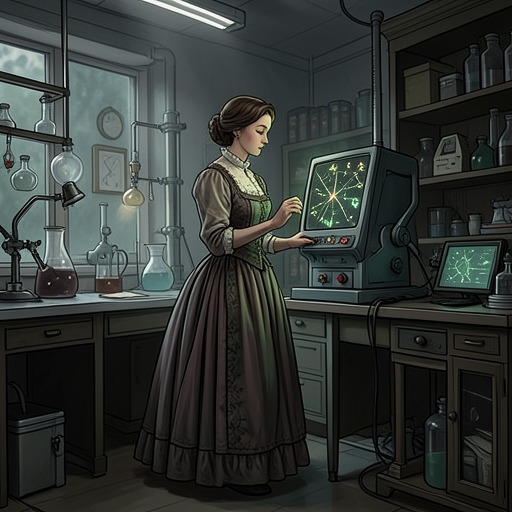
1908 Siberian Experiment
Miss Peregrine's Home of Peculiar ChildrenThe 1908 Siberian Experiment was a renegade attempt to reverse aging and attain immortality outside time loops; its catastrophic failure transformed the participants into the first Hollowgasts. Recalled by Miss Peregrine as a warning about the limits of time and the cost of trying to escape mortality, the episode also supplies the hidden history behind the monsters that shaped Abraham Portman’s childhood stories and the dangers facing peculiar people.
Ambition and opposition
Around the turn of the twentieth century, a splinter faction of disaffected peculiars proposed turning time loops to a new purpose. Their ambition went beyond the suspension of aging available to loop-dwellers: they sought to reverse aging itself, remain eternally young beyond the loops, and move between past and future without suffering the usual consequences. Miss Peregrine described the scheme as a repudiation of the natural laws governing time and mortality.
Her own brothers were among its advocates. Though technically brilliant, they lacked sound judgment, and they asked Miss Peregrine to help make the plan real. She refused, warning that the project amounted to making themselves gods and that, even if it could be achieved, it should not be attempted. The Ymbryne Council also issued warnings and threats, but neither intervention stopped the faction.
The expedition and explosion
In the summer of 1908, Miss Peregrine’s brothers and several hundred members of the renegade faction went to the Siberian tundra. Among them were powerful ymbrynes, whom Miss Peregrine condemned as traitors. They chose an unnamed time loop that had been unused for centuries and expected to return within a week, chastened by the limits of their experiment.
Instead, a massive explosion shook windows as far away as the Azores. The blast was so immense that people within five hundred kilometers could have taken it for the end of the world. At first, the other peculiars assumed that everyone at the site had died. Miss Peregrine later told Jacob that the participants had survived, but only in a radically altered condition; the disaster had not delivered the controlled mastery of time the faction sought.
The first Hollowgasts
Weeks after the explosion, attacks on peculiars began. The assailants could not be seen by ordinary observers, though peculiar people such as Jacob could perceive them. It took time for the community to understand that the creatures were the experimenters themselves: Miss Peregrine’s wayward brothers had emerged from the crater changed into Hollowgasts. The beings’ characteristic hiddenness and hunger thus had an origin in the faction’s failed attempt to remake itself.
Miss Peregrine explained that the precise mechanism remained disputed. One theory held that the experiment had reversed the participants’ age to a point before their souls had been conceived, accounting for the name Hollowgast and the belief that they lacked hearts or souls. In an ironic fulfillment of the faction’s desire, they had attained a form of immortality, possibly lasting thousands of years—but not eternal youth or freedom. Their existence was instead marked by isolation, constant suffering, and an insatiable hunger for the flesh of their former kin, the only possible means of salvation described to Jacob.
The transformation also established the connection between Hollowgasts and Wights: a Hollowgast that consumed enough peculiar people could become a Wight. The experiment therefore did not produce a stable new order of immortal peculiars. It created a danger that persisted beyond the original expedition and threatened the very community whose members the faction had once belonged to.
Historical and thematic consequences
The experiment’s aftermath gives a literal history to the monsters in Abraham Portman’s childhood stories. As a boy, Jacob heard that his grandfather had been sent from Poland to a children’s home in Wales because monsters were after him. Jacob initially dismissed those tales as inventions, but later learned that Abraham’s family had sent him to Britain at twelve and that the rest of the family were killed before he turned sixteen. The imagined monsters were also a disguise for human persecution: the people in uniform who murdered Abraham’s relatives were monsters with human faces. The Hollowgasts, by contrast, were a real supernatural threat to peculiars, rooted in this earlier experiment.
The distinction matters to the novel’s treatment of history. Abraham’s enchanted account of a safe home for peculiar children also reshaped the truth: the haven stood against the persecution of Jews and peculiars, while the children’s supposed magical difference represented the Jewishness for which they were hunted. The experiment’s history belongs to that same larger story of danger and concealment, but it should not be confused with the human perpetrators of the persecution. The narrative keeps the supernatural and historical threats in relation without making them interchangeable.
The episode also casts the time loop itself in a double light. Miss Peregrine explains that loops allow peculiar people to live indefinitely by repeating a day, while separating long-term residents from the ongoing present; entering and leaving a loop periodically helps keep its access point open and the system stable. Against that established arrangement, the faction’s bid for freedom from time’s constraints appears not as a simple escape but as a disastrous attempt to abolish the limits on which life depends. Its promised sovereignty over time reverses into dependence, isolation, and hunger.
Retrospective revelation
Miss Peregrine tells the history while explaining to Jacob why the Hollowgasts exist and why the idea of immortality has been pursued before. Her account turns what might appear to be an isolated origin story into a continuing cause: the experiment creates the Hollowgasts, their attacks threaten peculiars, and their transformation into Wights makes the consequences of the original ambition potentially cumulative. By tracing the creatures back to a faction within peculiar society, the revelation makes the threat more unsettling than an invasion from outside. The first monsters were once members of the community, and their apparent immortality was the ruinous price of trying to escape death.