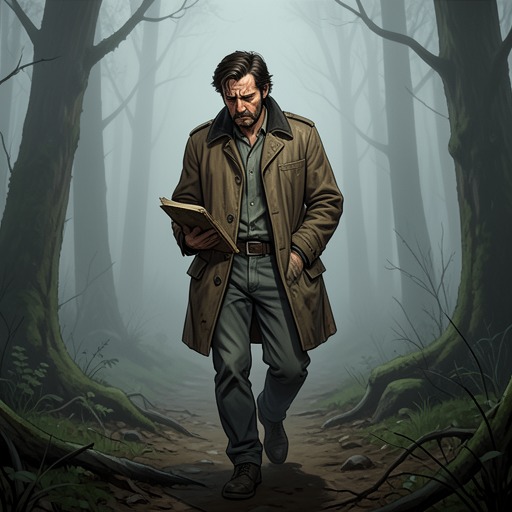
Abraham Portman
Miss Peregrine's Home of Peculiar ChildrenAbraham Portman is Jacob Portman’s grandfather and the figure whose carefully softened stories first shape, then overturn, Jacob’s understanding of his family. The adventures Abraham recounted as a boy were rooted in a history of persecution, displacement, and loss; his concealed identity as a peculiar and hunter of Hollowgasts explains both the stories and the dangers that followed him into later life.
Identity and Background
As a child, Jacob knew Abraham as a fascinating storyteller with a seemingly extraordinary past: an orphanage, wars, ocean crossings by steamship, desert journeys on horseback, circus performances, and knowledge of weapons, self-defense, wilderness survival, and several languages. Abraham told these tales as secrets entrusted to his grandson. He also spent afternoons with Jacob poring over maps, plotting imaginary expeditions marked with red pushpins, and encouraging the boy’s ambition to explore.
The apparent adventure was a protective disguise for a far harsher past. Abraham was the only member of his family to escape Poland before the Second World War. At twelve, sent by his parents to Britain, he left with a suitcase and the clothes he wore, on a one-way journey. He never saw his parents or his older brothers, cousins, aunts, and uncles again; all were dead before he turned sixteen, killed by the Nazis. The contrast between the young boy’s solitary escape and the family he left behind defines the cost beneath his later tales of adventure.
Refuge and Concealed History
Abraham’s account of an enchanted island and its magical children transformed a refuge into a fairy-tale paradise. The children’s home that received him offered a safe haven in contrast to mainland Europe’s persecution. In reality, the children’s apparent peculiarity in Abraham’s stories was bound up with their Jewishness and their status as war orphans. Their survival, rather than miraculous powers, was the wonder that his stories preserved in disguised form.
Miss Peregrine later confirms that Abraham really had been fleeing the Nazis. She found him in a displaced-persons camp on the mainland, a boy she describes as poor and deeply troubled but strong, and immediately recognized that he belonged with the children in her care. This recollection validates the essential truth beneath the family legend while clarifying that Abraham’s arrival was part of the upheaval of the years leading up to the war.
The Ordinary Life and the Hidden Work
After the war, Abraham left for America. Miss Peregrine says that there were few Hollowgasts there at the time and that a minor exodus of peculiars followed the war. For a while, many could pass as common, as Abraham did. He wanted an ordinary life, a wish he repeatedly mentioned in letters; Miss Peregrine believes he kept the truth from Jacob because he wanted his grandson to have the ordinariness he himself could never attain.
That aspiration remained in tension with what Abraham could do. His unique skill, together with the hunting abilities he had developed during the war, made him valuable against Hollowgasts. He was repeatedly asked to help eradicate troublesome pockets of them and, by Miss Peregrine’s account, rarely refused. The family photograph of Abraham in a suit on a hunting trip, once merely a childhood joke to Jacob, acquires a different meaning in retrospect: Abraham was hunting more than animals.
Relationships and Separation
Abraham’s relationship with Jacob was built around stories, shared maps, and encouragement. When Jacob grew older and rejected the stories as fabrications, Abraham did not argue; he simply accepted the dismissal, and the stories stopped. Jacob later learned that they were not simply lies but exaggerated, protective versions of real experiences. He felt ashamed of having envied a life whose apparent adventure had been purchased through displacement and loss.
Abraham’s departure also left a lasting separation from Emma Bloom. He left during the war, saying he loved her and promising to return, but did not. He believed he could not live with himself if he sat out the persecution and killing of his people; he regarded fighting as his duty. Emma waited through the war, fearing that each letter might bring news of his death. Afterward, Abraham said he could not return, explaining that he had learned to defend himself and no longer needed Miss Peregrine to look after him. He planned to make a home in America and send for Emma, but she waited so long that reunion no longer seemed possible; by then he had taken up with someone else. His choice of duty and a hoped-for common life therefore carried a personal cost, as well as separating him from the people and refuge he had left.
Final Message and Narrative Role
Near the end of his life, Abraham’s message to Jacob directs him to the island, warning that it is not safe where he is and asking his grandson to promise to go. Jacob initially recognizes this as the familiar paranoia of his grandfather’s later years, but the instruction proves consequential: he travels to the place Abraham meant and carries Abraham’s letter to Miss Peregrine. When Jacob explains that Abraham sent him to find her, she reads the letter, realizes that he is gone, and hears the account of his death that Jacob has been able to give her.
Abraham’s history is thus revealed in stages: first as boyhood adventure, then as an explanation for the guarded family stories, and finally as the key to Jacob’s search. On the island, Jacob tells its residents that Abraham was his grandfather. Miss Peregrine’s account of Abraham’s wartime life and his later work against Hollowgasts completes the contrast between the ordinary life he wanted and the exceptional responsibilities he could not escape. His last direction to Jacob transforms a private, concealed past into the beginning of the grandson’s own discovery.