Bombs in the Loop
Miss Peregrine's Home of Peculiar ChildrenThe bomb in the loop is both an image of the disaster Jacob Portman fears and the centerpiece of a staged demonstration that reveals the loop’s nightly reset. As it falls toward the children, Jacob understands it as the moment of their supposed deaths; when it stops in midair and the scene gives way to whiteness, the bomb’s threat resolves not in destruction but in the children’s return to their former positions. Its disappearance, followed by laughter and the children removing their masks, exposes Jacob’s fear as the effect of a deliberate initiation rather than a real attack.
The Apparent Threat
The bomb appears during the night’s approach of an airplane. Jacob hears an engine drawing close and recognizes the moment as the one he believes killed the children. His fear is sharpened by the loop’s repetition: he wonders whether the children die each evening only to be brought back, condemned to undergo the same destruction again. The bomb gives that dread a visible shape. Small and gray against the clouds, it hurtles toward the group; its fall seems to confirm Jacob’s belief that the nightly disaster is beginning in earnest.
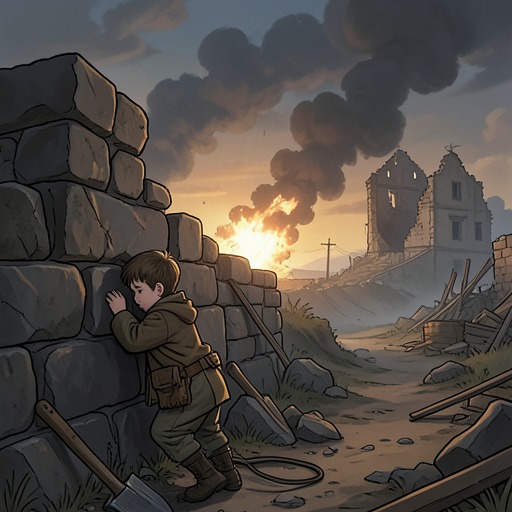
Jacob has no time to escape. He drops to the grass and covers his head, bracing for an explosion. The scene has compressed the loop’s familiar nightly danger into an immediate question of survival: the children’s apparent past death seems about to happen again before Jacob’s eyes. His alarm is not merely a reaction to the falling object; it comes from his attempt to understand what the loop’s repeated catastrophe means for those trapped within it.
Suspension and Whiteout
Instead of an explosion, the world falls silent. Jacob looks up to find the scene stopped around him: tree branches remain fixed, flames appear arrested against the clouds, and raindrops hang motionless. At the center of the children, the bomb hovers with its downward-facing tip balanced on Adam’s outstretched finger. The contrast between its imminent fall and its impossible stillness turns the bomb from a weapon in motion into an object held within the loop’s suspension.
The suspension ends in a spreading white flash that overtakes everything. The sequence does not show the bomb striking or exploding. Instead, the disappearance of ordinary movement and sound, followed by whiteness, marks a break in Jacob’s experience of the scene. The bomb’s arrival and interruption therefore make the loop’s reset legible to him through a sudden change in what he can perceive, rather than through an explanation of its mechanics.
Return and Revelation
When Jacob can hear again, he hears laughter. The white fades, and the children are arranged around Adam as they were before; the bomb is gone, and the night is quiet beneath a full moon. The scene’s return to its earlier arrangement makes the apparent catastrophe a repetition that has been interrupted and reset, not a new destruction. Miss Peregrine helps Jacob to his feet and apologizes for not having prepared him better, while smiling along with the other children.
The children remove their masks, and Jacob realizes that they have been hazing him. This revelation changes the meaning of the bomb’s appearance: the terror was part of a staged introduction to the loop’s nightly spectacle, not evidence that the children had just been killed. Jacob’s question about whether he may go home for the night follows his disorientation and lingering fear. For him, the bomb has made the loop’s danger feel immediate; for the children, the reset and the prank expose how differently they understand the recurring scene.
Significance in the Loop
The bomb concentrates the conflict between apparent catastrophe and repeated continuity. Jacob sees the falling object through the logic of ordinary death, imagining that the children are killed every evening; the reset instead restores the scene, leaving them gathered around Adam and the bomb absent. The object thus introduces Jacob to a world in which a threat can recur without producing the ending he expects, while still making that recurrence frightening to experience.
Its brief course—from fall, to suspension, to disappearance—also gives the loop a visible rhythm: danger approaches, the scene breaks, and the children return to their previous arrangement. The episode does not make Jacob immediately comfortable. Even after laughter replaces silence, he is lightheaded and asks to leave. The bomb’s lasting significance is therefore not an injury or a confirmed death, but Jacob’s first unsettling encounter with the repeated nightly disaster and with the gap between his understanding of it and the children’s.