Cairnholm time loop
Miss Peregrine's Home of Peculiar ChildrenCairnholm time loop is the temporal enclosure that holds Miss Peregrine and her wards in a single repeating day, September 3, 1940. It offers safety and continuity within a world otherwise moving through history, but that protection comes at the cost of ordinary change: residents may accumulate decades of experience while living the same date again and again. The loop is both refuge and confinement, and its eventual failure releases the children into a future that has been waiting beyond its boundary.
Discovery and Setting
The loop’s date first becomes legible to Jacob Portman through ordinary details. In a room, a calendar shows September 1940, with the first two days crossed out; the surrounding people and objects had seemed at once old-fashioned and strangely new. He connects the date to his grandfather’s directions about finding the children on the other side of the old man’s grave. The local name for the bog boy, he realizes, is the Old Man, whose grave is the cairn: Jacob had entered it and emerged elsewhere, on September 3, 1940.
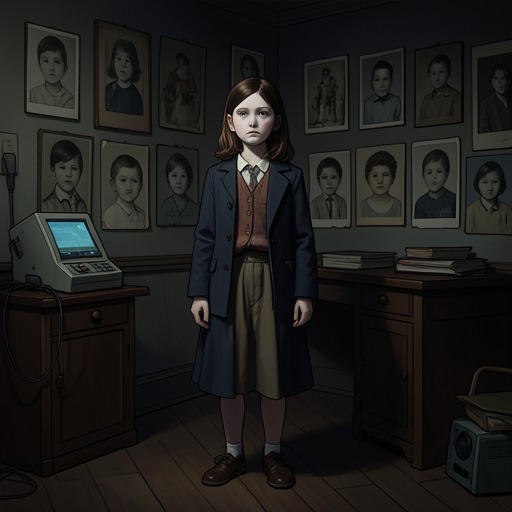
The recovered house makes the temporal displacement visible in space as well as in date. Emma Bloom and Millard Nullings lead Jacob from the woods across a broad, flowered lawn to the house he had previously explored in ruins. Inside, the obstructed hallways, damaged staircase, fallen plaster, mold, and rotted furniture have given way to varnished wood, wallpaper, painted rooms, arranged flowers, and sunlight through clear windows. The same building exists in radically different conditions because Jacob has crossed from the island’s later, ruined state into the loop’s preserved day.
How the Loop Works
Miss Peregrine explains that an ymbryne can manipulate time fields for herself and others, creating loops in which peculiar people may live indefinitely. The island’s loop is known as September 3, 1940: the day repeats over and over, but the residents’ experience remains continuous. They remember their past within the loop, including the decades they have spent there, even though the calendar does not advance. Millard Nullings confirms the repetition by observing that the events Jacob asks about happened yesterday and the day before as well.
The loop’s continuity requires maintenance. Miss Peregrine says that one of the ymbrynes must cross through the entrance periodically to keep it pliable. She compares the ingress point to a hole in fresh dough: without being opened from time to time, it may close. A functioning entrance also provides a way for pressures in the closed temporal system to vent; if there is no ingress or egress, the loop becomes unstable. The system’s apparent permanence therefore depends on recurring passage across its boundary, not on a self-sustaining stillness.
The loop also belongs to a wider, interconnected temporal geography. Millard describes leapfrogging from one loop to another, including a loop set fifty years earlier, as a dangerous and highly complex way to reach loops that have ceased to exist in ordinary time. Those loops may in turn provide access to further loops, expanding the possible routes through time. Cairnholm’s repeated day is thus a bounded home, but not the only temporal enclosure in the world.
Refuge, Routine, and Confinement
For Jacob, the loop’s daily atmosphere has a powerful effect. After Miss Peregrine warns him about other dangers and sends him outside, he finds that his concern over a withered apple fades from his attention. While waiting under a tree for Emma, who has gone on a supply run to the village, he becomes drowsy and serenely preoccupied with lunch. He experiences the loop as both mood-enhancing and sedative, as though staying there could soften the desire to leave.
That comfort gives the setting its double character. The children’s surroundings are beautiful, and their lives within the loop avoid the ordinary passage of time; yet Miss Peregrine has said they cannot simply leave without danger. Jacob recognizes that a repeated day may be a kind of prison as well as a haven. Its pleasantness does not remove the restriction. Instead, the ease of remaining may delay the moment when its residents ask what an unrepeatable future could have held.
Failure and Release
The loop’s dependence on its entrance makes temporal safety vulnerable. Miss Peregrine’s account establishes that a loop can become unstable if its passage is not maintained, and Cairnholm’s loop ultimately fails to reset after the children’s home is destroyed. The narrative consequence is not another repetition of the familiar date but the return of forward-moving time.
After the children leave the ruined home and cross the island, it is September 4. For the first time in a very long while, the days are moving again. Some of the children say they can feel the difference in their bodies; Jacob shares their sense that they are more vital and real. The ending converts the loop’s central tension into a change of condition: the repeated day had preserved a life, but leaving it restores the possibility of days that are genuinely new.
Narrative Significance
The loop organizes the novel’s contrast between historical time and lived time. The calendar’s fixed date initially reads as a puzzle; once Jacob understands what he has entered, it becomes a rule governing the children’s whole existence. Repetition does not mean that experience is erased: the residents remember decades, while the world outside continues to change. The result is a sharp separation between accumulated personal memory and a public calendar that remains stuck.
The loop also makes that separation tangible through thresholds. The cairn carries Jacob from the island’s ruins into its restored past; the maintained ingress keeps the enclosed day accessible; and the children’s departure marks the return of historical succession. Its shelter cannot be understood apart from its cost, nor its failure apart from the future it releases. When September 4 finally arrives, time is no longer a room the children inhabit but a direction in which they can move.