Frank Portman
Miss Peregrine's Home of Peculiar ChildrenFrank Portman, Jacob Portman’s father, is an amateur ornithologist and aspiring nature writer whose interest in birds helps bring father and son to Cairnholm. His memories also mediate Jacob’s understanding of Abraham Portman: Frank describes a father who was often absent, recalls a letter that seemed to confirm an affair, and remains uncertain when Jacob suggests that Abraham’s earlier losses may explain his distance. Frank’s role is therefore both practical and interpretive—he accompanies Jacob into the island setting, but the family history he shares leaves its central mystery unsettled.
Identity and family life
Frank volunteers part-time at a bird rescue, helping rehabilitate snowy egrets injured in collisions with cars and pelicans that have swallowed fishhooks. He is also an amateur ornithologist and a would-be nature writer, with a stack of unpublished manuscripts. Jacob’s narration presents these pursuits with affectionate irony, noting that Frank’s ambitions are supported by a household whose financial security comes from his wife’s family owning a hundred and fifteen drug stores.
Frank’s concern for his father is visible before the island trip begins. When asked whether Abraham has taken his pills, Frank cannot establish the answer and asks Jacob to stop by and make sure the older man is all right, explaining that work prevents him from going himself. Jacob agrees. Frank thanks him and promises that the family will sort out the situation with Abraham soon, a reassurance that conveys his effort to manage the problem even as responsibility passes to his son.
The journey to Cairnholm
Frank’s interest in birdlife becomes the practical rationale for a three-week trip to Cairnholm with Jacob in June. He says he needs that much time to make a thorough study of the island’s bird colonies. The family makes arrangements quickly, and Jacob initially wonders whether three weeks is excessive. Jacob’s mother appears enthusiastic, calling the trip a big adventure for her two men, though Jacob later overhears her telling a friend that she will be relieved to have her life back while they are away.
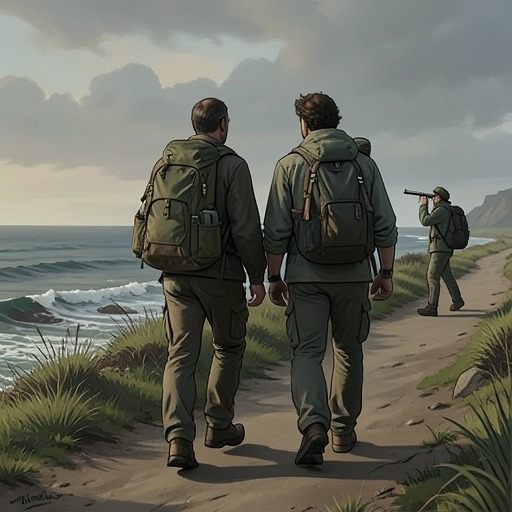
The passage to the island tests the expedition before it reaches its destination. Frank and Jacob endure thirty-six hours of travel, including three airplanes, two layovers, time spent sleeping in train stations, and a rough ferry crossing. In thick fog, Frank stands beside his son on deck in shirtsleeves despite the cold and wet. When the captain announces that they are nearly there, Frank spots the island emerging from the mist and calls Jacob’s attention to it. He then identifies Manx shearwaters among the birds overhead, responding to the landscape with the excitement of a naturalist. For Jacob, the bleak, bird-guarded island makes the possibility of a magical place seem less far-fetched.
Frank’s account of Abraham
Away from home, Frank speaks more openly than Jacob is used to hearing him speak. He describes Abraham as someone who, in Frank’s view, did not know how to be a father but felt obligated to take on the role because none of his brothers and sisters survived the war. Frank interprets Abraham’s frequent hunting and business trips as a way of coping with that responsibility: even when Abraham was physically present, Frank says, he often seemed absent.
Frank also recounts a discovery that shaped the family’s suspicions. He and Aunt Susie once found a letter addressed to Abraham from a woman whose name they did not know. Its declarations of love and longing led them to suspect that Abraham had another relationship. The children tore up the letter and flushed it away; Frank says they never found another, and assumes Abraham became more careful. The episode left Frank with a painful but incomplete explanation for his father’s absences: the letter suggested infidelity, but did not establish what Abraham had actually been doing on his travels.
Conflict and reinterpretation
Jacob proposes another way to understand Abraham’s distance. He points out that Abraham had lost his family twice—first in Poland and later, after being adopted, on Cairnholm—and asks whether those losses might have affected how Abraham related to his own children. Frank does not dismiss the possibility, but neither accepts it as a complete answer. He says he does not believe things are ever that simple, preserving uncertainty rather than replacing one confident explanation with another.
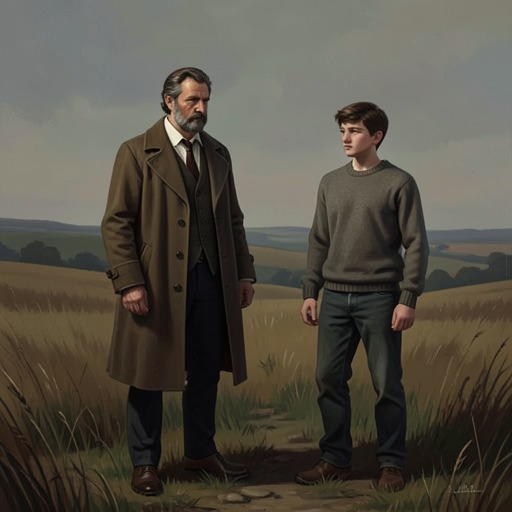
Frank instead turns the discussion toward Jacob’s closeness with Abraham. He suggests that their bond may itself be explained by the family history they have been discussing, though the conversation does not settle exactly how. This exchange makes Frank more than a source of background information: his recollections expose the emotional gap between himself and his father, while Jacob’s questions challenge the interpretation Frank has carried. Neither son nor father can make Abraham’s behavior entirely legible from the surviving evidence.
Narrative role and significance
Frank’s birding gives the trip a credible family purpose, while also placing him in a landscape where birds, weather, bog, and sea materially shape what the travelers can see and do. His response to the island contrasts with Jacob’s initial anxiety about the long journey: Frank is alert to bird colonies and eager to study them, whereas Jacob hopes the trip will help him put Abraham’s mystery to rest. The same journey thus serves two distinct aims—field observation for Frank and an inquiry into family history for Jacob.
As a character, Frank is rendered through both care and limitation. He asks Jacob to check on Abraham when he cannot leave work, takes his son on the journey, and shares a difficult family memory; at the same time, his account of Abraham rests on suspicion and recollection rather than certainty. His refusal to reduce the past to a simple explanation keeps the family story open, and leaves Jacob to weigh inherited stories against what he encounters on Cairnholm.