Jacob Portman
Miss Peregrine's Home of Peculiar ChildrenJacob Portman is the novel’s first-person narrator and the grandson whose search for the truth about Abraham Portman carries him from an apparently ordinary life into the hidden world his grandfather had tried to describe. His decisive transformation begins with grief and uncertainty, but takes shape through a chain of clues: a plea to go to an island, a photograph of a pipe-smoking headmistress, and the discovery that Abraham’s ability to see monsters has passed into the story of Jacob himself.
Identity and Early Life
Jacob grows up in Florida, where Abraham is the most fascinating person he knows. Abraham tells him about an orphanage, wars, ocean crossings by steamship, desert journeys on horseback, circus performances, weapons, wilderness survival, and languages Jacob cannot speak. To a child who has never left Florida, these experiences seem impossibly exotic; Abraham tells them as secrets entrusted to his grandson, making their relationship a channel for adventure and confidence.
At six, Jacob decides to become an explorer so that he might have a life half as exciting as Abraham’s. His grandfather joins him over maps, plotting imaginary expeditions with red pushpins and naming fantastic places Jacob might discover. Jacob carries a cardboard tube like a spyglass and shouts commands about landing parties, while his parents worry that the fantasies will divert him from practical ambitions. His mother tells him that everything has already been discovered and that he was born in the wrong century. The childhood exchange establishes the ordinary-versus-extraordinary tension that will later define his choices: the world is presented to Jacob as already mapped, but Abraham’s stories leave it open again.
The Call to Cairnholm
After Abraham is gravely injured, Jacob reaches him and tries to lift him, then stops when the movement makes him rigid with pain. Brushing loose soil from his face and thinning white hair, Jacob notices that Abraham is trying to speak. His grandfather shifts between English and Polish, then focuses long enough to tell him, “Go to the island, Yakob. Here it’s not safe.” Jacob calls the warning old paranoia and reassures Abraham that they will be fine, even though he recognizes that he has lied to him twice that day. Abraham repeats the plea and asks for a promise. The island first enters Jacob’s journey not as an exciting destination but as a final, urgent instruction from a dying man.
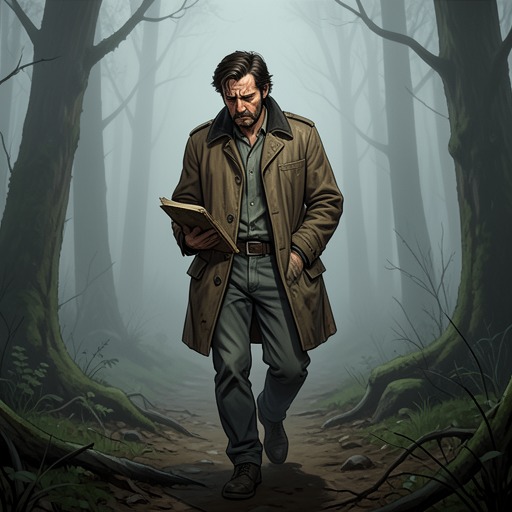
The clue gains meaning when Jacob studies an old snapshot of a woman smoking a curved pipe. A letter associated with the photograph bears a fading postmark for Cairnholm Island, Wales. Jacob connects it to Abraham’s earlier instruction to find the bird and to his childhood memory of a children’s home protected by a bird who smoked a pipe. The woman’s name, Peregrine, also recalls a hawk. He begins to suspect that the figure Abraham wanted him to find was the headmistress who had rescued him, and that she might still be on the island. The photograph and postmark turn the grandfather’s stories into an investigative trail: what once seemed like a child’s literal misreading becomes a plausible account of a real person and place.
Meeting Miss Peregrine
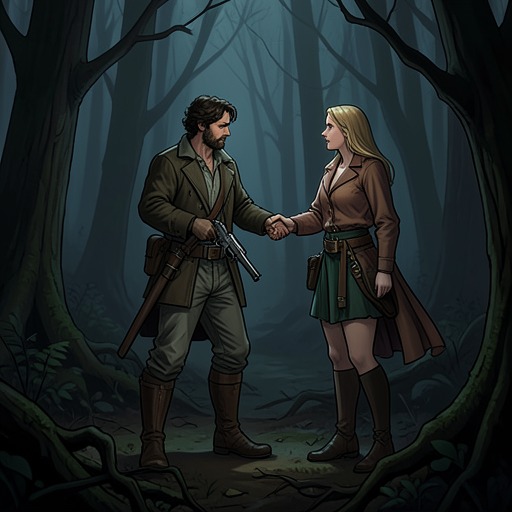
On the island, Jacob encounters Emma Bloom with a knife at his throat. She asks what he is and why he was in the house or following her; Jacob can only stammer that he is an American named Jacob and plead that he wanted to talk. The meeting makes plain that the island’s inhabitants do not automatically recognize him as a harmless visitor. His unfamiliarity with their world leaves him vulnerable, while Emma’s fear makes the encounter dangerous rather than welcoming.
Jacob eventually tells Miss Peregrine that Abraham meant to explain everything but waited too long, and that he sent Jacob instead. He hands her the crumpled letter that brought him there. Miss Peregrine smooths it over the arm of her chair and reads it, lamenting how desperately she had asked Abraham for a reply and recalling that she and the others had been desperate for news of him. Her wistfulness turns to a dark realization: Abraham is gone. Jacob’s arrival therefore serves both as the fulfillment of his grandfather’s instruction and as the bearer of news that ends Miss Peregrine’s long uncertainty.
Miss Peregrine then leads Jacob upstairs to the library, now arranged as a classroom with desks in a row, a chalkboard, and books organized on the shelves. She seats him and offers a primer intended to answer most of his questions. The room’s transformation into a place of instruction marks a change in Jacob’s position: rather than only chasing fragments from outside, he is invited to learn the history and terms of the world Abraham’s stories had concealed.
Inherited Sight and Responsibility
Jacob initially rejects the possibility that he is special, describing himself as the most average person Miss Peregrine could meet. She answers that Abraham possessed a rare ability, then identifies it directly: “He could see the monsters.” The words bring back the horrors Jacob thought he had left behind. They confirm that the creatures were real and that they killed Abraham, while recasting the grandfather’s stories as evidence of a world Jacob has inherited rather than escaped.
That inherited sight soon becomes useful to the group. When the children discuss forming a hunting party, Bronwyn says, “We’ve got Jacob,” because he can see the monsters. Jacob feels his throat tighten as he realizes that, if the party goes ahead, he will be partly responsible for everyone’s safety. He qualifies the confidence placed in him: he has seen only one and does not consider himself an expert. The exchange establishes both the practical value and the limits of his ability. Jacob is not presented as an experienced hunter; the children’s dependence on him arises from a particular capacity he scarcely understands, and it brings responsibility before mastery.
Narrative Role
Jacob’s story is organized around the widening gap between what he believes about his life and what the evidence forces him to accept. Abraham’s tales first provide a private imaginative world, then the island, photograph, letter, and Miss Peregrine give that world a concrete geography and history. His narration preserves the sequence of discovery: he recognizes the clues as a grandson trying to understand a death, while the reader learns alongside him that the supposed fantasies have real stakes.
The motif of seeing binds Jacob’s childhood and his emerging role together. He once studied maps with Abraham and imagined that the unexplored world lay ahead; now the task is not to discover a distant place for its own sake, but to recognize a danger others cannot see. His claim to be ordinary contrasts with the ability that makes him necessary to the children. That contrast does not make him instantly confident: it leaves him conscious that others may depend on him before he knows what he can do.