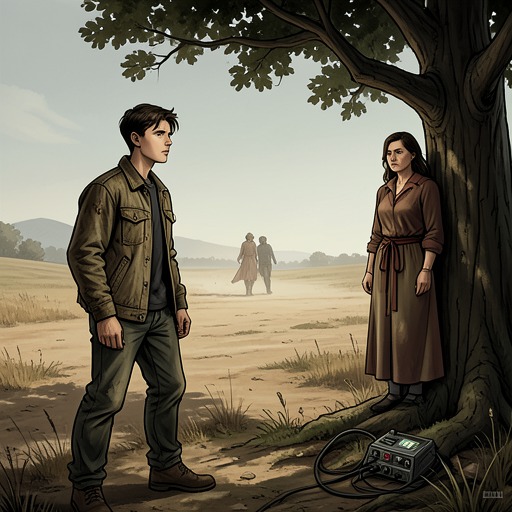
Jacob Portman and Abraham Portman
Miss Peregrine's Home of Peculiar ChildrenJacob Portman and Abraham Portman’s relationship is the emotional and investigative hinge of Jacob’s early story: Abraham gives his grandson a childhood rich in imagined possibility, then leaves him a final message that turns affection and grief into a search for the truth. Their bond changes as Jacob learns that the stories he once cherished were not simply inventions but imaginative disguises for the danger and loss Abraham had survived.
Childhood stories and shared imagination
To Jacob, Abraham is the most fascinating person he knows. His grandfather’s accounts of an orphanage, wars, ocean crossings by steamship, desert journeys on horseback, circus performances, weapons, wilderness survival, and languages beyond English make an extraordinary world seem close enough to enter. Abraham tells these stories as secrets entrusted to Jacob, giving their exchanges the intimacy of a confidence shared between the generations.
Abraham does more than entertain his grandson: he joins him in imagining a future. When Jacob decides at six that he wants to become an explorer, Abraham spends afternoons hunched over maps with him, plotting imaginary expeditions with red pushpins and describing places Jacob might someday discover. At home, Jacob parades around with a cardboard tube held to his eye, calling out, “Land ho!” and “Prepare a landing party!” His parents eventually send him outside, while his mother tells him that everything has already been discovered and that he was born in the wrong century. The disappointment of that answer is a measure of how much Abraham’s stories have enlarged Jacob’s sense of what a life might contain.
Belief, embarrassment, and the stories’ hidden truth
Jacob believes Abraham’s tales for several years, partly because he wants them to be true. That belief becomes socially costly in second grade, when Robbie Jensen pulls down Jacob’s pants at lunch in front of a table of girls and mocks him for believing in fairies. Jacob fears being branded the “fairy boy” and resents Abraham for having made him vulnerable to humiliation. When Abraham picks him up in his old Pontiac, Jacob declares that he no longer believes the stories. Abraham does not argue; he says “Okay,” puts the car in gear, and drives away. The abrupt end to their storytelling leaves Jacob feeling deceived, even though he cannot understand why his grandfather had encouraged such belief in the first place.
Years later, Jacob’s father explains the distinction that reshapes his understanding: Abraham had told him similar stories as a child, but they were exaggerated versions of the truth, not straightforward lies. Abraham had been the only member of his family to escape Poland before the Second World War. At twelve, sent to Britain on a one-way train with only a suitcase and the clothes he wore, he never saw his parents, older brothers, cousins, aunts, or uncles again; they were killed before he turned sixteen. His stories’ human-faced monsters evoke the danger he had fled, while the enchanted island and its children’s home transform a refuge from European horrors into a paradise of endless summers and guardian angels. Jacob learns that the supposed magical peculiarity at the heart of those stories was, in reality, the children’s Jewishness and the persecution that made them orphans.
This revelation also changes the meaning of Jacob’s earlier resentment. The stories had offered him a child’s fairy tale, but their imaginative shape carried a history of terror that Abraham did not disclose directly. Jacob stops asking for more stories, and an air of mystery closes around his grandfather’s early life. He does not pry, believing Abraham has earned the right to keep his secrets. He feels ashamed that he had envied a life whose apparent adventure came at such a terrible price, and tries to feel grateful for his own safe, unextraordinary one.
A dying message and Jacob’s responsibility
The bond takes on a new urgency when Jacob finds Abraham gravely wounded. Unable to move him without causing pain, Jacob brushes loose soil from his grandfather’s arms, face, and thinning white hair, then leans close to hear him mumbling between English and Polish. Abraham tells him to go to the island because it is not safe where they are. Jacob recognizes the warning as part of his grandfather’s old paranoia and reassures him, although the reassurance is another lie offered to a dying man.
Abraham then admits that he thought he could protect Jacob and should have told him something long ago. Before he loses strength, he gives Jacob a set of instructions: “Find the bird. In the loop. On the other side of the old man’s grave. September third, 1940.” He also invokes Emerson and a letter, telling Jacob to show them what happened. The message is both intimate and obscure: Abraham addresses Jacob by the name Yakob, asks for a promise of safety, and entrusts him with a task whose significance the boy cannot yet grasp. Jacob tells his grandfather that he loves him as Abraham’s gaze drifts away.
From grief to investigation
After Abraham’s death, Jacob resists dismissing the last words as delusion. They have been troubling him alongside his nightmares, and he feels he owes his grandfather more than disbelief. Dr. Golan also argues that understanding the message might help Jacob’s dreams, giving the investigation both a personal and a practical impetus. Jacob reasons that Abraham feared the monsters might come after him and thought the island could offer safety, as it had once offered safety to Abraham. He suspects that the references to the loop, the grave, and the letter are breadcrumbs leading to someone who knows the secret Abraham could not explain in time.
At first Jacob tries to interpret the clues in familiar surroundings. He wonders whether “the loop” means a looping street in Circle Village and whether Emerson is a person Abraham once knew. He imagines a letter dated September third, 1940, perhaps connected to a graveyard, and searches online before asking at the Circle Village community center whether anyone knows a Mr. Emerson or where the graveyard is. These guesses show how far the message initially stands from Jacob’s understanding; what Abraham leaves him is not an explanation but a path Jacob must learn how to read.
The investigation also returns Jacob to the human history behind the stories. On Cairnholm, after hearing Oggie describe Abraham as having asked when the next boat would leave for the mainland so he could take up arms against those who murdered his people, Jacob identifies himself plainly: “I knew him. He was my grandfather.” The others are astonished. For Jacob, the recognition joins the island’s account of the boy Abraham had been to the grandfather he knew: the imagined adventurer was also a bereaved child who wanted to fight back.
What the relationship leaves to Jacob
Abraham’s influence persists through a reversal. As a child, Jacob receives the stories as an invitation to dream; after learning their historical basis, he understands that their wonder had concealed a survival story. After Abraham’s death, the same storytelling relationship becomes an unfinished act of transmission: the grandfather who once plotted imaginary expeditions with him leaves clues that require Jacob to travel, interpret, and uncover what was withheld.
The relationship therefore binds tenderness to secrecy without making the secrecy a simple betrayal. Jacob is hurt when Abraham’s stories collapse into apparent make-believe, and later ashamed of that hurt when he learns what the stories protected him from confronting. Abraham’s final words do not resolve every silence; they turn it into responsibility. Jacob’s pursuit of the island, the loop, and the letter begins as an effort to honor the last request of the person who first taught him to imagine a world beyond the ordinary.