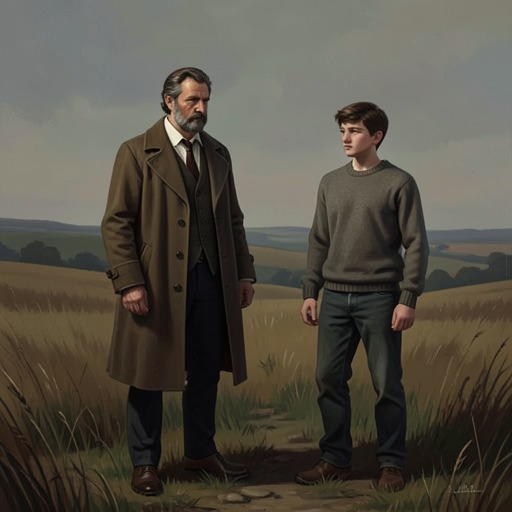
Jacob Portman and Frank Portman
Miss Peregrine's Home of Peculiar ChildrenJacob Portman and Frank Portman’s relationship is shaped by a family history neither initially understands in the same way. Frank remembers Abraham Portman as a distant father who kept his past and his travels to himself; Jacob, by contrast, had been close to his grandfather and had believed the extraordinary stories he told. Their journey to Cairnholm Island brings these accounts together. Frank speaks of hurt that had gone unspoken, and Jacob tries to understand how Abraham’s loss might have affected both his father and himself. The relationship becomes a point where inherited silence can be questioned, even though understanding the past does not undo its effects.
Family History and the Journey
Frank agrees to travel with Jacob to Cairnholm Island for a three-week trip in June. Jacob’s stated reason for wanting to go is to learn more about the family, while Frank plans to study the island’s bird colonies. Jacob does not tell his parents the full reason for his determination, which is bound up with his grandfather’s last words, a letter, and a photograph. The trip therefore begins with a gap between what father and son say they are doing and what Jacob privately hopes to discover.
At the island, Frank gives the journey a family explanation: his father had spent part of his childhood there. When asked about the trip, he describes it as a small genealogy project, avoiding talk of psychiatrists or dead grandfathers. His brief answer shows that the family past is present in their plans but not yet openly discussed between them.
Frank’s Account of His Father
A conversation between father and son turns toward Frank’s relationship with Abraham. Asked whether he had been interested in understanding his father, Frank says that he eventually stopped trying. He explains the withdrawal through the image of someone who will not let another person in: after repeatedly finding the door closed, he stopped knocking. His account makes clear that their distance was not a simple lack of interest, but the result of Frank’s attempts to reach a father who remained emotionally inaccessible.
Frank recalls Abraham as someone who, in his view, did not know how to be a father but felt obliged to take on that role after the war had killed his brothers and sisters. He says Abraham dealt with that difficulty by being away on hunting trips and business trips, and that even when he was home he seemed absent. Frank’s description gives a painful domestic shape to a history that Jacob had encountered mainly through his grandfather’s stories.
The estrangement is attached to a specific childhood memory: Frank had waited in a pink bunny costume for Abraham to take him trick-or-treating, but Abraham never came. Frank’s mother photographed the upset child as evidence of the broken promise, and the picture later became a family story that embarrassed Frank. When Jacob brings up the episode, Frank insists that the problem amounted to more than one missed Halloween. He also tells Jacob that Jacob had been closer to Abraham than he himself had been, suggesting that grandfather and grandson shared a closeness Frank had not experienced.
What the Past Reveals
Frank tells Jacob about a suspicion he and Jacob’s aunt had formed: that Abraham’s frequent absences might have involved another woman. He admits that he had avoided investigating too deeply because he feared what he might find. The disclosure unsettles Jacob, who had worshipped his grandfather, and Frank reaches out to comfort him; Jacob shrugs off the gesture and says he does not worship anyone. The exchange exposes both the tenderness and the defensiveness in their relationship: Frank wants to prepare his son for painful information, while Jacob resists being treated as someone whose image of Abraham can simply be corrected.
After Jacob learns more about Abraham, he returns to Frank and considers another explanation for the older man’s distance. Abraham had lost his birth family in Poland and later, Jacob suggests, may have experienced the family he formed in the present as another possible loss. Jacob wonders whether fear, rather than infidelity, could account for Abraham’s behavior toward Frank and his aunt. Frank gives this possibility a guarded reception, but the conversation lets Jacob propose a reading that differs from the suspicion Frank had carried.
Frank’s response to the revelation reflects his own grievance: he is angry that Abraham never told him about this history. Jacob recognizes the difference between a grandfather withholding painful history from a grandchild and a father keeping it from his son. He nevertheless imagines that Abraham’s losses could help explain why he seemed distant when Frank and his sister were young, and why his bond with Jacob emerged later. Jacob cannot tell his father directly that Abraham may not have loved him enough; instead, he ends the conversation and goes upstairs.
Inherited Silence and Its Cost
The relationship is set within a longer chain of loss. Abraham was the only member of his family to escape Poland before the Second World War, sent to Britain at twelve and separated permanently from the relatives who remained behind. Later, Jacob learns that Abraham’s life as a Jewish person and a peculiar was marked by persecution and the deaths of people belonging to both communities. Miss Peregrine believes Abraham kept his knowledge from Jacob because he wanted to protect him from a life of trials and deprivation. These details make Frank’s account of an absent father part of a larger history without erasing the hurt he describes.
For Jacob, the family history becomes an acute emotional burden. He thinks about Abraham’s lost relatives, Frank’s experience of growing up without a present father, and his own distress, understanding the old wound as something passed down through the family. This recognition does not give him a way to punish the dead or repair what Frank missed as a child. It does, however, change how he interprets the distance between father and son: Frank’s pain and Abraham’s trauma are connected, but they are not interchangeable.
Change and Significance
Jacob and Frank do not reach a simple reconciliation. Frank’s memories remain painful, and Jacob cannot make the explanation he offers erase them. Yet the conversations mark a change in what can be said between them. Frank risks telling Jacob about his estrangement and his fears; Jacob listens, questions the assumptions surrounding Abraham, and tries to place his father’s childhood within a history of repeated bereavement.
Their relationship gives the family narrative a generational structure: Abraham’s unspoken losses shape the father Frank remembers, and Frank’s account becomes part of the past Jacob must learn to interpret. The bond between Jacob and Frank is therefore neither a repetition of Frank and Abraham’s distance nor an easy escape from it. It is a fragile effort to understand one another while confronting what the family’s silences have already cost.