Jacob’s Passage Through the Cairn into the 1940 Loop
Miss Peregrine's Home of Peculiar ChildrenJacob’s passage through the cairn into the 1940 loop is the turning point at which his search for a girl from the photographs becomes an encounter with the island’s hidden history. Following her footprints through the bog, he enters a Neolithic tomb and emerges into a radically altered Cairnholm; later, the calendar and Miss Peregrine’s explanation establish that he has crossed into a day that repeats. The passage makes his grandfather’s cryptic directions literal and gives the ruined children’s home a living counterpart inside the loop.
The pursuit and the cairn
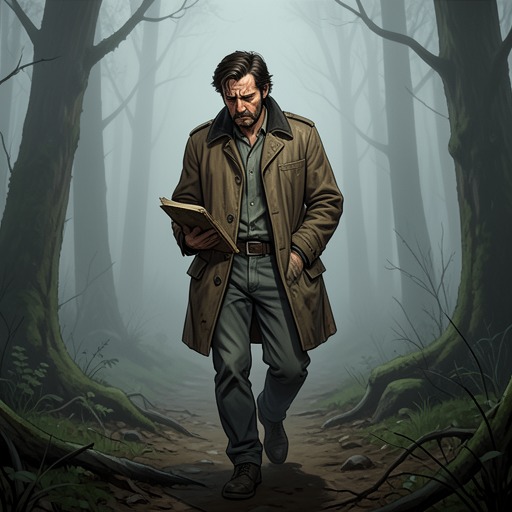
After the people he had seen in the ruined house disappear, Jacob catches a glimpse of a white dress beyond the trees and runs after its wearer. The chase leaves the path and carries him into open bogland. The girl appears to know where the ground is firm, while Jacob struggles through mud and follows her footprints into the mist. Calling out that he is Abe’s grandson and means no harm, he nevertheless loses sight of her and the path.
The footprints lead to a mound of stones: a cairn, one of the ancient tombs associated with the island’s name. Its narrow, rectangular entrance opens onto a tunnel cut into the mound, with carved loops and spirals on either side. Jacob follows the trail inside, moving in a cramped, hunched posture through the damp darkness. He speaks reassuringly to the girl, but his words echo back; when the passage opens into a chamber, it is empty. With his phone serving as a makeshift flashlight, he finds no sign of her.
A mistaken explanation
Unable to account for how the girl could have passed him, Jacob decides that she never existed: he thinks his mind invented her and the other children while he was looking at their photographs. He interprets the sudden darkness before their appearance as a blackout and reasons that the children must have died long ago. That explanation turns the pursuit into a humiliating mistake rather than a supernatural encounter. He abandons the search and decides he wants to go home, tired of his grandfather’s mysteries and convinced that pursuing them has made him worse.
Crawling back out of the tomb, Jacob recognizes the view from a photograph at Martin’s museum, one showing where the bog boy had been discovered. He regards the cairn as a grave, not an entrance to another time. But leaving it reverses that assumption: the same bog and path are now under bright summer sunlight, with the mist gone and the weather markedly warmer. The path, which had seemed muddy, has dried; the island’s animal-drawn carts and older-looking surroundings further unsettle his sense of when he is.
Recognition of September 3, 1940
At the Priest Hole pub, Jacob notices a calendar whose picture shows a tropical beach scene. Above it is the year 1940, and the first two days of September have been crossed out. The date displayed is September 3. In that moment, he connects the altered island to his grandfather’s final directions: the “Old Man” was the local name for the bog boy, whose grave was the cairn, and the instruction to go to the other side of that grave referred to entering it. Jacob realizes that he went inside the cairn and came out on September 3, 1940; the recognition overwhelms him, and he collapses.
The calendar does more than identify a date. It supplies the missing link between the strange setting and the words Jacob had not understood, replacing his earlier theory of hallucination with a concrete route through time. His grandfather’s directions prove literal, and the apparent dead end of the cairn becomes an entrance into the very world Jacob had been trying to find.
The loop and its rules
Miss Peregrine confirms that the place Jacob has entered is a time loop: it is September 3, 1940, repeated over and over, while the inhabitants experience their lives as continuous. She explains that the residents had lived on Cairnholm before that date, but needed temporal isolation from then on. The loop therefore preserves a particular day while allowing its inhabitants to remember the decades they have spent within it.
The entrance is not simply a doorway that can be ignored. Miss Peregrine explains that a ymbryne must periodically cross the entryway to keep it pliable. Without ingress or egress, the loop can close and the temporal system can become unstable. This maintenance rule gives the cairn’s function lasting importance: the threshold Jacob crosses is also part of the mechanism that allows the loop to persist.
What the passage makes possible
Inside the loop, the repeated day offers apparent safety and ease, but Jacob also senses its confinement. Waiting for Emma after learning she is on a supply run, he finds himself unusually calm and drowsy, and wonders whether the loop’s pleasantness helps its residents endure repeating the same day. Its comfort has a cost: the children cannot simply move forward into ordinary historical time, and leaving can be dangerous. The loop’s attraction and restriction are inseparable.
That contrast becomes clearer at the end of the island’s crisis. After the children leave Miss Peregrine’s damaged home and set out across Cairnholm, it is September 4, and time is moving forward again. Some feel more vital and real, a change Jacob shares. The cairn passage thus marks not only his entry into a preserved day but the beginning of an experience against which the later return of chronological time can be measured. By following a trace through a tomb, Jacob crosses from disbelief into the world his grandfather had described.