Martin Pagett
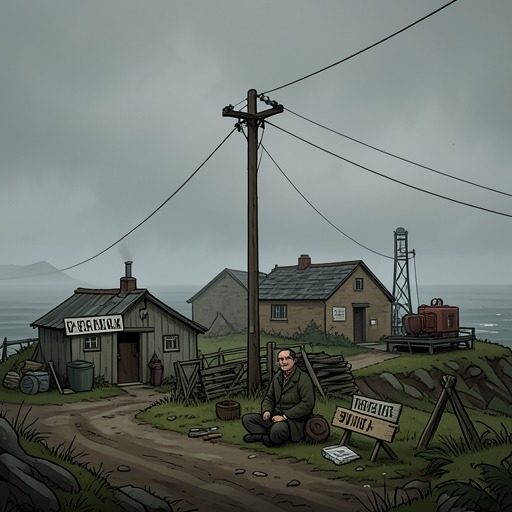
Miss Peregrine's Home of Peculiar ChildrenMartin Pagett, the curator of Cairnholm’s museum, becomes Jacob Portman’s guide to the island’s recorded past. His courteous explanations turn a visit prompted by family questions into a confrontation between local history and Jacob’s inherited memories: Martin names the preserved body in the museum, describes the children’s home as destroyed in a German air raid, and introduces Jacob to an eyewitness who remembers the aftermath.
Identity and Introduction
Martin is introduced as the museum curator, a local source Jacob hopes can explain the island and the people who once lived in the abandoned house. When Jacob encounters a blackened body displayed in a case at the front of the former church, Martin arrives and identifies it as the Old Man, also known to archaeologists as Cairnholm Man. He treats Jacob’s alarm with good humor, observing that other visitors have reacted more dramatically, then introduces himself by name.
Martin explains that the body is more than 2,700 years old, although its occupant was only sixteen at death. Its preservation, he says, is due to conditions beneath the island’s bog, where oxygen and bacteria cannot exist. The museum’s display makes local history tangible, but Martin’s account also turns the apparent age of the body into a distinction between the preserved dead and the young person who died.
The House and the Air Raid
Jacob later returns to the museum to ask what happened to the people from the house. Martin answers plainly that they are dead and that nobody has lived there since the war. When Jacob questions what war he means, Martin clarifies that locals mean the Second World War and attributes the deaths to a German air raid. An anti-aircraft battery at the far end of the island, beyond the wood where the house stood, had made Cairnholm a military target; one bomb went astray and struck the home.
Martin’s explanation gives Jacob a public, historical account of the house’s destruction, but it cannot resolve the questions Jacob brings with him. He admits that he does not know whether the bombing happened early or late in the war. Rather than pretending certainty, he offers to introduce Jacob to his uncle Oggie, who has lived on the island all his life and, Martin says, remains sharp. Martin proposes visiting before Oggie settles down to watch Father Ted, turning the search for testimony into a practical visit to a local home.
A Guide to Local Memory
Martin’s role is not limited to supplying facts: he makes a connection between the museum’s official history and the memories held by island residents. He escorts Jacob to Oggie’s living room and patiently steers the conversation toward the air raid and the children from the home after Oggie has spoken about other topics. The visit gives Jacob access to a witness whose account contains details Martin himself could not provide.
Oggie recalls the sirens, the nighttime preparations to conceal light, and the expectation that Cairnholm would be spared because more important targets lay on the mainland. He remembers that the raid killed no townspeople, but that the island’s gunners and the children at the home died. He gives the exact date as September 3, 1940. Martin’s introduction thus changes the scale and precision of the story: what had been his concise account of a mistaken bomb becomes a witnessed episode with a date, a sequence of wartime precautions, and named groups among the dead.
Jacob’s Family Connection and Narrative Role
Oggie also remembers one boy from the aftermath who asked when the next boat would leave for the mainland, intent on joining the fight against the people who had killed his companions. Jacob recognizes the account as the story of his grandfather and tells Martin and the others that he knew the boy: the dead child was his grandfather. Their astonishment confirms that Martin’s effort to find an older witness has brought Jacob’s family history into the island’s communal memory.
Martin serves as a mediator between places and kinds of evidence: the museum case, the ruins, a curator’s local knowledge, and an old resident’s recollection. His explanations are useful but incomplete, and his willingness to acknowledge what he does not know is what makes the next step possible. Through him, Jacob moves from looking for a history of the house to discovering that its wartime story is also part of his own family’s past.