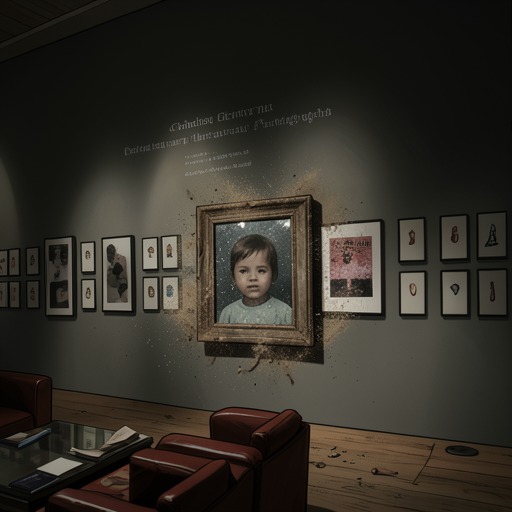
Miss Peregrine’s photo album
Miss Peregrine's Home of Peculiar ChildrenMiss Peregrine’s photo album is both a personal archive and a visual bridge between Jacob Portman, his grandfather, and the peculiar children. Its photographs first invite disbelief, then recognition: images Jacob once dismissed as tricks become evidence connecting his family’s stories to the people he finds in the ruined children’s home.
Collection and Provenance
Miss Peregrine keeps a massive album among her belongings. She brings it down from a shelf and turns its stiff pages with Jacob, searching for a particular picture while lingering over others with nostalgic affection. The album gathers images Jacob recognizes from two earlier sources: the trunk of photographs smashed in the basement of the ruined home and the cigar box his grandfather had shown him when he was young. Its contents therefore connect an older collection associated with Abraham Portman to the photographs Jacob has newly discovered.
The images also carry a history of being shown and handed on. Miss Peregrine had shown the same photographs to Abraham when he was Jacob’s age; now she shows them to Jacob, in what feels to him like an entry into his grandfather’s past. The album is not simply a store of pictures: its sequence makes a family history visible across generations, even as the images leave questions about what they can prove.
Pictures and Interpretation
The album’s photographs are not uniform in their appearance or effect. Among the images Jacob associates with it are portraits that seem manipulated: two girls photographed with their backs turned to the camera, a girl in a cemetery whose reflection shows two girls, and a young man whose upper body appears to swarm with bees. These compositions encourage suspicion because familiar photographic effects could explain them. Jacob initially treats the apparent wonders in his grandfather’s pictures as tricks, including the supposed invisible boy and levitating girl.
That skepticism has a material and emotional history. As a child, Jacob wanted to believe his grandfather’s stories; later, examining the brittle, peeling prints as an almost-adult, he judged their fakery obvious. The album complicates that judgment without making every image equally persuasive. Some photographs of the grandfather’s cigar box are conspicuously crude: one uses a laughable double exposure to place a girl in a bottle, another hides the support for a levitating child in a dark doorway, and a dog bears a boy’s face pasted onto it. Other images are unsettling precisely because they do not look as easily explained to Jacob, such as the cemetery reflection.
The Album as a Key to Recognition
A photograph of Miss Finch and her aunt appears in the album: the elder woman usually remained a finch, Miss Peregrine explains, and was not much of a conversationalist. The picture makes the album’s strange portraits part of a community rather than an isolated set of curiosities. Miss Peregrine also identifies Miss Avocet in a group portrait of women and children gathered around a paper moon. She describes her as a revered figure among the peculiars, a teacher who founded an academy with Miss Bunting and whose former pupils included Miss Peregrine herself.
The photographs’ most consequential change is in Jacob’s reading of them. After discovering similar images in the broken trunk, he comes upon the children themselves and realizes he has seen them in the photographs. One girl holds a ball of raw flame in her bare hands, matching the image Jacob had examined only minutes earlier. The picture no longer functions merely as a suspicious representation: its correspondence with a living person gives Jacob a new reason to reconsider both the photographs and his grandfather’s stories.
From Private Keepsake to Public Record
The book’s final photograph credit distinguishes the narrative’s peculiar images from wholly invented illustrations. It states that the photographs are authentic vintage found photographs, with only a few subjected to minimal postprocessing, and that collectors lent them from personal archives. Those collectors had searched flea markets, antiques malls, and yard sales, rescuing selected snapshots from obscurity and likely disposal. This afterword places the visual material in a real history of collecting and preservation, while leaving the fictional characters’ interpretations to the story.
The album’s significance lies in that tension between image and explanation. Photographs can be staged, altered, or misread, and Jacob’s early suspicion is grounded in examples of obvious fakery. Yet the images also preserve details that lead him toward recognition: the match between a photograph and the flame-bearing girl, and Miss Peregrine’s identifications of Miss Finch and Miss Avocet. As a private archive passed between grandfather, guardian, and grandson, the album makes looking itself part of the plot: doubt does not disappear, but the pictures become evidence that Jacob can no longer dismiss outright.