Peculiar supremacy
Miss Peregrine's Home of Peculiar ChildrenPeculiar supremacy is the doctrine Dr. Golan voices during the confrontation over the captured ymbrynes: Peculiars, he argues, should stop hiding from ordinary people and claim mastery over them. The speech recasts the group’s vulnerable concealment as an unacceptable surrender and reveals that his aim is not merely to secure cooperation, but to establish domination.
The ideology in Dr. Golan’s speech
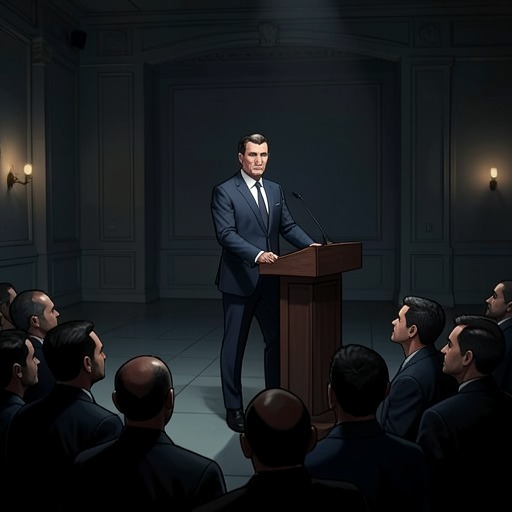
Dr. Golan states the doctrine in stark terms. He condemns Peculiars for hiding when they could rule the world, accepting death when they could dominate, and allowing ordinary humans to drive them underground rather than making those humans their slaves. He presents subjugation as what ordinary people deserve, not as a reluctant tactic, and punctuates his claims by shaking the cage holding the birds.
The speech is a direct contrast with the hidden life the Peculiars inhabit. Earlier, Jacob sees the children living in the enclosed world of Miss Peregrine’s home, where their unusual abilities shape the practical details of daily life: Olive must be secured to her chair, while Hugh eats beneath a mosquito net because bees live in his stomach. Golan interprets concealment as weakness and difference as grounds for rule; the children’s community, by contrast, is shown through the work of living together with those differences.
Coercion and the ymbrynes
The immediate dispute concerns whether the captured ymbrynes will help Dr. Golan and his allies. Emma insists that kidnapping them will not change their refusal. Golan answers that they will be made to cooperate or killed one by one; if that fails, he threatens to kill the other captives while the ymbrynes watch. His supremacy is therefore more than a boast about power: the scene connects it to threats against both the imprisoned guardians and the people used to pressure them.
When Emma protests, Golan takes her response as proof that she cares about the captives. He then swings the cage toward her. The gesture makes the logic of his speech concrete: the promised order of Peculiar rule depends on treating other people as instruments, threatening them when they resist, and turning their attachments into leverage.
Concealment, vulnerability, and the stakes
The novel places Golan’s claim against a history in which being outside a protected loop can have devastating consequences. Miss Peregrine recounts how Charlotte, a young girl in her care, wandered out of a loop and was found by a constable. After being sent to a child-welfare agency on the mainland, Charlotte aged thirty-five years in two days and was never the same. That episode gives concealment a protective dimension absent from Golan’s rhetoric: remaining hidden is not simply a refusal to claim power, but can shield Peculiars from a world whose ordinary institutions do not understand them.
Other experiences sharpen the contrast between the ideology’s language of strength and the characters’ actual vulnerability. Jacob initially accepts Dr. Golan’s explanation that the creature he saw was the product of trauma and suffers nightmares and paranoia afterward. His grandfather, meanwhile, becomes increasingly consumed by stories of monsters and an enchanted island as his dementia advances. These episodes do not make Peculiar supremacy a response to every form of vulnerability; rather, they place Golan’s demand for domination beside the novel’s recurring distinction between fear, care, and the wish to control others.
Narrative significance
Golan’s speech gives the conflict an explicit political dimension. The ymbrynes’ captivity is tied to a larger ambition: to replace concealment with rule and to treat ordinary humanity as an inferior population fit for enslavement. His certainty that Peculiars ought to dominate others is set against Miss Peregrine’s offer to let Jacob live with the children, even as she warns that his parents will never understand him. Protection and belonging may require separation from the wider world, but Golan turns that separation into an argument for supremacy.
The scene also exposes the gap between Golan’s claim to liberation and his methods. He denounces Peculiars for being driven underground, yet advances his cause by threatening captives and using their relationships against them. The doctrine’s promise of freedom thus resolves into a new hierarchy, maintained through coercion rather than mutual safety.