Rapid aging after leaving the loop
Miss Peregrine's Home of Peculiar ChildrenRapid aging after leaving the loop is the delayed cost of the peculiar children’s suspended lives: a child who remains outside too long may undergo decades of aging in hours. The rule makes the time loop both refuge and constraint, preserving its residents from ordinary time while making departure dangerous.
The Loop and Its Protection
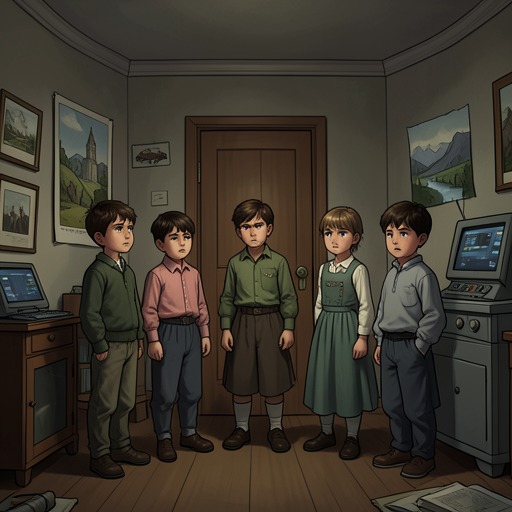
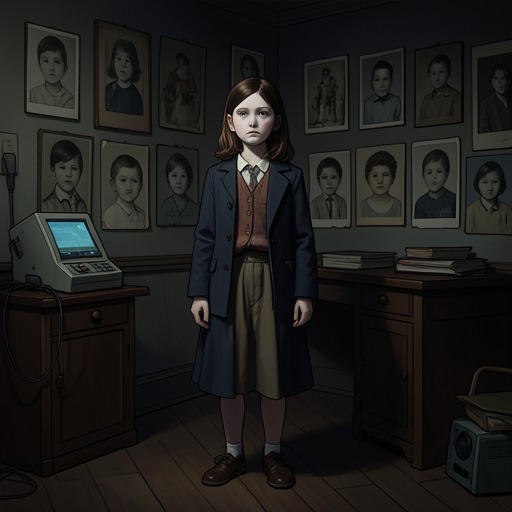
Miss Peregrine explains that the children’s apparent freedom from aging is an illusion sustained by life inside a temporal loop. Her loop repeats September 3, 1940, while the residents experience the day continuously and retain memories accumulated across their many years there. The calendar outside advances, but the children remain within the same repeating day.
The loop’s continuity depends on its entrance remaining usable. Miss Peregrine describes how an ymbryne must periodically cross the entryway to keep it pliable; without ingress or egress, the temporal system can become unstable. The mechanism that protects the children is therefore not simply a sealed refuge: it requires maintenance and a functioning connection to the world beyond it.
The Cost of Leaving
Miss Peregrine states that peculiar children cannot linger in the ordinary world because the years from which they have been sheltered will descend on them at once. The change can take only hours. Leaving the loop is thus not a simple passage into a different place; it exposes the traveler to accumulated time and the possibility of death.
She recalls a case from her own care to make the danger concrete. During a visit to another ymbryne, a young girl named Charlotte slipped away from the older children and wandered out of the loop. A constable found her in the village, and she was sent to a mainland child welfare agency after failing to explain who she was or where she had come from. Miss Peregrine reached Charlotte two days later, by which point Charlotte had aged thirty-five years. She never recovered her former mental state.
Confinement and the Pull of the Present
The loop’s repeated day is not experienced only as a safeguard. During his stay, Jacob notices that its atmosphere seems to soothe him: after learning about the danger of leaving, he soon finds himself relaxed and nearly asleep beneath a tree, no longer preoccupied by the warning. He considers whether the loop itself has a narcotic effect, making a pleasant, unchanging life easier to accept.
That comfort sharpens the rule’s double edge. The children can live indefinitely within the loop, but their inability to leave safely restricts their access to change and to the advancing world. What looks like paradise can also function as a prison: the risk of rapid aging makes departure more than a difficult choice, while the loop’s serenity can make the constraint easy to overlook.
Time Beyond One Loop
The novel later presents a way to reach loops that have ceased to exist: Millard describes leapfrogging from one loop to another, including into a day fifty years in the past, to gain access to other loops and then to further loops beyond them. He calls the undertaking highly complex and dangerous. This possibility broadens the story’s temporal geography, but does not erase the personal danger of remaining outside a loop too long.
The contrast becomes especially clear when the children leave their damaged home on September 4. For the first time in a very long time, the days are moving again; the children say they feel more vital and real, and Jacob shares that change. Their experience distinguishes the motion of time itself from the accelerated aging that threatens an individual who leaves a protective loop: renewed movement offers a new condition of life, while prolonged exposure outside can make the years arrive all at once.
Inherited Time and Trauma
The rule’s consequences resonate beyond the children’s immediate predicament. Jacob’s grandfather, Abraham Portman, escaped Poland as a child and never saw his family again; the loss shaped his later distance from his own son. Jacob recognizes how the earlier family rupture may have affected his father, and later understands that his own distress is entangled with suffering passed down across generations. In this context, time is not merely a supernatural mechanism: protection from it can preserve a life, but neither isolation nor delay can undo the losses carried forward through a family.