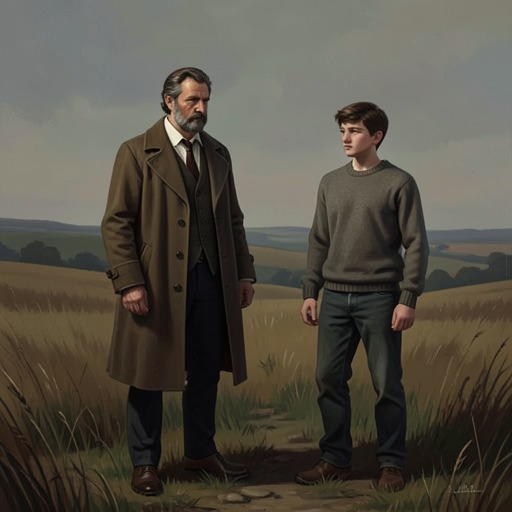
“Before and After”
Miss Peregrine's Home of Peculiar Children“Before and After” is the name Jacob Portman gives to the divide made by a terrible event: the moment when his ordinary life gives way to an encounter with a creature and the death of his grandfather, Abraham Portman. The phrase also gathers a longer family history into that rupture. What Jacob once dismissed as fantasy proves rooted in war, persecution, and survival, while the secrets that protected one generation leave fear and unanswered questions for the next.
The phrase and its first divide
At the opening of the narrative, Jacob says that he had only just accepted that his life would be ordinary when extraordinary things began to happen. The first of them shocks him so deeply that it splits his life into “Before and After.” He identifies his grandfather as part of this change from the outset: the break is not simply between childhood and a later crisis, but between the stories Abraham told and the reality those stories concealed.
The phrase returns when Jacob, at fifteen, faces an extraordinary and terrible event. The recurrence makes “Before and After” more than a label for a single moment. It marks a change in what Jacob can believe about his family and about the apparently ordinary world around him.
The stories behind the divide
As a child, Jacob treated Abraham’s accounts of an orphanage, war, travel, and remarkable children as adventures. Abraham encouraged his grandson’s dreams of exploration, spending afternoons with him over maps and imaginary expeditions. But when Jacob grew older, he called the stories fabrications and dismissed the photographs that accompanied them. Abraham accepted the rejection without arguing, and the storytelling stopped.
Jacob later learns from his father that the stories were not simply lies: they were exaggerated versions of a painful truth. Abraham had been the only member of his family to escape Poland before the Second World War. At twelve, sent to Britain by his parents with a suitcase and the clothes he wore, he left on a one-way journey and never saw his family again. His relatives died before he turned sixteen, victims of persecution by people whose outwardly ordinary human appearance made them difficult to recognize as monsters in time.
The enchanted island in Abraham’s account was likewise a truth in disguise. The children’s home where he found refuge had become, in his telling, a paradise of endless summers and magical children. Jacob understands that its residents were not remarkable because of supernatural powers: they were Jewish children who had escaped persecution, and survival itself was extraordinary. Once he recognizes the history beneath the fairy tale, he stops asking Abraham to tell it. He feels ashamed of having envied his grandfather’s adventurous life and believes Abraham has a right to keep its painful details private.
The moment that makes an After
The decisive rupture occurs when Jacob is with Abraham in the woods. After his grandfather fades from consciousness, Jacob senses that something is present and raises his flashlight toward it. He sees a creature that recalls his childhood nightmares; Ricky, who is there with him, does not see it. Ricky fires his gun after the creature moves away, but Jacob is left unable to explain what he witnessed and then loses consciousness.
The difference between Jacob’s certainty and other people’s disbelief deepens the divide. He blames himself for not having believed his grandfather, but when he tells the police what happened, they treat his account as grounds to question his mental health. Ricky also denies seeing a creature, and the police settle on feral dogs as the explanation for Abraham’s death. The event therefore changes not only Jacob’s understanding of his grandfather’s stories, but also his sense of whether his own testimony can be trusted by others.
A family wound carried forward
The phrase’s reach extends beyond Jacob’s immediate shock. His father explains that Abraham struggled to act as a father after losing his siblings and the rest of his family; he often left on trips and could seem absent even when present. Jacob considers whether Abraham’s earlier losses, followed by the bombing of the adopted family he had found on the island, might help explain that distance. The possibility reframes an apparent personal failing as a consequence of repeated bereavement, though it does not erase the pain of the strained relationship.
Jacob later gives this inheritance a more explicit shape. He thinks of the deaths and persecution that marked his great-grandparents’ generation, the children killed in the bombing, Abraham’s loss of his family, his father’s feeling that he had not truly had a father, and his own fear and nightmares. He describes the accumulated hurt as something passed down like a poisonous heirloom. Miss Peregrine also explains that Abraham faced danger both as a Jew and as a peculiar, and suggests that he kept Jacob ignorant in an effort to protect him. In this way, “Before and After” marks a personal awakening while exposing how a history that was concealed to spare the next generation can nevertheless continue to shape it.
Narrative significance
The expression organizes the story around a belated recognition. Jacob first rejects Abraham’s tales, then experiences an event that makes their hidden truth newly urgent. What he had interpreted as deception becomes a guarded account of survival; what others interpret as an ordinary explanation for Abraham’s death conflicts with Jacob’s direct experience. The phrase holds these differences in view without resolving them all at once.
Its sharp division is also undercut by the connections it reveals. The After does not begin from nothing: it carries Abraham’s wartime losses, his silence, and the family distance that followed. As Jacob learns to understand those connections, the phrase comes to signify both an irreversible change in his life and the return of a past that the family had tried, for reasons of protection and pain, to leave unspoken.