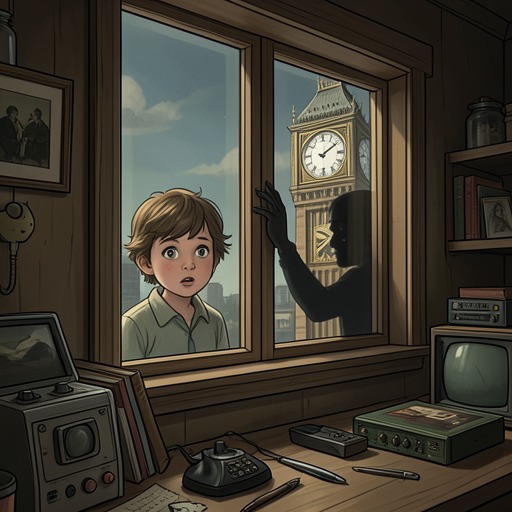
Cairnholm loop’s daily reset
Miss Peregrine's Home of Peculiar ChildrenCairnholm loop’s daily reset is the rule that holds its inhabitants within a repeating September 3, 1940, while allowing them to experience their own lives as continuous. The mechanism depends on keeping the loop’s entrance open through periodic passage across it: a small act of maintenance with enormous consequences, since without an ingress or egress the enclosed temporal system can become unstable. The rule gives the island’s children a refuge from historical time, but it also makes repetition a condition of their lives; when the loop ultimately fails, they leave its protection and encounter a day that moves forward.
The loop’s date and discovery
The date that defines the loop is introduced first as an apparent contradiction. On a calendar, the first and second days of September 1940 have been crossed out, leaving September 3 as the day in progress. Jacob Portman connects that detail to his grandfather’s instruction to find the bird in the loop, on the other side of the Old Man’s grave. The Old Man is the name given to the ancient Cairnholm Man displayed in the island museum; his grave is the cairn in the bog. Jacob had followed a girl’s footprints inside the cairn, only to discover an empty chamber and realize that the girl, like the other children he had thought he saw, was a hallucination. Later, the calendar and his grandfather’s directions give the cairn a different significance: Jacob has crossed its entrance and emerged in September 1940.
The crossing is not merely a journey to an earlier date. Miss Peregrine explains that the place is a time loop, which Jacob may recognize as September 3, 1940. The same date repeats, but the inhabitants’ experience is continuous: they remember the many years they have spent there rather than beginning each repetition without memory. That distinction separates the loop’s external calendar from the life lived inside it. The island returns to the same date, while its residents accumulate experience within the recurrence.
Maintenance and the entrance
The loop’s repetition requires active maintenance. Miss Peregrine explains that one of the Ymbrynes must cross the entryway from time to time to keep it pliable. She compares the ingress point to a hole in fresh dough: if it is not pressed open now and then, it may close. Passage through the entrance therefore has a practical function beyond travel; it preserves the route into and out of the temporal enclosure.
Miss Peregrine also describes the entrance as a valve for pressures that naturally build in a closed temporal system. If no one can enter or leave, the loop becomes unstable. Her brief pantomime of an explosion makes clear that the danger is not simply losing access: a failure of passage threatens the system itself. The daily reset is thus not an automatic guarantee. Its regularity depends on a living custodian maintaining the boundary, and on the entrance remaining usable.
The rule is demonstrated in a smaller, immediate way when Millard consults his leather-bound notebook before the children leave a house under search. He concludes that they need wait only about a minute before they can walk safely out the front door. His confidence rests on recurrence: the sequence of events has happened before, and the loop gives him knowledge of what comes next. Elsewhere, Millard explains the principle directly to Jacob, observing that the events have already happened yesterday and the day before. For those who understand the loop, repetition is not only a restriction but a source of actionable knowledge.
Refuge, repetition, and confinement
The loop’s fixed day shapes the emotional texture of life as well as its chronology. Jacob finds that time spent there seems to lull him into calm: while waiting for Emma, he becomes drowsy under a tree and serenely anticipates lunch. He considers whether the loop itself acts like a sedative, making the repeated day feel so pleasant that its limits may go unnoticed. The same arrangement that offers beauty and apparent safety can therefore resemble a prison. Its inhabitants may remain content within the familiar day, while the possibility of a life beyond it becomes difficult to confront.
That tension follows from the loop’s central bargain. Its inhabitants keep their memories and continuity, but the date around them does not advance. The recurrence affords security from the changing world outside, yet it restricts access to historical time and to an ordinary future. Jacob’s impression that leaving may be dangerous further complicates the idea of choice: a resident can become attached to the refuge even as its repetition narrows what life can become. The loop’s comfort and its confinement are not separate effects; they arise from the same suspension of ordinary time.
Failure and the return of historical time
The daily-reset rule reaches its decisive limit when the loop is no longer functioning as before. After the children’s home is destroyed, the children prepare to leave the island. On September 4, they notice a change in their experience: some say the air feels fuller in their lungs and their blood seems to move faster; they feel more vital and more real. Jacob shares that sense. For the first time in a very long while, the days are moving again.
The arrival of September 4 makes the end of recurrence concrete. Rather than waking into another September 3, the children enter a day beyond the loop’s repeated date. Their departure is consequently both a physical leaving and a temporal change: the protection of the fixed day gives way to forward-moving time. The rule’s failure exposes its double meaning. The loop had made continuous life possible within a refuge, but its exit also marks a release from the repetition that had held the children there.
Passage beyond a single loop
The loop’s entrance also connects its local rule to a larger geography of time. Millard explains that travel between loops by leapfrogging can lead to loops that have ceased to exist within the past fifty years; those loops, in turn, can provide access to still more loops. He describes the undertaking as highly complex and dangerous, while Jacob recognizes that it amounts to real time travel. The cairn’s threshold is therefore part of a broader possibility: temporal boundaries can be crossed in sequence, opening routes to places and periods otherwise inaccessible.
This broader possibility sharpens the significance of the daily reset. A loop is not simply a day replaying without consequence, nor is its entrance only a doorway into a fixed historical scene. Its repeated date organizes a distinct lived world, maintained by passage and remembered from within; its points of entry can also participate in movement among other temporal worlds. Cairnholm’s September 3 is at once a refuge, a boundary, and a constraint. When that pattern ends and September 4 begins, the children experience the change not as an abstract alteration in the calendar but as the return of time moving forward.