Hollowgast
Miss Peregrine's Home of Peculiar ChildrenHollowgasts are the monstrous survivors of a failed immortality experiment, transformed from peculiars into beings of endless hunger and physical torment. They are central threats to the hidden peculiar community: difficult to see, unable to enter time loops, and dependent on fresh prey, they drive both the protections that keep peculiars concealed and the danger that reaches beyond those protections.
Origins and Transformation
In the summer of 1908, two technically gifted brothers joined a renegade faction of several hundred peculiars, including powerful Ymbrynes, to conduct an experiment in an old, long-unused loop in the Siberian tundra. They sought to make themselves gods by reversing the limits of nature. The experiment instead produced a catastrophic explosion, initially believed to have killed everyone at the site.
The experimenters survived, but in a radically altered state. Weeks afterward, attacks on peculiars began, and the attackers could not be seen by ordinary people except as shadows. The community eventually understood that the creatures were the experimenters themselves, risen from the crater. Rather than attaining godhood, they had become Hollowgasts: beings whose transformation is described as a living damnation.
The precise mechanism remains disputed. One theory holds that the experiment reversed the participants’ ages to a point before their souls had been conceived, leaving their hearts and souls empty. In this account, the name Hollowgast describes a spiritual as well as physical condition. The experiment did achieve a form of immortality, since Hollowgasts are believed capable of living for thousands of years, but that longevity entails continual suffering, isolation, and hunger rather than mastery over death.
Appearance, Perception, and Hunting
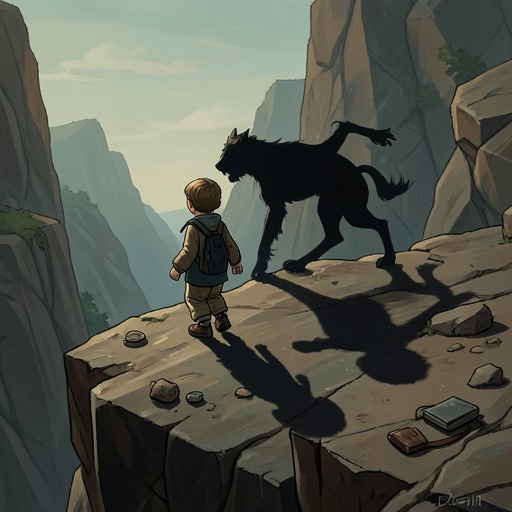
Hollowgasts are generally imperceptible to ordinary people, who may see only their shadows. Peculiars such as Jacob can perceive the creatures themselves. That difference helps explain why sightings are dismissed or misunderstood: Jacob’s ability to see what others cannot had been mistaken for madness, although his fear and perception were signs of his peculiar gift. Hollowgasts hunt mainly at night, when their near-invisibility gives them an advantage.
They cannot enter time loops. This rule makes a loop a refuge from them, and helps explain why the peculiars on Cairnholm Island are safe there. The protection comes with a severe limitation: those sheltering in the loop cannot simply leave without exposing themselves to danger. Hollowgasts’ inability to cross into loops therefore creates both security and confinement.
Their bodies are described as withered and monstrous, with outsized jaws and long, powerful tongues. When Jacob and his companions encounter one in the fishmonger’s icehouse, Emma’s flame reveals the creature while the others can recognize its shadow. It holds back at first, extending its tongues toward Jacob, Enoch, and Emma as the group retreats. The scene makes the danger of its concealment concrete: the creature can approach while those who cannot see it clearly struggle to judge its position.
Hollowgasts prefer peculiar prey, but they will eat almost any fresh, meaty food to survive. Their need to feed leaves evidence behind: bodies accumulate around their hunting grounds. Because such traces make them easier to track, they move from place to place rather than remaining in one location. Their predation is thus not only a direct threat to individuals; it creates a pattern that can expose the creature’s presence while also making it difficult to pursue.
Relation to Wights and the Peculiar Community
A Hollowgast that consumes enough peculiars can become a wight. This transformation links the creatures to a wider hierarchy of enemies. Wights can pass as human and act as scouts, spies, and procurers for Hollowgasts, though they lack peculiar abilities. The two forms occupy different positions: Hollowgasts are driven by instinct and hunger, while wights can move through ordinary society and assist them deliberately.
Hollowgasts apparently do not retain memories of their former lives. That loss is strategically significant: although they were once peculiar and might be expected to know the community’s hiding places, they do not appear to remember them. Their former identity nevertheless remains crucial to the history of the threat, because the monsters are not an outside species but the consequence of peculiar ambition and a failed attempt to exceed natural limits.
The danger also extends beyond direct attacks. Golan tells Jacob that the four children with him might be enough to change Malthus from the degraded form in which he has long been trapped. Later, the group learns that wights have been abducting Ymbrynes in order to make them recreate the reaction that originally produced the Hollowgasts, only on a much larger scale. The origin story is therefore not safely confined to the past: the same experiment may be attempted again, with the potential to multiply its consequences.
Encounters and Narrative Significance
Jacob’s encounters with Hollowgasts establish the practical importance of his ability. Martin, briefly revived through Enoch’s intervention, had seen a Hollowgast attacking him at night in the rain but mistook it for his prized exhibit. Jacob recognizes the truth: the creature is on the island. His capacity to identify a threat that others have misread makes him useful to the group, even as it exposes him to the danger firsthand.
During the escape from the island’s sheep house, a Hollowgast pursues the group and begins feeding on the animals between them and the exit. Jacob runs for the door, then is caught near the cairn entrance and pulled toward the creature. He survives when he collides with it, driving his shears into its eyes; the Hollowgast dies in the rain-swollen bog. This encounter marks a change from fearful recognition to direct resistance: Jacob’s unusual perception becomes part of the means by which the group can fight back.
The Hollowgast is both predator and warning. Its existence embodies the disastrous outcome of a project undertaken by peculiars who sought immortality, while its continued hunger turns that failed ambition into a persistent danger for their descendants. The wights’ plan to reproduce the experiment raises the stakes from survival against individual monsters to preventing the conditions that created them from being deliberately revived.