Hollowgast Pursuit in the Marsh and Jacob’s First Hollowgast Kill
Miss Peregrine's Home of Peculiar ChildrenJacob’s first killing of a Hollowgast turns a flight through the island’s storm-dark landscape into a decisive change in his sense of what he can do. The pursuit tests knowledge and courage against a creature that seems almost impossible to escape; its death leaves Jacob not merely alive, but newly able to imagine himself as a defender.
Causes and Setting
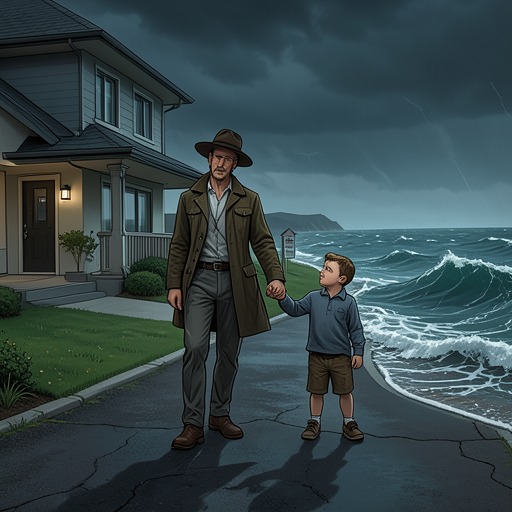
The danger unfolds during a violent storm on Cairnholm, where wind and rain have already confined the islanders to their homes. The weather makes movement hazardous, while the bog and its ancient stone cairn offer both an obstacle and a possible route to safety. The cairn is one of the Neolithic tombs from which the island takes its name; earlier, Jacob followed a girl’s footprints to its narrow entrance and entered its dark tunnel.
The bog’s material history is part of the scene’s atmosphere and its practical danger. In oxygen-free conditions, it can preserve bodies: an islander explains that the remains of the more-than-2,700-year-old Cairnholm Man were found in the bog, still appearing fresh. The ground that preserved the dead now threatens to swallow Jacob and his pursuer.
The Pursuit
After the Hollowgast attacks the group, Bronwyn uses her strength to overturn an ice trough, buying the others an opportunity to escape from the icehouse. The group runs toward the time loop, which the creature cannot reach. The storm makes the route treacherous: Enoch falls, and Bronwyn slips down the ridge before Jacob and Emma help her back up. A flash of lightning briefly reveals the Hollowgast climbing after them, using its tongues to propel itself through the mud.
The creature later finds Jacob and Emma sheltering among sheep. When it enters the room, the animals crowd together and pin them against the wall; a sheep is taken. Jacob runs outside and deliberately draws the Hollowgast after him rather than leave it with Emma. He carries a pair of shears and heads for the bog, choosing a route he knows from Emma’s guidance well enough to follow in darkness and a storm.
Twice the Hollowgast comes close enough to strike at Jacob, but it loses its footing in the bog. Jacob reaches the cairn and dives into the tunnel, expecting the chamber farther inside to put him beyond its reach. The creature instead anchors two tongues around the capstones and blocks the entrance with its body. Its third tongue catches Jacob by the ankle and begins pulling him back. He tries to cut free with the shears, but cannot; the collision that follows sends them both out of the tunnel and down the cairn mound.
The Killing and Its Consequences
Jacob finds the shears embedded in the Hollowgast’s eyes. The creature thrashes in the rain-swollen bog, then dies, and its grip on Jacob loosens. The victory does not immediately make him safe: the bog begins to pull him down as well. Emma reaches him with a branch and hauls him out, and Jacob collapses into her arms, shaking too hard to stand.
His response marks the inward consequence of the fight. Jacob recognizes that he has actually killed a Hollowgast, something his earlier fear had made seem beyond his abilities. He says aloud that the creature is dead and that he killed it; Emma embraces him and tells him that his grandfather would have been proud. For Jacob, the act changes fear from an absolute limit into something he can act through: he knows he can defend himself and is no longer willing to think of himself as a weakling.
Narrative Significance
The episode brings together the island’s recurring forces—weather, bog, ancient stonework, and predatory danger—as active conditions shaping the action rather than mere scenery. The cairn is both refuge and trap: Jacob knows it as the route toward safety, yet the Hollowgast turns its entrance against him. Likewise, the bog first hinders the pursuit, then becomes the place where the creature is killed and where Jacob nearly disappears.
The fight is also a turning point in Jacob’s developing role among the peculiar children. He escapes not through strength alone but by combining Emma’s practical knowledge of the route with his own decision to draw the creature away from her. The outcome gives him a first direct proof that he can meet the danger he once only feared, and that knowledge changes the meaning of his grandfather’s example: Jacob does not become as strong as his grandfather, but discovers a capacity to protect himself and others in his own right.