Jacob’s Investigation of Abraham’s Last Words
Miss Peregrine's Home of Peculiar ChildrenJacob’s investigation of Abraham Portman’s last words is the first sustained effort to treat his grandfather’s final warnings as a trail of clues rather than as delusion. Driven by grief, troubled dreams, and a sense of obligation, Jacob moves from failed guesses about the words’ meaning to a concrete lead connecting a pipe-smoking headmistress, Cairnholm, and Abraham’s childhood. The search also brings him face to face with the gap between family memory and the island’s public account of its past.
Grief and the decision to investigate
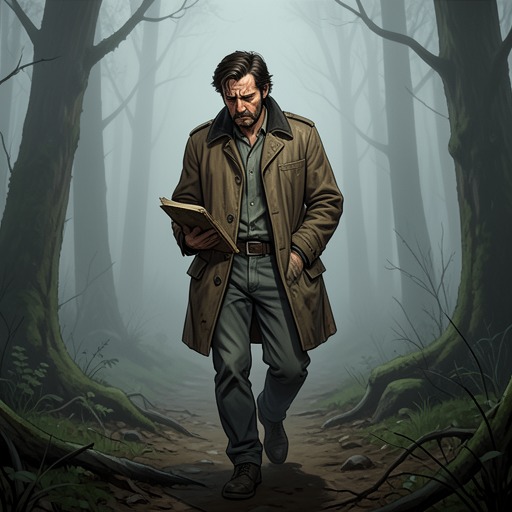
Abraham’s last words continue to trouble Jacob after his death. Jacob wants to behave as if they do not matter, but they have been eating away at him alongside his nightmares. He feels he owes Abraham more than a dismissal of the final thing his grandfather said to anyone, while Dr. Golan has suggested that understanding the words might help with the dreams. These two pressures—family loyalty and the hope of relief—make the investigation both an act of remembrance and an attempt to recover his own footing.
Some of the message already seems intelligible. Jacob understands that Abraham wanted him to go to the island because he feared monsters would pursue his grandson and believed the island could offer the same kind of refuge it had offered him as a boy. But Abraham had also said that he should have told Jacob something, without having time to explain what it was. Jacob therefore wonders whether he left a trail of clues leading to someone who knew his secret. He interprets the references to the loop, the grave, and the letter as parts of that trail, not as disconnected ravings.
Failed readings and recovered clues
Jacob initially tests an ordinary, literal explanation. He imagines that the loop might be a street in Circle Village, whose looping cul-de-sacs seem to fit the word, and that Emerson could be a person Abraham had corresponded with. Perhaps, he speculates, an old friend named Emerson lived near a graveyard and had kept a relevant letter dated September 3, 1940. After finding no help online, Jacob visits the community center and asks its older regulars about a graveyard and a Mr. Emerson. There is no graveyard, no Emerson, and no street called Loop Drive, Loop Avenue, or anything similar. The attempt is a complete dead end, but it establishes that Jacob is willing to test his interpretations rather than accept the first one.
A separate family conflict unexpectedly puts evidence back in his hands. During an argument with his father about Abraham’s belongings, Jacob insists that throwing them away will not make him forget his grandfather. His father relents and tosses him old papers, but after Jacob leaves the argument, he hears the shredder start and realizes an apology is unlikely. Alone in Abraham’s bedroom, he notices an old cigar box beneath the bedspread and pulls it out. Inside are the photographs he remembers from childhood, now visibly brittle and less convincing to his older eyes. Beneath them are five additional images Abraham had never shown him, including pictures whose unsettling subjects would have been frightening to a child. The box makes the investigation intimate: Jacob is not simply pursuing a puzzle but encountering what Abraham chose to preserve, and what he chose to keep from him.
At a family gathering, Aunt Susie gives Jacob an old, dog-eared hardback: The Selected Works of Ralph Waldo Emerson. The gift unsettles him because, as far as Jacob knows, only Dr. Golan knew about the last words, and Dr. Golan had promised to keep their conversations confidential. Aunt Susie explains that she found the book in Abraham’s desk while the family was clearing the house; Abraham had written Jacob’s name inside, and she believes he intended it for him. Jacob opens it, sees his grandfather’s inscription, and, as he gets up to leave, a letter slips from between the pages. The family’s discarded possessions have become a deliberate-looking chain of evidence, though Jacob cannot yet know how the letter reached him.
The letter and the meaning of the bird
The letter gives Jacob a more persuasive way to read Abraham’s clues. It contains an old snapshot of a woman smoking a curved pipe. Unlike the photographs Abraham had shown him as a child, this image appears unmanipulated: it depicts a woman, not an obvious trick. Jacob finds a fading postmark on the envelope: Cairnholm Is., Cymru, UK. He recognizes Cymru as the Welsh name for Wales and connects Cairnholm Island to the island named in Miss Peregrine’s letter.
The photograph also changes the meaning of Abraham’s repeated references to a bird. Nine months earlier, Abraham had told Jacob to find the bird; nine years earlier, he had described the children’s home as protected by a bird who smoked a pipe. Jacob had once taken that image literally. Now he connects the pipe-smoking woman in the photograph with the name Peregrine, which is also a kind of hawk, and considers whether Abraham meant the woman who had served as headmistress and rescued him. The apparent riddle begins to resolve into a person: Miss Peregrine, potentially still on the island or known to people who had lived there with Abraham.
Jacob does not assume that the letter guarantees she is alive. Its postmark is fifteen years old. He reasons that if she was running a children’s home in 1939 at about twenty-five, she would now be in her late nineties; that age seems possible to him, but her survival remains uncertain. Even if she had died, Jacob thinks, other people on Cairnholm might have known his grandfather as a boy and could help explain his secrets. The uncertainty does not undo the clue; it gives the journey a practical purpose beyond finding one particular person.
Cairnholm’s public history and Abraham’s testimony
On Cairnholm, Jacob and his father stay at the Priest Hole, a modest pub across the street from the black-stone Waiting Woman memorial. The statue commemorates islanders lost at sea and stands with outstretched arms toward the harbor; its placement makes the island’s losses visible before Jacob learns about its wartime dead. His father describes their visit as a genealogy project, keeping the family’s connection to the island separate from the circumstances that brought them there.
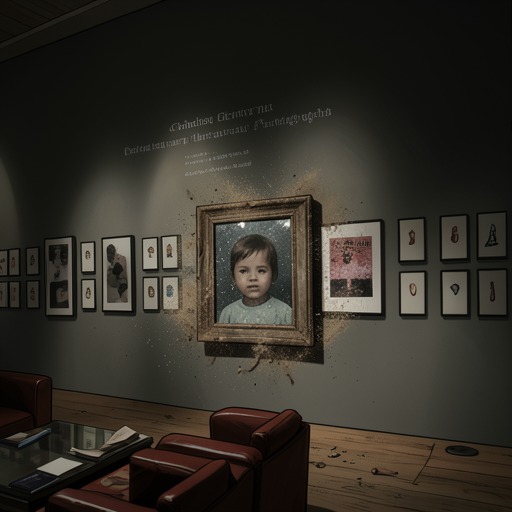
Jacob later encounters the island’s past through its museum. In the former church, displays about fishing life and local history occupy the space where pews once stood. One exhibit is given particular prominence: the preserved body of Cairnholm Man, also called the Old Man, whom curator Martin Pagett identifies as more than 2,700 years old, though he was only sixteen when he died. The body’s preservation in the island’s oxygen-poor bog gives Jacob an unexpected confrontation with something that resembles the creatures of his nightmares. The museum turns the island’s ancient past into an exhibit, while the carefully displayed remains make death a literal feature of its local heritage.
The curator’s account also corrects Jacob’s assumption that the children’s home might simply have emptied over time. Martin says that no one has lived there since the war. When pressed about what happened, he explains that the island was struck during the Second World War: an anti-aircraft battery at its far end made Cairnholm a military target, and one bomb went astray toward the home. The explanation gives the ruined house a historical cause, but it does not yet explain the people Abraham said had been there.
That distinction becomes clearer when Jacob hears Oggie describe the raid. Islanders heard air-raid sirens and scrambled for shelter; a volunteer warden checked houses at night to ensure that blinds were drawn and streetlights extinguished. Though residents expected more important mainland ports and factories to be targeted, bombs eventually fell on the island. Oggie says that no one in the town was killed, but the gun crews and the people at the orphan home died. He gives the exact date as September 3, 1940. His story confirms the date Jacob has been trying to understand and supplies a communal account of the home’s destruction.
Oggie also remembers Abraham’s departure from the island in the immediate aftermath. In shock, Abraham said little beyond asking when the next boat would leave for the mainland; he wanted to take up arms against those who had killed his people. Jacob recognizes the speaker as his grandfather and tells the men so, surprising them. Oggie’s account is nearly as far-fetched as Abraham’s old stories, yet Jacob sees no reason to doubt it. The investigation has reached a crucial threshold: the island’s oral history confirms Abraham’s presence and loss, while leaving Jacob’s deeper questions—about the bird, the loop, and the secret Abraham could not tell him—open for further pursuit.