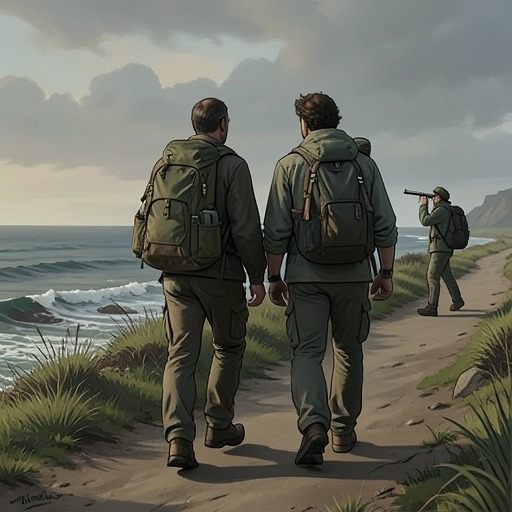
Jacob’s Journey to Cairnholm
Miss Peregrine's Home of Peculiar ChildrenJacob’s Journey to Cairnholm is the decision, preparation, and arrival that carry Jacob Portman from the unsettled aftermath of his grandfather’s revelations to the island at the center of them. The trip is arranged as a way to test those stories against ordinary reality, but Cairnholm’s first appearance in mist gives the mystery new force rather than dissolving it.
The Journey Becomes Possible
Jacob wants to spend part of the summer on a small island off the coast of Wales, but his parents see plenty of reasons to refuse. He has no companion to travel with, and the summer had been expected to include a stay with Uncle Bobby, learning to run a drug empire. More important, Jacob cannot explain the real urgency behind his request: he feels he is supposed to go, but telling his parents about Abraham Portman’s last words, the letter, and the photograph would make him sound even less credible to them.
Instead, Jacob offers more acceptable explanations. He says he wants to learn about the family history and points out that Chad Kramer and Josh Bell are going to Europe. Neither argument seems likely to work. The impasse shifts when Uncle Bobby gets cold feet about having Jacob stay with him, opening up Jacob’s summer schedule. His father, meanwhile, discovers that Cairnholm is an important bird habitat and becomes interested in studying its colonies for a possible bird book. Jacob encourages that interest, giving his father a reason of his own to make the journey.
The decisive support comes from Dr. Golan, who backs the trip and urges Jacob’s mother to agree. He presents a visit as a way to reduce the power of Abraham’s stories: seeing the place, he argues, could show Jacob that it is normal and unmagical, and thereby help him confront his grandfather’s fantasies with reality. The rationale is pointedly at odds with Jacob’s private purpose. He has not told his parents what Abraham said or shown them the letter and photograph, so the adults approve the trip on the assumption that it will demystify what Jacob is secretly trying to investigate.
A Family Excursion with Different Purposes
Once permission is secured, the practical arrangements come together quickly. Jacob and his father plan to spend three weeks in June on the island. Jacob wonders whether that is too long, but his father says he needs the time to make a thorough study of the bird colonies. The same journey thus carries two projects: the father’s ornithological research and the son’s effort to put his grandfather’s mystery to rest.
Jacob’s mother appears increasingly enthusiastic as the departure approaches. She calls them her two men, off on a big adventure, and the warmth initially touches Jacob. He later overhears her telling a friend that she will be relieved to have her life back for three weeks without two needy children to worry about. Jacob feels the sting but keeps quiet; his sarcastic response remains unspoken. His account holds affection and estrangement together: he says he loves his mother, while admitting that he does not think he would like her much as a stranger. The planned expedition is therefore not simply an escape into adventure; it also exposes the irritations and unequal expectations of family life.
The island is remote enough that even arranging contact with it offers little reassurance. When Jacob reaches Cairnholm’s only phone, the call ends abruptly, leaving him puzzled and unwilling to call back. The name he has been given for the local establishment sounds to him like a den of iniquity, and he wonders whether the trip will mean evading drunken maniacs and watching birds on rocky beaches. Even so, he decides that any discomfort will be worth enduring if the journey can settle the mystery and let him return to an unextraordinary life.
Arrival Through Fog
The outward journey is arduous: thirty-six hours involving three airplanes, two layovers, naps in grubby train stations, and an interminable, seasick ferry crossing. June is colder and wetter than Jacob expects. As the ferry approaches, fog obscures the destination so completely that the captain’s announcement that they are nearly there seems unbelievable. Jacob clutches the rail, watches the green waves, and worries about losing his breakfast to the sea; his father stands beside him shivering in shirtsleeves.
The island first emerges as a towering mass of rock in the gray. Its cliffs rise into ghostly cloud, while birds wheel and cry above it. To Jacob, Cairnholm looks like an ancient fortress built by giants, bleak and guarded rather than welcoming. The sight changes the terms of his expectation: the idea that his grandfather’s island might be magical no longer seems ridiculous. The journey that was supposed to test and dispel the story instead brings Jacob face to face with a landscape capable of sustaining it.
His father responds to the same arrival through his own enthusiasm for birds, pointing out Manx Shearwaters. The contrast gives the island two simultaneous meanings from the outset: it is a field site for the father and the charged place of Abraham’s history for Jacob. The first view does not resolve the difference between those interpretations; it sharpens it.
From Grand View to Uneasy Reality
As the ferry rounds a headland, the cliffs descend toward a rocky, half-moon bay. Jacob sees a small harbor crowded with colorful fishing boats and a town set into a green bowl of land. Sheep-speckled fields climb toward a high ridge beneath a wall of cloud. The landscape feels dramatic and beautiful, giving him a thrill of adventure and the impression of sighting a place outside the familiar world.
Once ashore, however, the close view complicates the spectacle. Whitewashed cottages stand along muddy gravel streets, their quaint appearance interrupted by satellite dishes. Cairnholm is too remote and insignificant, in Jacob’s understanding, to justify power lines from the mainland; diesel generators buzz around the town alongside tractors, its only vehicles. At the edges, abandoned roofless cottages point to a shrinking population, as younger residents leave old fishing and farming traditions for other opportunities. The island is neither a pure legend nor an untouched picturesque refuge: modern equipment, economic isolation, and signs of decline sit within the same landscape that seemed almost mythic from the ferry.
Jacob and his father drag their luggage through town searching for the Priest Home, where his father has booked a room. Jacob imagines an old church converted into a bed-and-breakfast, but local people give them confused looks when they ask for directions. They eventually find a church and enter expecting accommodation, only to discover that it has been converted into a small, dingy museum instead. Arrival therefore replaces the island’s distant grandeur with a sequence of practical uncertainties. The journey has brought Jacob to the place he sought, but not yet to an explanation of it; Cairnholm’s ordinary, weather-beaten details coexist with the mystery that drew him there.