Millard Nullings
Miss Peregrine's Home of Peculiar ChildrenMillard Nullings is an invisible member of Miss Peregrine’s peculiar children, introduced through the paradox that he is plainly present but cannot be seen. His invisibility is more than a visual trick: it shapes his habits, his access to information, and his role in the group. Quietly observing other people, he becomes both an uncanny witness to ordinary life and a practical guide when the children face danger.
Identity and Introduction
Before Jacob Portman meets him, his grandfather Abraham describes Millard as a boy who could follow someone without being seen, since he went about without clothes. Abraham recalls that Millard would reveal where he had been, what he had eaten, and even what he had done in private, leaving his listener with the unnerving sense of being watched by an invisible observer. The anecdote makes Millard’s ability comic and unsettling at once: invisibility grants him access to everyday details others assume are hidden.
Jacob first hears Millard’s voice while bound to a cooking range in Miss Peregrine’s house. Millard and Emma Bloom are discussing whether Jacob might be a wight and whether he had understood that he was inside a time loop. Emma points out how clueless he seems, especially for a relative of Abraham’s; Millard counters that the possibility of a wight cannot simply be dismissed. When Jacob identifies the unseen speaker as invisible, Millard introduces himself by name. Emma immediately warns him not to do so, revealing her suspicion of Jacob, while Millard’s calm self-introduction establishes a more open, wry manner.
An Invisible Observer
Millard’s invisibility makes routine movement conspicuous in its absence: he can be present in a room without Jacob knowing where he is, and his clothes must be put on when the children gather for supper. At the meal, Jacob mistakes a chair for an empty place and sits on Millard’s fork. Miss Peregrine nevertheless makes Millard surrender the chair and sends him to get dressed, admonishing him for taking supper nude. The exchange turns an extraordinary condition into a practical household problem, without making Millard’s difference disappear.
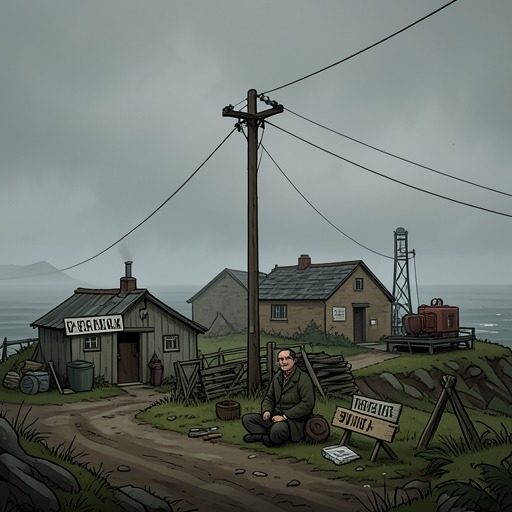
That same unseen presence gives Millard unusual freedom to watch and record. He is the person Hugh identifies as knowing everything about what happens around Cairnholm. Millard says he is compiling what he describes as the world’s first complete account of one day in a town, recording every action, conversation, and sound made by its 159 human and 332 animal residents, minute by minute from sunup to sundown. After twenty-seven years of observation, he has seen half the animals and nearly all the humans. The scale and duration of the project turn his peculiar ability into a sustained work of documentation, not merely a means of eavesdropping.
Knowledge in Action
Millard’s knowledge proves useful when Jacob and Emma are trapped in town and a mob is searching the houses. To decide whether they can safely leave, he consults a small leather-bound notebook: the blinds close, the book rises from a table and opens in midair, and he flips through its pages before concluding that they need wait only a minute or so to walk out the front door. Emma objects that the crowd will attack them, but Millard’s confidence rests on information that she does not have.
Once they venture outside, the streets are filled not only with the men pursuing them but with townspeople looking up at a squadron of Nazi fighter planes. In the alley, Millard chooses to stay behind and trip the pursuers, telling Emma and Jacob to meet him behind the pub in precisely five and a half minutes. They see a rope uncoil and float at ankle height; as the mob reaches it, the rope pulls taut and sends the pursuers sprawling into the mud. Millard’s invisibility converts a simple obstacle into a concealed intervention, buying time for his companions as they run on.
The Town as a Record
The daily repetition of the loop gives Millard’s observations a special value. Jacob notices that the town has reset: a wagon follows the same path, women line up at the well, and a man is still tarrying the bottom of a rowboat, no further along than the day before. Against that cycle of repeated actions, Millard’s project attempts to preserve the entire day’s particulars. He does not claim merely to know the town’s broad routines; his stated ambition is an account of each resident’s activity, speech, and sound.
The project also defines a productive tension in Millard’s character. His record promises near-total knowledge of one enclosed day, but the events around him show that information is not the same as certainty. During the children’s argument over whether to leave the house, he cautions that the danger may not be outside at all. Later, as they consider a hunting party, he challenges the assumption that Jacob’s failure to see a hollowgast would prove that none were present: it could mean there were none to see, or that they were hiding. Millard’s logic does not guarantee safety, but it prevents the group from confusing the limits of their sight with proof about the world.
Relationships and Narrative Role
Millard’s exchanges with Emma place him between her guardedness and Jacob’s unfamiliarity with the children’s world. He recognizes that Jacob is inexperienced, but approaches the uncertainty with questions and practical reasoning rather than Emma’s immediate suspicion. His teasing description of Emma as paranoid conveys familiarity between them, while his decision to introduce himself despite her warning shows that he is willing to make his own judgment about Jacob.
Among the children, Millard is both observer and participant: he quietly gathers knowledge, but he also risks being left behind to obstruct a mob and speaks up when the group’s assumptions could expose them to danger. His unseen body gives the story a recurring contrast between presence and visibility. Others may overlook him, yet he can notice what they miss; still, his detailed records and careful logic cannot abolish uncertainty. The invisible boy is therefore not simply an embodiment of secret knowledge, but a reminder that observation has limits—and that deciding what those limits mean can matter as much as seeing clearly.