Miss Peregrine’s peculiar children
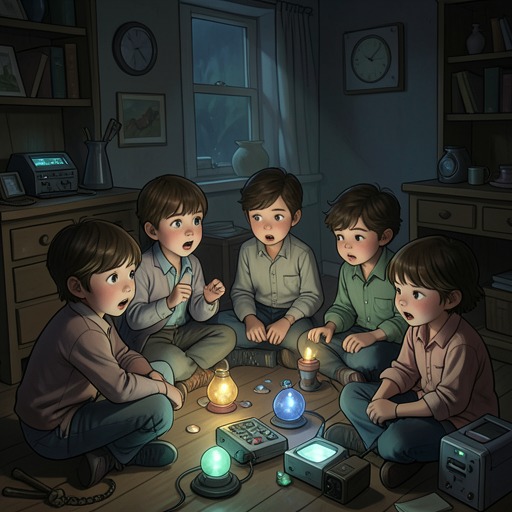
Miss Peregrine's Home of Peculiar ChildrenMiss Peregrine’s peculiar children are the gifted young community Jacob Portman first encounters through his grandfather’s stories and photographs, then recognizes alive at the home on Cairnholm Island. Their abilities explain why they were threatened for being unlike other people, but their ordinary games and exuberant shared life make them more than a catalogue of marvels: they are the reality that overturns Jacob’s disbelief and unsettles his idea of what counts as normal.
Identity and Introduction
Jacob’s grandfather, Abraham Portman, gives the children a name and a reason for their danger: they were not like other people, but peculiar. Asked what that meant, he described abilities across a range of forms: a girl who could fly, a boy with bees living inside him, and a brother and sister able to lift boulders over their heads. The explanation is at once fantastical and specific. It makes the children’s difference legible to Jacob, even as he doubts whether Abraham is serious.
Abraham answers that doubt by fetching a cigar box of old photographs. The images connect his spoken accounts to an apparent record: children, portraits, and scenes that Jacob will later encounter in a different setting. That visual link does not initially settle the question of truth. Instead, the photographs leave the children suspended between family lore and credible evidence, preparing the reversal that occurs when Jacob sees them in person.
The Photographs and the Children’s Image
In the ruined home, Jacob salvages photographs from a demolished trunk among splintered floorboards, broken glass, and torn carpet. At first the pictures seem like ordinary old family-album images: people on beaches and porches, views of the island, and children photographed alone or in pairs. Their formal portraits show subjects holding dead-eyed dolls; their old-fashioned hair and unsmiling faces amplify the images’ eeriness, but the deeper disturbance for Jacob is their resemblance to Abraham’s hidden photographs, as though both sets belong to the same uncanny world.
Some pictures suggest that the children’s peculiarities have been preserved, or manipulated, in the photographic image itself. Two young women face away from the camera in front of a painted ocean backdrop. A girl in a cemetery appears alone while the reflecting pool shows two girls. In another photograph, a young man’s upper body seems to swarm with bees. Jacob reaches for ordinary explanations—darkroom trickery, a fake rock, fake bees—but the images’ repeated oddities echo Abraham’s accounts and make dismissal increasingly difficult.
Life at the Home
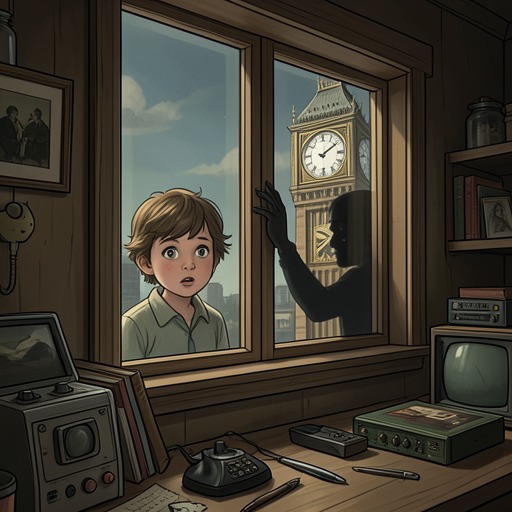
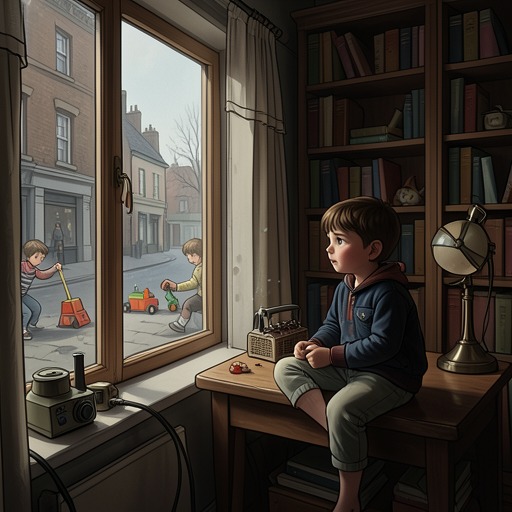
The children first become undeniable to Jacob not in a portrait but through the home’s windows, where he sees them out in the yard. Some rest in the shade; others throw a ball and chase one another past flowerbeds. Their ease and play resemble the paradise Abraham had described, while the familiar faces from the yellowed photographs bridge the distance between his grandfather’s past and Jacob’s present. For a moment, the place feels so enchanted that Jacob would rather not wake from it.
Their peculiar abilities emerge within the game rather than as a formal display. After a ball lodges in a towering topiary centaur, a girl Jacob recognizes from the photographs as the levitating girl approaches on foot, each step laborious. The boys tie a rope around her waist; she removes her shoes and rises like a balloon until the rope draws taut, leaving her hovering ten feet above the ground as they hold her. The scene shows that her ability is not constant: she can walk heavily anchored to the ground before she begins to float.
A second girl, wild-haired and nearing dreadlocks, retrieves the ball in a different way. She takes the centaur’s leafy tail, wraps it around her arm, and concentrates; the topiary’s fingers flex, its arm bends, and it reaches into its own chest to pluck out the ball and toss it to the children. When she lets go of the tail, the figure becomes still again. The children’s abilities thus appear not only as individual bodily gifts but also as a way of animating their surroundings, turning a garden ornament into a temporary participant in their play.
Jacob’s Recognition and Significance
Watching the children, Jacob moves from interpreting peculiar abilities through dubious photographs to witnessing them in a shared, ordinary setting. Millard, standing beside him at the window, notes that there are easier ways to retrieve the ball, but the children know they have an audience. Their play is both genuine communal activity and a performance for the newcomer, making Jacob’s act of looking part of the encounter.
Jacob asks what the people at the home are, and Millard replies that they are peculiar, then asks whether Jacob is one too. Jacob cannot say that he is. The exchange leaves his own identity open, while making the children’s community the measure against which he must consider it. Their decisive narrative importance lies in this shift: what Abraham had told as a story, and what the photographs seemed only to imply, becomes a visible world whose inhabitants invite Jacob to reconsider his place within it.