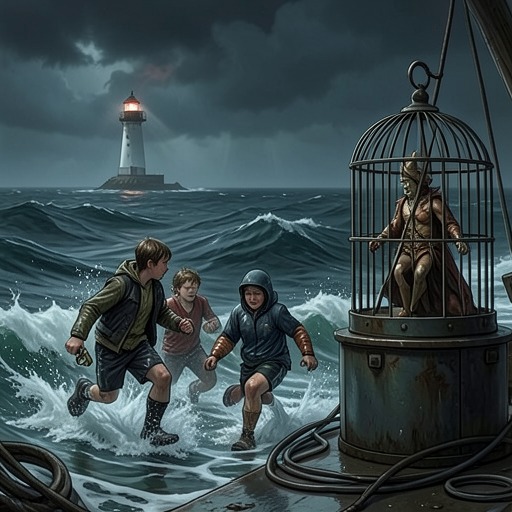
The attempt to rescue the ymbrynes at the lighthouse
Miss Peregrine's Home of Peculiar ChildrenThe lighthouse rescue attempt is a turning point in the children’s effort to recover the abducted Miss Peregrine and Miss Avocet: a desperate search becomes an armed confrontation at the lighthouse, where the rescuers’ loyalty is tested by the danger to one another. The sequence brings together a divided group, a hidden boat, Millard’s risky pursuit, and Bronwyn’s resourcefulness against Dr. Golan’s gun.
The Search Is Redirected
As planes and distant explosions sound overhead, Fiona appears on the path in a state of frantic alarm. She pulls at the others and struggles to make herself understood until Hugh steadies her and asks her to slow down. Fiona then reports that Millard had been hiding when the man locked everyone in the basement and followed him when he left. Her news gives the children a lead, but also reveals that Millard has gone into danger alone.
Fiona explains that Golan has taken Emma’s concealed boat, launched with the birdcage, and ended up on the lighthouse rock after rough water forced him to leave the open sea. This changes the children’s destination from a speculative search of the docks to a specific location where Golan and the captives may still be found. The lighthouse, isolated by water and exposed in the night, becomes both the target of the rescue and the setting for its immediate danger.
A Small Team Sets Out
Emma takes charge of deciding who will go. After Enoch voices the risks, Hugh’s tearful anger makes the emotional stakes plain: he insists that the children cannot simply abandon the Bird after everything she has done for them. Jacob and Bronwyn volunteer, and Millard offers to join because Golan cannot see him. Emma decides that four are enough and warns them that they will need to swim. The others wish the team luck; there is no time for long farewells.
The group reaches the shipwreck and uses its rusted hull for cover, keeping their heads above water as they look toward the lighthouse and its small, barren island. A low full moon appears intermittently through the bomb smoke. From the end of the wreck, the team faces a fifty-yard stretch of open water to the lighthouse rocks. Emma proposes a coordinated attack: she and Jacob will draw Golan’s attention, Bronwyn will approach from behind and strike him, and Millard will seize the birdcage. Her plan depends on surprise and on each member’s distinct advantage, but Golan’s gunfire soon makes the intended approach untenable.
The Gunfire Breaks the Plan
The first shots change the rescue from a planned diversion into a scramble for survival. A small-caliber report and then a splash alert the group that Golan is firing from the lighthouse. Emma calls for a retreat; the children race back along the wreck’s hull and dive into open water. Later, Golan appears in the lighthouse doorway, kneels, and aims across a railing. Jacob’s warning comes too late: a shot rings out, and Millard screams. The others clamber onto the wreck and rush toward him, while Jacob mistakes the splashes of their feet for bullets. The firing stops as Golan reloads, leaving the rescuers only a brief window. Millard is kneeling in the water, dazed and bleeding; for the first time, his invisible body is visible, painted red by his blood. His injury makes the cost of the group’s chosen rescue immediate and unmistakable.
Bronwyn Turns the Shipwreck into a Shield
With Golan still armed and Millard wounded, the team’s original division of roles gives way to a more immediate problem: crossing the exposed ground under fire. Bronwyn disappears down the ladder, leaving Emma uncertain what she intends to do. Below, Millard is surrounded by curious flashlight fish. A moment later the hull vibrates, and Bronwyn surfaces carrying a rectangular metal cargo-hold door, about six feet by four, with a riveted round opening near its top; she has torn it from its hinges. When Emma asks what she will do with it, Bronwyn says she is going to the lighthouse and holds the door in front of her as a shield.
The choice turns rescue into a direct charge. Bronwyn urges the others to rush Golan before he can react, then runs toward the lighthouse with the heavy door while the rest follow because it is their protection. Bullets clang against the metal and chip the rocks around their feet. The image of Bronwyn advancing beneath gunfire, her arms and back smeared with Millard’s blood, makes the group’s solidarity physical: the shield is improvised from the shipwreck, and the wounded boy’s blood accompanies their attempt to reach the captive birds. Near the lighthouse, Bronwyn tells Emma and Jacob to get behind the wall; they take Millard with them and cut left for cover, while she raises the door above her head and hurls it toward Golan.
The Charge’s Turning Point
The assault reaches its decisive threshold when Bronwyn throws the cargo-hold door toward Golan. Until then, the metal slab has been a shield: it absorbs bullets and lets the children cross ground that the gunman controls. Hurling it turns that defense into an attack, but it also leaves the group without its protection at the very moment they reach the lighthouse. Emma and Jacob have taken Millard behind the wall, while Bronwyn confronts Golan’s position directly. The rescue’s tactics have shifted repeatedly—from a coordinated ambush, to retreat under fire, to a shielded advance—and now depend on Bronwyn’s forceful improvisation.
Stakes and Narrative Function
The episode’s immediate purpose is to bring the children within reach of the abducted ymbrynes and the birdcage, but its progress is measured in new risks rather than a secure recovery. Millard’s wound exposes the normally invisible boy through his blood, and Bronwyn carries that blood into the charge; protection and injury become physically linked. The improvised door likewise embodies the group’s resourcefulness: an object torn from the shipwreck becomes the means of approaching an armed enemy. Yet the scene ends at the instant Bronwyn throws it, before the consequences of that attack or the fate of the captives are established. The rescue remains an assault in progress, not a completed victory.