Victor Bruntley Killed by a Hollowgast
Miss Peregrine's Home of Peculiar ChildrenVictor Bruntley Killed by a Hollowgast is the revelation that makes the danger of leaving the island’s time loop personal and irreversible. Victor, Bronwyn Bruntley’s brother, had gone outside the loop because he could not bear remaining inside it; a Hollowgast killed him there. His death is first encountered through a body in the house, then understood through the history of his departure and the vulnerability that departure exposed.
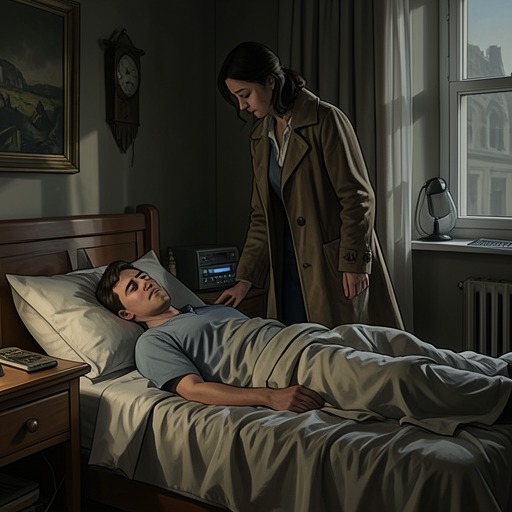
Discovery in the House
Jacob finds Victor motionless and realizes that he is dead. Bronwyn appears in the doorway and rebukes Jacob for being there; when she sees the boy, her expression changes as she recognizes him. Her identification gives the discovery its family meaning: the dead boy is not an unknown resident of the house, but her brother.
Jacob recognizes Victor from his grandfather’s photographs, where Victor had appeared lifting a boulder. That remembered image connects the still figure in the house to the remarkable children Jacob had only recently encountered through photographs. The recognition also makes Victor’s death a bridge between Jacob’s family history and the children’s present danger.
The duration of Victor’s death is uncertain. Because the loop repeats, what may have amounted to a short interval in the children’s daily experience could correspond to as much as fifty years outside it. The loop’s repetition thus complicates the ordinary measures by which the living judge how long someone has been gone.
The Choice to Leave
The later account of Victor’s departure explains how he came to be vulnerable to the Hollowgast. When Jacob points out that Victor left the loop, Miss Peregrine confirms that he said he was going mad and could not stand remaining there any longer. Victor’s departure was an attempt to escape a life he found unbearable, not evidence that the loop offered an uncomplicated freedom.
The island’s protection is defined by a severe boundary: the pursuers do not know where the children are, and Hollowgasts cannot enter loops. Miss Peregrine says that this makes the group safe on the island, but also means that they cannot leave. Victor’s fate marks the cost on the other side of that boundary: outside the sanctuary, the protection no longer applies.
Family and Loss
Bronwyn’s recognition of Victor establishes the loss as intimate and familial. Her brother’s death is not presented as an abstract warning about the Hollowgasts; it is a death within the children’s own close community. The contrast between Victor’s former strength in Jacob’s grandfather’s photograph and his later discovery in the house sharpens that reversal without changing the fact that Jacob cannot know how long Victor had been dead.
Miss Peregrine relates Victor’s decision to leave to Abraham Portman’s departure as well. She says that Abraham also left, but distinguishes his experience from Victor’s: Abraham was not murdered by Hollowgasts. The comparison links the two departures while making their outcomes sharply different. Leaving the loop is a shared rupture, but Victor’s death gives that rupture a consequence Abraham did not suffer.
Consequences and Significance
Victor’s death explains why the loop’s protection is inseparable from confinement. The children are sheltered from Hollowgasts while they remain within it, yet the same shelter restricts their ability to go elsewhere. Victor’s choice exposes the human pressure behind that restriction: safety does not erase the distress of a life that feels impossible to endure.
The discovery also changes how the loop’s repetition can be understood. Its unchanged daily pattern can make an absence difficult to measure, but it cannot undo a death suffered outside its boundary. Victor remains a brother, a familiar figure from the photographs, and a warning about what happens when someone who cannot bear the loop leaves its protection. His fate gives the loop’s promise of safety a tragic limit.