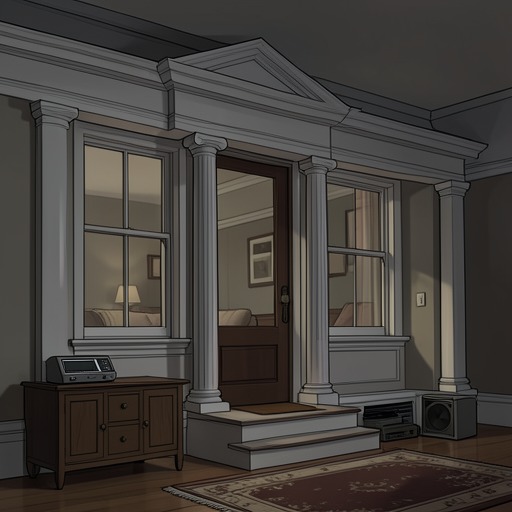
Assassins Attack and Destroy the Smiths’ Home
Mr. & Mrs. SmithThe attack on John Smith and Jane Smith’s home transforms the place that housed their domestic life and concealed their secrets into a battlefield, then destroys it outright. When an attacker’s laser sights mark Jane and armed intruders pour in from the front and rear, the couple must act as a unit; a basement trap ends with grenades exploding beneath the boiler, blasting them outside as their house collapses around the remnants of their former lives.
The attack reaches the house
The assault becomes unmistakable when a red point appears on Jane’s forehead, followed by a green point on the wall. John recognizes that the light is a weapon’s aim and shouts for her to get down, rushing her toward the kitchen. Smoke and gunfire immediately fill the danger around them: a smoke bomb bursts on the living-room floor, and bullets strike the wall above them. John’s split-second intervention matters because he later realizes that a moment’s hesitation could have left Jane’s brains against the wall.
The attack escalates from targeted fire to a coordinated entry. The front door bursts open and roughly ten shadowy figures stampede across the hardwood floor. John and Jane run toward the French doors leading to the backyard, but bullets tear through the glass and force them to turn back; more attackers are coming in from the garden. The couple are surrounded, and their own weapons lie empty on the living-room floor. The house, once a place in which they could hide their double lives, has become a confined space controlled by their pursuers.
The basement trap
John pulls Jane toward the basement and tells her to follow. She stops him with a finger to her lips, then communicates through terse, emphatic hand signals: going downstairs would mean walking into an ambush. Her warning proves justified. At the basement door, gunfire blows the hinges away, and a silhouetted attacker calls down to them before dropping two objects that bounce along the stairs. Jane recognizes the danger: one grenade for each of them.
With no time to devise another plan, John takes Jane by the hand and heads for the basement door, only to find it secured with a padlock. The lock is an unintended consequence of Jane’s attempt the previous evening to keep John out. He steps back, shoots it off, and throws the door open just as the grenades explode. The blast destroys the boiler and the basement, propelling both spouses upward and out through the doorway while flames lick at their heels. Their escape depends on a crude opening made at the last possible moment, and on John’s willingness to break the lock that Jane herself had put in place.
The house is destroyed
John and Jane run, crawl, and stagger away from the wreckage, coughing and gasping for breath. The explosion’s force travels through the other rooms like a heat-seeking projectile, destroying the material traces of the secrets and lies held inside. The house shudders as if in an earthquake; its structure gives way and collapses into a smoldering heap. The couple cling to each other while watching the destruction. The ruined building becomes the visible end of the lives they had been living there: what they see is not merely damage to a home, but the irreversible disappearance of their old existence.
The scene’s domestic details sharpen that loss. Earlier, John had hoped to make one last dinner perfect, planning the menu, dishes, tablecloth, and whether to buy flowers before everything fell apart. In a later exchange of fire, he destroys the kitchen’s glasses and cabinets, hitting Jane’s carefully cherished teapot and its matching kettle; she pauses to stare at the wreckage of her favorite room before turning back toward him. The final assault makes that domestic ruin literal and total. The house that had contained both their routines and their concealed identities no longer stands.
Escape and narrative significance
Even as John and Jane watch the ruins, a dark figure appears to emerge from the flames and approach them. They cannot remain at the site. Jane turns to John and says they need a car; he identifies the Colemans’ place as their next option. They cross the fence between the properties, reach the garage, and find the neighbors’ Dodge minivan ready to take. It is backed in, so they can jump inside and drive straight out. Their escape begins with a practical improvisation, not a return to safety: the house is gone, and the attackers have not been left behind.
The attack forces the spouses’ relationship and their survival to occupy the same immediate ground. Jane’s silent warning counters John’s proposed route; his hand takes hers when the grenades leave them no time for argument; together they escape the blast and choose the next vehicle. The explosion also gives physical form to the collapse of their former domestic cover. By destroying the rooms that held their shared secrets, it makes their old lives impossible to resume and sends them onward as fugitives who must rely on one another.