Desert North of the Mexican Border
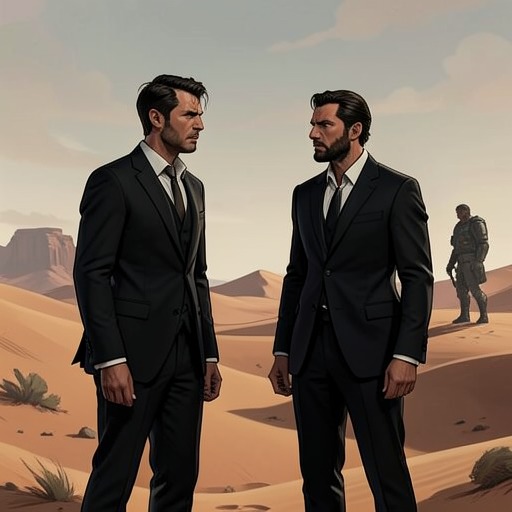
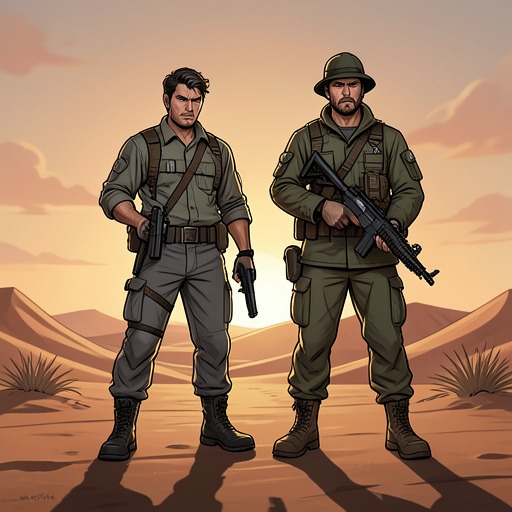
Mr. & Mrs. SmithThe Desert North of the Mexican Border is the setting of the failed double assassination of Benjamin Danz, where Jane Smith and John Smith arrive separately to carry out missions against the same target. Its defining contrast is between apparent emptiness and concealed danger: Jane sees a vast, beautiful expanse of sand, while John occupies a commanding position above the road and identifies the desert as the site of a prepared kill zone. What should have been a controlled operation becomes an explosive encounter between the two agents.
Setting and Operational Use
John’s assignment briefing identifies the desert as the weak point along Danz’s planned transfer from across the Mexican border to a federal base. He studies a map with his team, singles out a location just south of the border, and asks for the valley’s GPS and satellite coordinates and a three-day weather report. The landscape is not incidental background: its terrain is treated as operational intelligence, a place whose geography can make an ambush possible.
Jane’s position is far less precisely located. She has established a camp in an old mine cut into a steep rock face, somewhere north of the Mexican border, but cannot specify where within that immense region. Looking through binoculars, she sees nothing but blazing sand stretching for miles. The mine offers a place to conceal herself, while the exposed wilderness around it makes even a distant movement significant.
John watches the road from a high hill with an excellent view of the approaching convoy. He estimates its distance at roughly eight hundred meters and has time to open his lunchbox and take out sandwiches and a piece of lemon cake before the vehicles arrive. The ordinary detail of a packed lunch sits beside the precision of a planned killing, establishing the matter-of-fact routine with which he approaches fieldwork.
The Overlapping Missions
John greets the approaching convoy as Benjamin Danz’s, viewing it through binoculars from his hilltop position. His calm preparations and advantageous vantage point suggest that the transfer is the target of a carefully arranged operation. Jane, meanwhile, is already positioned in the old mine, scanning the same hostile terrain for what she initially takes to be her own opportunity.
The missions collide when Jane sees a buggy driver raise a large rocket launcher. She recognizes that the armed figure is hunting a person, not game, and realizes that the apparent threat is aimed at her husband. Her own planned killing is suddenly entangled with someone else’s attack on John. The desert’s distance has not kept their work separate; it has placed both agents in the same exposed field of action.
The Kill Zone and Its Failure
Before John can fire, an explosion tears through the desert and shakes the ground. The blast knocks him down and fills the air with dust, temporarily blotting out the sun. When the sky clears, he gets to his feet, battered and covered in sand, and looks around to reorient himself.
He infers that his nemesis has established a lethal zone with a timed bomb intended to detonate as the convoy passes through. The method is familiar to him: he has used the same elementary trick many times. He also recognizes that the system appears to have been programmed to activate on its own, even though he attacked the other agent. The explosion therefore transforms a prepared ambush into an uncontrolled mechanism, while the convoy, alerted by the fight, speeds away into the distance.
Narrative Significance
The desert makes the spouses’ professional competence visible while stripping away the domestic routines that usually contain their conflict. In the suburban setting, disagreement can attach itself to a grocery item or a household plan; here, the same marriage is revealed through rival plans, a rocket launcher, and an automated bomb. The contrast gives the book’s shifts between household comedy and lethal action a sharply concrete form.
Its openness also proves deceptive. Jane’s view seems to promise only heat, sand, and solitude; John’s elevated position seems to offer a clear advantage; and the convoy’s route appears vulnerable to a deliberate trap. Yet the shared operation and the explosion disrupt those expectations. The landscape supplies room for surveillance and ambush, but no stable control: the agents’ encounter exposes how quickly a mission can turn against its planners.