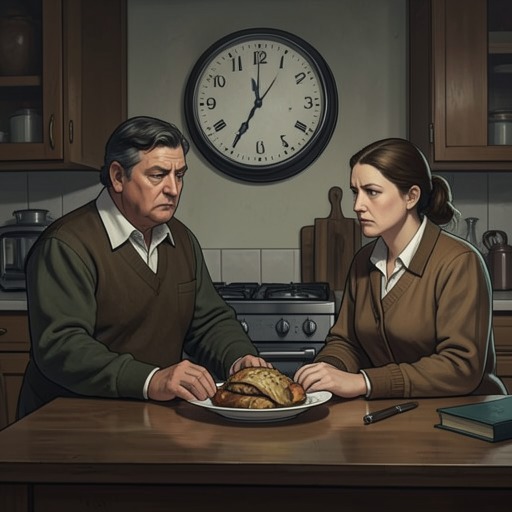
Het eten staat om zeven uur klaar
Mr. & Mrs. Smith“Het eten staat om zeven uur klaar” (“Dinner will be ready at seven”) is a domestic refrain that changes meaning when John Smith hears it after discovering Jane Smith’s secret life. First a marker of the couple’s carefully maintained household routine, it becomes an almost unbearable reminder that their ordinary intimacy coexisted with deception and mortal danger.
The phrase in the household routine
The line belongs to a life Jane works hard to make ideal. She invests in the house, garden, and meals with the same ambition and energy she brings to her job, and can turn an elaborate dinner into a performance of planning and competence. Yet the effort is disproportionate to the occasion: she prepares as if for a dinner of fifty and does it night after night for two.
That domestic ambition sits alongside small, recurring failures of connection. Their arguments can concern curtains, conversation at dinner, or who should pass the salt; seemingly minor details matter because they accumulate into the experience of one spouse being physically present yet emotionally absent. Jane’s proposed changes to the living room illustrate the pattern: striking green curtains lead her to consider a new sofa cover and a darker rug, while John sees an unnecessary chain of purchases. His suggestion to keep the old curtains does not resolve the difference in how they inhabit their shared home.
Intimacy reduced to routine
The meal is part of a larger schedule of parallel lives. Sometimes Jane goes to bed while John stays in his office, hobby room, or shed; sometimes she remains up doing kitchen chores or falls asleep on the sofa. She sometimes wishes they could go to bed together and really talk, but says that they never do. Even when they share a task, their familiarity can take the form of silence: during the dishes, John rinses and Jane loads the dishwasher, as they always have.
The salt at dinner makes the same distance visible in miniature. Jane gives up trying to answer John’s criticism of the meal and continues eating without speaking; when she asks him to pass the salt, he anticipates another contest in which she must win. Against this history, the seven-o’clock announcement sounds less like an invitation to closeness than one more dependable item in a household where ordinary exchanges have become strained.
The phrase after the discovery
After the spouses’ hidden identities have come to light, Jane sends a message through Jasmine: dinner will be ready at seven. John reacts first with disbelief at how little the message seems to acknowledge. He mutters that it is just as usual, hangs up, and looks up at the fifty-second floor. The familiar schedule has survived the revelation; the marriage, as he understood it, has not.
His thoughts turn the routine into evidence of betrayal. For five years, he says, he could set his clock by the promise that dinner would be ready at seven. He has brushed his teeth beside Jane, shared a closet with her, and slept beside her unarmed and exposed, while she slipped away to kill people when he was not watching. The same domestic closeness that once implied trust now measures how thoroughly her other life was hidden from him.
Domestic reassurance turned into irony
The phrase’s force comes from its unchanged wording and radically changed context. Before the revelation, punctual dinner belongs to Jane’s determined performance of an ideal home; afterward, its familiar calm seems grotesquely inadequate to John, who remembers that Jane tried to kill him the previous night. His experience in psychological warfare against dangerous spies offers no defense against this intimate contradiction: the woman who shared his routines was also his enemy.
The line therefore joins the novel’s larger contrast between marital ritual and concealed violence. At seven, dinner may still be ready, but the routine can no longer guarantee the ordinary life it once appeared to promise. Its recurrence makes the household’s apparent stability feel both real and false: the meals, shared bed, and everyday habits existed, yet they did not reveal the whole marriage.