Jane and John as Fugitives from Their Agencies
Mr. & Mrs. SmithJane and John as Fugitives from Their Agencies describes the couple’s abrupt transformation from operatives serving separate organizations into targets hunted by both. Their flight is driven by an agency conspiracy built around their marriage, but it also forces them to decide whether survival means taking separate escape routes or trusting each other enough to resist the system that set them against one another.
From Operatives to Targets
The danger takes shape before Jane and John understand its real cause. Mother tells Jane that Benjamin Danz, also known as the Tank, is a direct threat to the firm and is being held by military intelligence. A helicopter is waiting roughly fifteen kilometers north of the Mexican border for his transfer, and Jane is ordered to make sure the target does not fall into other hands. Jane studies Danz’s information and judges him by his eyes, assuming that he is a dangerous man whose last day has arrived. The assignment places her in the same desert operation as John, who is pursuing Danz for his own agency. At this stage, their collision appears to be a contest over a wanted prisoner rather than a plan directed at the couple themselves.
The agencies’ reach becomes clearer when John returns to his office and tells Jasmine that the package has been lost: the FBI has taken Danz into protective custody that morning. Jasmine understands the scale of the failure, and John admits that their operation has gone badly wrong. This loss matters beyond the immediate mission. Danz is now an asset claimed by competing powers, while the agents involved have lost control of both the prisoner and the consequences of their assignment.
The Marriage Becomes the Trap
The decisive disclosure comes after Jane and John reach Eddie for help. Jane tells him that they have a problem; Eddie distinguishes an ordinary problem from their predicament and says they have been seriously compromised. John asks whether an apology could win their jobs back. Eddie’s answer is conditional: if Jane works for the organization rumor identifies, she and John belong to opposing sides, and there is no returning to their former positions once the operation has gone wrong. Jane reduces the implication to its practical conclusion: they have to run.
Eddie makes the danger measurable. Alone, John might have a ten-to-one chance of surviving; together, their odds fall to one hundred to one. The bleak arithmetic captures the agencies’ advantage, but it does not settle the couple’s choice. They have no time to wait for better information. Every second gives each organization another second to put a bullet through their heads, so Jane proposes that they go after Benjamin Danz. He was the target they had both pursued when they nearly killed each other in the desert, and all three powers—their respective agencies and the FBI—want him. They do not know why. They do see a possibility: if they can get Danz, they may acquire something with which to negotiate their way out.
That plan is an attempt to turn the original assignment against the system that created it. Danz had first appeared to each agent as a target to be eliminated or secured. Now, with their employment and survival in question, he becomes a possible bargaining counter. The shift does not make the mission safe; it gives the fugitives a concrete objective before the pursuing organizations can close in.
The Conspiracy Is Exposed
Danz overturns the couple’s understanding of the mission by telling them that he is not the target: they are. He reveals that their organizations learned Jane and John were married, joined forces, and sent them to the same location so that they would aim at each other. The desert confrontation was therefore not simply a clash between two agents chasing the same prisoner. It was an engineered encounter in which the spouses themselves were the intended victims.
The revelation makes the agencies’ earlier language newly legible. Mother had called Danz a direct threat to the firm and assigned Jane to stop him falling into other hands. John had likewise been sent after him. Both agents had interpreted the urgency as evidence about Danz; they had not known that their organizations had made their marriage the real target. Jane and John’s private relationship, hidden behind their professional identities, has become information their employers can exploit. The plan’s force lies in its reversal: the couple had believed they were acting against one another, when their separate chains of command had arranged the conditions for them to do so.
The disclosure comes with immediate physical confirmation that the danger has not passed. Jane and John hear helicopters approaching. Jane runs to the motel window while John searches Danz’s clothes for a concealed microphone, finding nothing until he notices the belt buckle. Outside, six black helicopters fly toward the motel in combat formation. The pair get away in time through instinct and adrenaline, but Jane knows that Mother’s and Father’s operatives will follow. Flight is no longer a contingency discussed with Eddie; it is the condition of their lives.
Choosing Whether to Flee Together
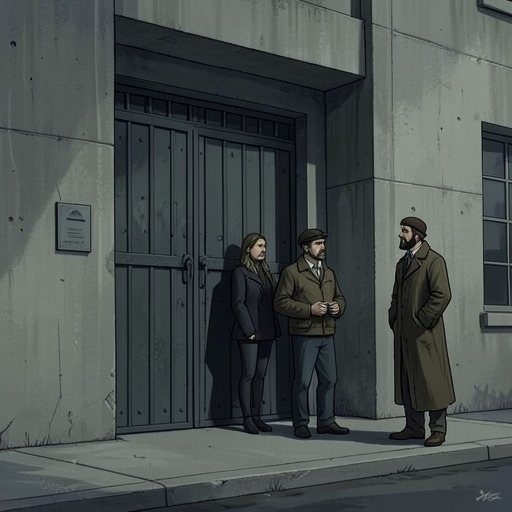
Even with the helicopters bearing down, Jane and John briefly face the possibility of separate escapes. At the car, Jane stops John to tell him that her way out is a blank ticket to a boat moored in La Paz. John pales, looks away, and eventually admits that his own escape plan is a secret hideout in the Atlas Mountains. Each has imagined a route to safety that does not depend on the other. Their plans make the emotional cost of their new predicament concrete: they have shared a life, yet each can still picture survival as solitary departure.
Jane gives John her spare ammunition, invoking their good old days, and turns to leave. John calls her crazy. The remark turns their parting into a confrontation rather than a clean separation; his response carries the tension between their former intimacy and the survival strategies they have each prepared alone. The exchange does not erase the danger or settle every question about trust. It does make clear that escaping their agencies will require a decision about the marriage as well as a decision about where to go.
The fugitives’ position worsens as the pursuit spreads into public space. During a confrontation at a model home, what should have been a skirmish with an undercover agent becomes a major public incident. Customers scream and scramble for the exits as teams of killers burst through doors on both sides; snipers descend through shattered skylights. Jane and John retreat through the front door, reach the petunias where they have hidden smoke bombs like Easter eggs, pull the pins, and roll the devices across the floor. Colored smoke gives them cover. Their escape depends not on a secure refuge but on rapid improvisation, concealed equipment, and a shared ability to move under fire.
A Shared Fugitive State
Jane and John’s fugitive status is defined by a convergence of threats rather than a single pursuer. Their employers have targeted them, the FBI has separately taken Danz into protective custody, and the agencies’ pursuit becomes visible in the helicopters and the armed teams that descend on the model home. These powers do not represent a simple division between lawful rescue and covert violence: the FBI’s custody of Danz disrupts the private agencies’ operation, while the couple’s own organizations are revealed as participants in a plan to make them kill each other.
The status also changes what Danz means to the story. At first he is the apparently murderous prisoner at the center of two competing assignments. Once he reveals that the spouses are the real targets, he becomes the source of the information that explains their predicament and the reason Jane and John thought they might be able to bargain. The evidence establishes the couple’s attempt to use him as leverage, not that this attempt guarantees their freedom. Their flight therefore remains precarious: the revelation explains the trap, but knowledge alone cannot disarm it.
The central irony of the fugitives’ situation is that their most intimate bond has been turned into an operational vulnerability by the institutions they served. Their agencies send them toward each other as targets; survival then demands that they reassess whether separation is safety or another consequence of the same manipulation. The helicopters, hidden microphone, spare ammunition, and smoke bombs give this crisis its material texture, but the decisive question is relational: whether Jane and John can stop acting out the roles assigned to them and make a choice together while both sides are closing in.