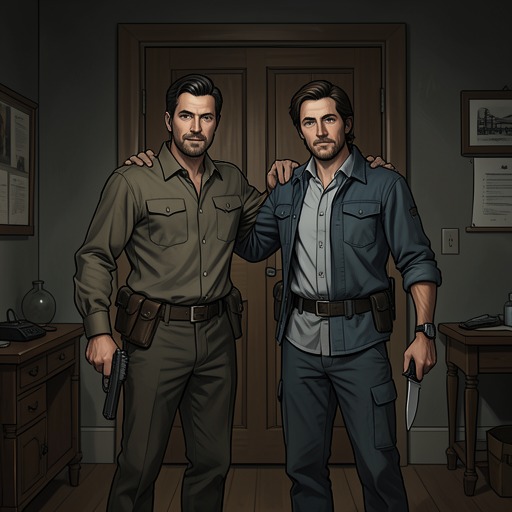
Jane and John’s Marriage in Crisis and Reconciliation
Mr. & Mrs. SmithJane and John’s Marriage in Crisis and Reconciliation is the story of a marriage whose private fractures become inseparable from its partners’ work as covert operatives. The revelation that each is expected to kill the other turns secrecy into an immediate threat, but the decisive test is not whether they can defeat one another: it is whether either can pull the trigger. They cannot. Their eventual reconciliation is therefore neither a return to their polished suburban ideal nor a simple forgiveness of deception. It is a choice to begin again while admitting that the marriage is built on lies and danger remains close.
Domestic Friction and the Ideal of Perfection
Before the crisis becomes openly violent, ordinary household tasks expose how far the couple are from understanding one another. When John brings home salted butter instead of the unsalted butter Jane had asked for, he feels inwardly defeated by a request he thinks he can never satisfy. He compares himself to a tormented knight set an impossible task by an ice princess. Jane waves away his apology, says she will improvise, and quickly changes the subject to new living-room curtains. The exchange is minor, but its emotional pattern is not: he experiences her standards as an ordeal, while her brisk change of subject leaves the underlying irritation unaddressed.
That small failure belongs to a larger performance of domestic competence. As the marriage approaches its breaking point, John plans dinner in meticulous detail on the way home: the menu, the dishes, the tablecloth, even whether to buy flowers. He wants everything to be perfect one last time, before it all falls apart. The thought makes the couple’s ideal home feel less like a shared refuge than a carefully arranged scene whose perfection cannot survive what they have concealed from each other.
Their comic domestic life repeatedly collides with the lethal demands of their professions. Jane’s teasing interrogation of a client she calls a bad boy takes place while the bed shakes at his meek nod, a moment John dismisses as idiotic. Later, the danger is not comic at all: a small grenade rolls from a ventilation opening and across the floor. It resembles a cheap toy, a Barbie grenade, but is real, and the couple are only milliseconds from death. The sudden switch from marital banter and familiar household imagery to an explosive threat captures the unstable terms on which they live together.
The Marriage Becomes a Mutual Assignment
The crisis changes meaning when Jane tells Jasmine that the spy they are supposed to kill—the man who tried to kill her—is her husband. The revelation collapses the distinction between the professional target and the person with whom she has built a life. Jasmine reacts with disbelief at the odds; Jane’s predicament is not an abstract conflict between duty and affection, but the discovery that her intimate relationship has become part of a lethal assignment.
The couple’s separation is also emotional and, for a time, almost literally wordless. In John’s arms, Jane tries to cry out but finds her jaw and lips held fast, as in a nightmare. Every second in which he says nothing adds another second to her own silence; the silence itself seems to drive them apart. She reads the answer in his eyes and recognizes that there will be no happy ending in that moment. Neither can bear the closeness, yet neither can readily let go. The music eventually stops, the other people applaud and return to their tables, and the spell breaks, but the scene leaves the couple suspended between physical intimacy and the truth that has undone it.
Their inability to act on the assassination assignment becomes clearest when Jane’s finger slips from the trigger and her weapon falls from her hand. She knows she cannot kill John and never will be able to. As she falls, frightened, he catches her and holds her in a crushing embrace. The reversal is decisive: the weapon that could have made their professional conflict final is dropped, and John’s arms become a means of catching rather than restraining her. Their love does not make the danger disappear, but it prevents the assignment from ending in either spouse’s murder.
Violence Inside the Home
The home does not remain a neutral backdrop to the marriage. During their armed conflict, John fires as he moves toward the dining room, shattering the attractive glassware and throwing open the cupboards. Jane’s cherished teapot is hit, along with its companion kettle. She pauses to stare, incredulous, at the destruction of her favorite room: appliances, cupboards, decorations, all of it. Her kitchen is gone as she knew it, and she turns toward John with a look of fury.
The scene makes domestic objects carry the consequences of their conflict. The tea service and kitchen fixtures are not simply scenery around a gunfight: they are the belongings through which the couple’s carefully made home had been expressed, now damaged by the violence they have brought into it. John’s thought that the cake will have to wait sets an everyday domestic plan against the destruction unfolding around him. The comedy of the interruption sharpens, rather than softens, the cost of the confrontation.
The couple’s ideal home is later described as a sham marriage collapsed like a house of cards. Jane wonders whether a marriage founded on so many lies can survive at all. That doubt arrives even as the black BMW team prepares another attack, leaving almost no space between the intimate question and the immediate practical threat. Their relationship is not allowed to become a private conversation separate from the agencies and violence surrounding them: the next attack presses in while they are still trying to decide what their marriage means.
Choosing to Begin Again
The reconciliation does not arrive as a polished declaration. Jane and John fight each other with the fury of everything they have experienced over the preceding days, striking, kicking, and parrying. They are equally trained and experienced, so evenly matched that the fight could continue for hours without producing a winner. At last they end up in each other’s arms, sweaty and only inches apart. Their physical equality gives the reconciliation its particular force: neither has conquered the other, and neither can settle the relationship by winning.
John asks whether they are really going to start over. Jane cannot find words for what she feels. He answers by naming the marriage plainly: it is a terrible marriage; he does not know her, she does not know him, and both are liars. The confession does not repair the history between them, but it replaces the performance of a perfect couple with an admission of their actual condition. Jane’s agreement comes with a condition: she will drive. Even in the middle of reconciliation, she asserts a choice rather than simply surrendering to John’s appeal. They get into the van without another word.
The closing image joins intimacy to survival without pretending that the relationship has become uncomplicated. After the fight, John draws Jane into a long kiss that expresses their recognition that they are alive and still have a life of possibilities ahead. She laughs at the thought of what their neighbors would make of the sight of their supposedly perfect home now. The joke acknowledges the ruin of the facade while allowing affection to return between them.
That fragile beginning is tested almost immediately. During the final action at the home-goods store, the couple sense that agents have entered the building. John’s hand on Jane’s elbow signals that they must move; as the lights go out, they jump from a swing and escape into the store. When the life-sized mascot Homey rises from a bin of teddy bears, equipped with a house-shaped hat, a moustache, and a sawed-off shotgun, Jane and John each shoot its oversized stuffed head. The mascot falls back into the bin and fires into the ceiling. What should have been a skirmish with an undercover agent becomes a large public incident. The episode turns their renewed coordination into action, while its absurd domestic-store setting preserves the book’s collision of danger and comedy.
What Reconciliation Means
The marriage’s resolution is a decision to proceed, not proof that trust has been fully restored. The question of whether a bond founded on lies can survive remains meaningful precisely because the couple do not erase the lies before choosing one another. Their words acknowledge mutual ignorance and deceit; their actions show that they can still meet as equals, protect one another, and move together when danger returns.
The contrast between the ruined kitchen, the collapsed image of the ideal home, and the couple’s later embrace defines the change. Their old domestic perfection depended on appearances and went hand in hand with silence. The new beginning is less secure but more candid: John names their failures, Jane agrees to continue on her own terms, and they enter the van together. Reconciliation here is not a safe ending outside the action. It is an alliance made inside an unresolved crisis, with love and mistrust, humor and violence, still occupying the same marriage.