Lies and Confession
Mr. & Mrs. SmithLies and Confession is the central contradiction of Jane Smith and John Smith’s marriage: each has built a life with the other while concealing the identity that organizes their work, and the disclosures that follow threaten the relationship even as they make it possible to rebuild. The novel places romantic language, household irritations, and violent action side by side, so that truth is neither a clean cure nor a simple opposite to deception. It emerges in stages—as a therapeutic exercise, a painful reckoning, and finally an imperfect decision to start again.
A story invited into the open
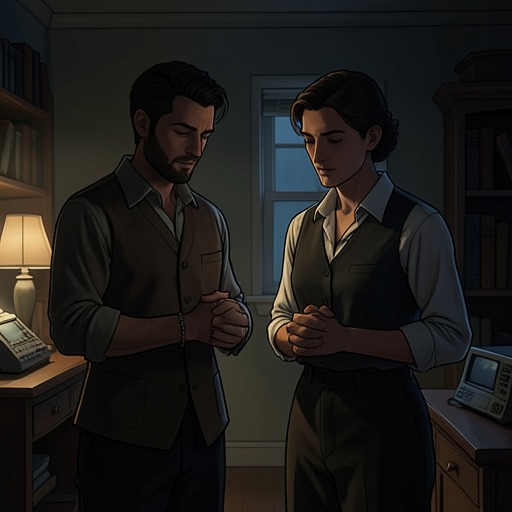
The book’s frame makes narration part of the subject. Dr. Wexler introduces recordings of sessions with Jane and John Smith, transcribed and typed by his assistant Katrina Östlicher and supplemented with notes about the patients’ expressions and body language. He initially sees a polished couple: young, attractive, well dressed, courteous, and intelligent. The clinical record promises an account of marriage, but its layered form also reminds the reader that what is available is mediated through recordings, transcription, and observation.
Dr. Wexler asks Jane to put her feelings on paper. She hesitates, citing her workload and saying she is not much of a writer; he stresses that the exercise need not be polished, complete, or shown to anyone, even him. Its purpose is self-understanding: a person may not know what their story is until they tell it to themselves. When he asks Jane to begin with how she and John met and why she fell in love with him, her expression changes; she smiles at a pleasing memory and begins with Bogotá, six years earlier. The invitation to narrate turns recollection into a route toward what the present marriage has concealed.
Small omissions and performed domestic life
The conflict between what is said and what is meant appears in ordinary household scenes as well as in the couple’s dangerous professional lives. John brings Jane salted butter when she had asked for unsalted. She dismisses his apology and says she will improvise, while his inward reaction casts their exchange as a futile assignment from an ice princess to a suffering knight. She then changes the subject to new living-room curtains. A minor shopping failure becomes a compact portrait of a marriage in which irritation, evasion, and domestic performance can coexist without either partner naming the larger grievance.
The same collision of registers makes deception comic and unsettling. In one of John’s recollections, Jane teasingly interrogates her client Marco Racin about whether he has been a naughty boy; John calls him an idiot in thought. The exchange belongs to work disguised as flirtation, not to an honest domestic conversation. Elsewhere, the gap between the couple’s composed appearance and the facts of their lives becomes lethal: a small grenade rolls out of a ventilation opening, looking like a cheap toy from a Happy Meal, though John knows it is real. The familiar language and objects of everyday life do not make the danger less real; they make the boundary between an ordinary couple’s world and their hidden one harder to trust.
Confession under pressure
When Jane and John’s professional identities and mutual danger have shattered their marriage’s reassuring surface, romantic words become difficult to accept. Jane remembers John telling her she looked like Christmas morning, but the compliment arrives amid years of mutual boredom and the discovery that he has played deadly games with coolness and calculation. She had looked through an open doorway with longing, yet fear stopped her: he had proved himself a monumental liar, and she could no longer tell who he was, what was real, or what might be a plan. The hesitation gives the revelation its cost. Intimacy is still desired, but desire cannot by itself certify the truth of the person offering it.
The couple’s later exchange in the car shows how confession can start without immediately becoming easy. Jane considers whether one more small lie matters after their discussion of major lies. She tells John she never served in the Peace Corps. He pauses, surprised, and says that was what he liked about her. Jane regrets bringing up the small deceptions and suggests that perhaps it was not a good idea after all, since everyone lies. John agrees, then discloses that he did not attend the Massachusetts Institute of Technology: he went to Notre Dame and studied art history. Jane questions the subject, and he insists that art history is respectable. The disclosures are modest beside their concealed careers, but they expose how much ordinary biography has also been curated between them.
Jane’s thoughts widen from the two newly admitted facts to education, the Peace Corps, favorite colors, and television shows. If a marriage can contain lies about so many small things, she wonders whether anything between them is real. The scene refuses the comforting idea that confession instantly restores confidence: information is offered, but it also multiplies the questions the couple must live with.
The marriage beneath the cover story
John’s question about Jane’s parents brings this uncertainty to a more painful limit. He asks whether they never liked him. Jane is silent, then tells him that her parents are dead and that they died when she was five; she barely remembers them. John is stunned, experiencing this as the ultimate deception. Their disagreement is not merely over a mistaken impression but over the meaning of what was withheld: he had imagined a relationship with parents who were absent because they rejected him, while Jane had no remembered family history of that kind to offer.
The revelation feeds the couple’s bleak assessment of their shared past. John says through clenched teeth that they will have to repeat every conversation they have ever had; Jane solemnly agrees. They regard their marriage as a sham collapsed like a house of cards. The image makes the scale of the crisis plain: the problem is no longer a particular lie but the fear that the structure of their life together cannot be trusted. Yet the conversations continue. Their willingness to name what has been concealed does not undo the damage, but it keeps the marriage from remaining only an unexamined cover story.
From mutual targets to a new beginning
Benjamin Danz’s revelation changes the meaning of the couple’s conflict. He tells them he is not the target: they are both targets. Their agencies learned that they were married and sent them to the same point so that each would aim at the other. The danger they had interpreted as a private betrayal is also the result of a joint institutional plot. This does not erase the personal deceptions, but it explains why their hidden marriage has become a weapon turned against both of them—and changes the immediate stakes from suspicion between spouses to survival together.
After the violence, John and Jane hold each other. John describes the moment as waking from a nightmare to find that nothing is wrong, and calls the day a chance to start again. The renewed beginning does not settle every question of honesty; later, while they are trying to escape, Jane admits she never served in the Peace Corps and John answers with his own false education history. Their fresh start therefore means neither total transparency nor a return to the old performance. It means choosing to continue together while the accumulated small lies are still visible.
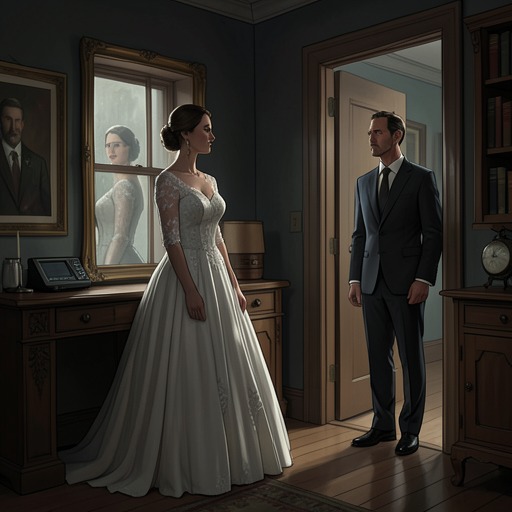
The clinical frame supplies a quiet coda to that choice. Dr. Wexler calls the Smiths a successful case and credits the practice of writing feelings down. Some time after he last saw them, a change-of-address notice arrives in Jane’s handwriting, signed with love from Jane and John Smith. He sends a fruit basket to congratulate them on their new home and a card reminding them that they still have a session owed. The ending links the couple’s new address to the earlier exercise in telling their own story: the record does not certify that every secret has been resolved, but it shows the marriage continuing beyond the crisis, with space left for another conversation.