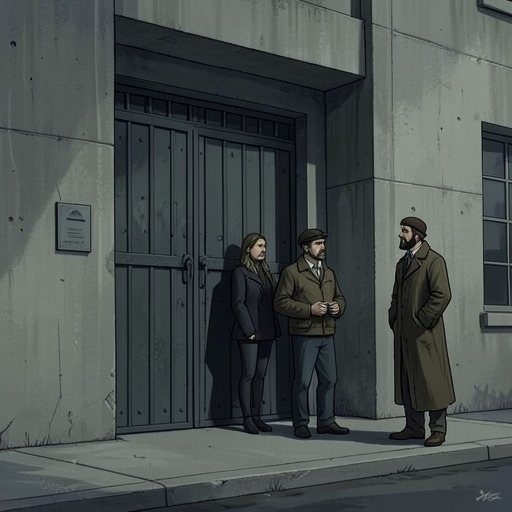
Secret Armory Beneath the Shed Floor
Mr. & Mrs. SmithThe Secret Armory Beneath the Shed Floor is John Smith’s hidden stockpile of weapons and cash beneath the tool shed at the suburban home. Its discovery gives Jane Smith control of the resources John had kept out of sight, exposes how thoroughly professional violence has been folded into domestic space, and becomes a sharp reversal when John returns to find the cache stripped bare.
A Secret Built into the Home
The shed belongs to John in the division of the household: Jane’s domain is the kitchen, while she has paid little attention to what John keeps in his workshop or how often he goes there. That routine separation conceals a second, more consequential arrangement. Jane has hidden her own weapons among kitchen supplies, reasoning that the kitchen is the best place to keep secrets because John cannot even boil water. The house is therefore not simply a shared residence; its ordinary rooms and outbuildings provide separate compartments for each spouse’s concealed working life.
Jane’s discovery begins after she has searched the home and turns to the shed as the remaining place worth investigating. She enters expecting to find something valuable, switches on a bare bulb, and confronts a disorderly jumble of tools she scarcely recognizes. The unfamiliarity matters: this is not her territory, and she does not know what John owns or does there. The search changes when her footsteps produce a hollow echo beneath the floor. She identifies the false flooring, stamps to confirm the sound, and follows the clue rather than accepting the shed’s visible clutter as the whole story.
Finding the Cache
The hidden space has been secured, but not well enough to stop Jane. She shifts aside what looks like a workbench and finds a floor safe. Combination locks are one of her specialties, so she opens it quickly, locates the trapdoor lever, and descends with a flashlight. The sequence makes the cache a discovery earned through observation and practiced skill: the decisive clue is not a document or confession, but the mismatch between the solid floor the shed appears to have and the hollow sound it gives back.
Below the floor, the scale of John’s preparations becomes unmistakable. Weapons of many types and sizes line the walls; the shelves also hold piles of banknotes in different denominations and foreign bills. Jane compares the amount to more money than the local bank branch might have held in its vault. What looked like a neglected tool shed opens into an armory and reserve of cash, a hidden infrastructure of force and mobility embedded beneath the suburban household.
Jane Seizes the Weapons
Jane’s team arrives and shares her astonishment, but the discovery immediately becomes a recovery operation. She orders the women to bag everything. They carry John’s weapons up the ladder, then load a black van on the street, using pillowcases and sheets to hold the arms. The domestic linens are an incongruous covering for a cache of weapons, and the ordinary neighborhood setting persists around the seizure: Jane smiles as two girls from the neighborhood skip past. The contrast makes secrecy look less like a distant spy-world convention than a practical fact of suburban life, maintained in plain view.
The removal is also a transfer of power. The weapons and money had been John’s hidden reserve; after Jane’s team clears the space, they are no longer available to him. His assumption that no one would suspect him at home in the suburbs proves disastrously misplaced. Jane’s success rests on reading a familiar domestic setting as a place that can conceal an operation, then applying her specialist abilities to the particular safeguards John left behind.
The Empty Space and Its Afterlife
John later returns to the shed after receiving an address change that points him toward a new Triple Click office. He makes an excuse to a guest, goes directly to the shed, closes the door, takes a flashlight, opens the trapdoor, and jumps down. The reveal is not another cache but its absence: his money and weapons are gone, down to the last pocketknife. He recognizes that Jane and her team must have cleared the arsenal, and his curse registers both the material loss and the fact that she has penetrated his private domain.
The empty armory also unsettles John’s brief romantic sentiment. He experiences the theft as a cold shower that tempers an impulsive feeling, so the cache’s removal has an effect beyond depriving him of equipment. It interrupts his attempt to approach Jane sentimentally by forcing the conflict between them back into view: she has searched his space, taken his resources, and demonstrated that the home’s secrets can be reached from either side.
The object’s significance is sharpened by its recurrence in the couple’s preparations for violence. At the home, John later pulls a box marked MODEL TRAINS from among the boxes and finds two weapons, one large and one small; Jane objects to being given the smaller, described as the ladies’ pistol. At Home-Made, the couple enter with shopping bags full of weapons, and Jane insists on a full-size shopping cart rather than John’s small basket, both to carry the heavy armament and to serve as cover. These scenes extend the armory’s logic: weapons are concealed, transported, sorted, and made to pass through ordinary domestic packaging and errands. Beneath the shed floor, that logic first appears as a hidden collection; later, it becomes part of the pair’s shared, improvised arsenal.
Concealment as Material Culture
The cache belongs to a broader pattern in which weapons emerge from places associated with everyday life. Jane keeps sleek weapons and polished knives in her oven; John hides weapons beneath a workshop floor; office walls conceal rocket launchers behind panels. The settings differ, but each turns an ordinary fixture into a compartment for lethal equipment. A weapon can remain invisible while its hiding place is familiar, and the domestic surface does not erase the violence beneath it—it helps make that violence administratively and practically available.
The shed’s false floor makes this contradiction literal. Above it are tools Jane cannot identify; below it are weapons and foreign currency arranged in abundance. The secret is not merely that John owns an arsenal, but that he has made it part of the architecture of home life while expecting the suburban setting to protect it from suspicion. Jane’s discovery exposes the weakness in that expectation, and her removal of the entire stockpile turns the concealed space into an emptied measure of their mistrust. In the couple’s conflict, the cache is both a practical reserve and a material record of how much each spouse has kept from the other.