Smith Construction
Mr. & Mrs. SmithSmith Construction is the legitimate building company through which John Smith presents himself as an ordinary business executive, while its office also houses the secure room where he conducts covert work. The contrast between construction as public identity and the concealed machinery behind it makes the company both a practical cover and a vulnerable link in the agency’s command structure.
Public Business and Cover
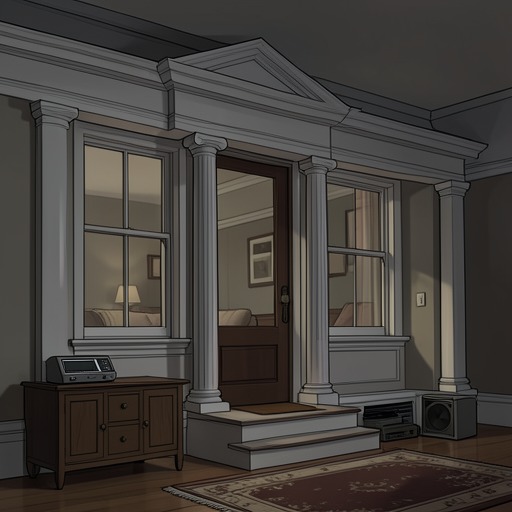
John parks outside an unremarkable waterfront building and enters a small ground-floor office marked SMITH CONSTRUCTION. To the surrounding world, he is simply the manager of an internationally operating construction company. The modest setting helps make the cover plausible: it looks like an ordinary workplace rather than the entrance to a clandestine operation.
The office staff also belong to the cover’s everyday surface. Louise and her husband Louie work there; John regards the couple as almost parental, and they serve as secretary, personal attendant, and bodyguard. His treatment of them as people deserving exceptional respect coexists with an awareness that anyone who mistakes their capabilities for harmlessness would be making a serious error. Louise’s chocolate wafers are another small, domestic detail in a workplace that has a much more dangerous purpose.
The Secure Office
Behind the public office is John’s secured workspace, where the company’s actual covert operations take place. He values its restrained 1950s decor, describing it as comfortable, orderly, and functional, like a room from an early James Bond film. The room offers him a place to concentrate and think; he feels at home there. When the door closes, the space is secure, giving the apparent construction business a hidden operational interior.
John’s transition into that interior is triggered by an ordinary office object: he drops a rolled blueprint onto a stack of blueprints that have never been opened or read, then pulls the arm of a model crane on his desk. The gesture moves a wall panel, revealing a large, advanced plasma screen bearing the company’s dark logo. Construction imagery thus doubles as concealment: the model crane and unused plans belong to the visible business environment, but the crane also activates the concealed equipment.
Orders and Agency Control
The company’s office is where John receives covert assignments from the agency’s leadership. Vader appears on a screen and personally asks him to handle a problem; the target is Benjamin Danz, and Vader stresses that the job must be done quickly, properly, and under control. The request is unusual enough that John recognizes it as outside normal procedure, yet he accepts it.
The agency’s authority is not confined to John’s secure room or to his assignments. In a later reprimand, Vader tells Jane that witnesses cannot be left and imposes a forty-eight-hour deadline to clean up the operation. That command shows the organization’s governing method: failures and exposure are treated as risks to be eliminated, with employees expected to obey its rules. Smith Construction’s orderly office may feel like John’s refuge, but the covert work conducted there remains subject to a hierarchy that dictates its targets and consequences.
The Company as a Point of Exposure
Smith Construction’s public identity cannot protect John and Jane once their marriage becomes known to the agencies. Benjamin Danz explains that, after the organizations discovered the couple were married, they coordinated and sent them to the same location so they could aim at one another. The revelation reframes their assignments: what had looked like separate work was part of a plan that made their relationship a liability.
The company therefore embodies the divide at the heart of John’s working life. Its outwardly mundane construction business provides a cover, and its hidden office gives him a secure place to act; neither can insulate him from the institutional system directing those actions. Once the couple’s marriage is exposed, the same command structure that had entrusted John with controlled operations turns their shared life into grounds for mutual targeting.